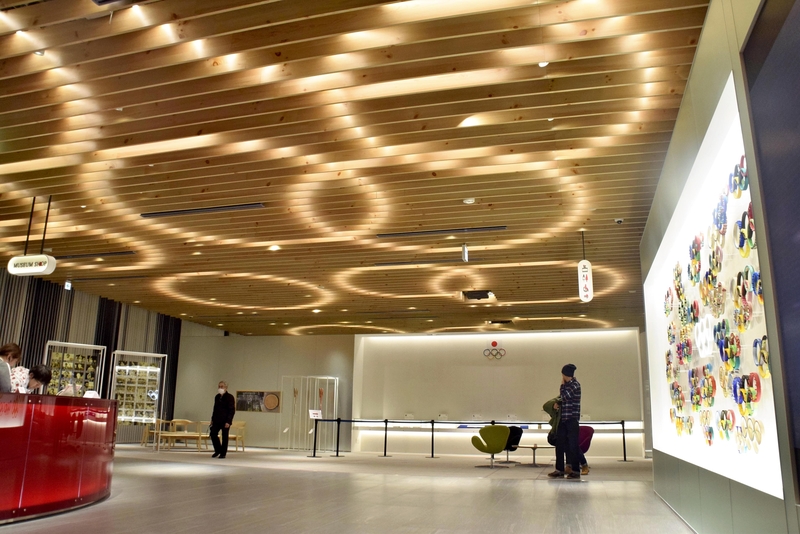
The sparkling new Japan Olympic Museum naturally has an abundance of mementos from past Olympics on display. But it also has the legacy of the 1964 Tokyo Olympics built right into its ceiling.
Wood from trees grown in a Hokkaido town out of seeds donated by delegations from participating countries at the 1964 Games was used for the ceiling and other items of the museum, which opened last September in Shinjuku Ward, Tokyo.
It is unknown where most of the trees grown from the donated seeds are located. As such, the "legacy" trees have attracted attention as a valuable property telling a half-century of history since the previous Tokyo Games.
At the 1964 Games, the National Greening Promotion Committee (now known as the National Land Afforestation Promotion Organization), called on participating countries to donate seeds for trees to be planted on mountains and forests left ruined in the post-World War II period. A total of 272 varieties of seeds were accumulated from 44 countries, and seedlings were later dispersed around the country. Tokyo's Yoyogi Park and Miyazaki prefectural forests were among the known locations, but the organization said because no records were kept, the whereabouts of many of the trees are unknown.
In Engaru, Hokkaido, 10 varieties of seedlings donated by Finland, Sweden and other countries were planted on the grounds of Hokkaido Kateigakko, a juvenile self-support facility, in 1968, four years after the Tokyo Games. Students of all ages played a main role in taking care of the trees. About 160 trees grew to an average height of 24 meters, with an average diameter of 34 centimeters.
The municipality learned of the history of the trees after a photographer hailing from the town featured them in a magazine. In 2017, the municipality set up a task force to find ways to utilize the trees for the 2020 Tokyo Olympics and launched promotional activities. The next year, the Japanese Olympic Committee decided to use the trees for the museum, and about 20 spruce and pine trees were logged.
Wood from the trees adorns the ceiling of the Welcome Area on the museum's first floor, and was also used for shelves, chairs and desks in the area. A signboard explains the trees' connection to the 1964 Tokyo Games, while a cross section of wood on display shows the age of the trees.
"Their existence is important for conveying the legacy of the previous Tokyo Olympics," curator Naoki Shimoyu said.
To prepare for future Olympics to be held in Japan, the town plans to grow seedlings from seeds of the trees at Hokkaido Kateigakko and plant them on its grounds.
"We want to pass the legacy on to the next generation," Engaru Mayor Shuichi Sasaki said.
Read more from The Japan News at https://japannews.yomiuri.co.jp/