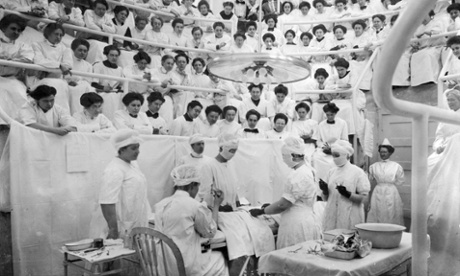
For physicians teaching in Georgian London, the solution was never in question. Faced with a shortage of bodies to dissect, they chopped up cadavers and handed parts out.
The sheer number of students passing through London’s medical schools in the mid 18th century made it the only city where resourceful doctors had to share out bodies, often acquired from dubious sources.
The revelation comes from the first large-scale investigation into dissection and autopsy practices across Britain from 1600-1900.
“There were so many students, they couldn’t all be given a single cadaver,” said Jenna Dittmar, from the University of Cambridge. “So they were given them in pieces. They might have a knee one day, an elbow another. As long as they dissected two complete bodies they could be medically licensed. It didn’t matter if it was in bits.”
Dittmar studied bones from hundreds of people whose remains were used for medical dissections and autopsies. Some of the bodies had been dug up from graves, though some had been donated to science.
She found records instructing physicians in London on how to dismember corpses so that students received the right parts to study. “They seemed to focus on the joints. Maybe they would cut mid-forearm and then you would have the elbow, wrist or shoulder to give to someone. The head was normally given to someone, the body divided in the middle, the legs given to someone else.”
Presenting her work at the American Association for the Advancement of Science meeting in San Jose, Dittmar said that when somebody died, their bones were sometimes accompanied by the remains of their pets. “If somebody died, they would have added a leg and arm and other pieces they were dissecting to the coffin. Maybe along with a dog,” she said.
“These individuals have sometimes been taken from graves and dissected, but they have also contributed massively to modern medicine and modern surgery. Whether they were willing participants or not.”