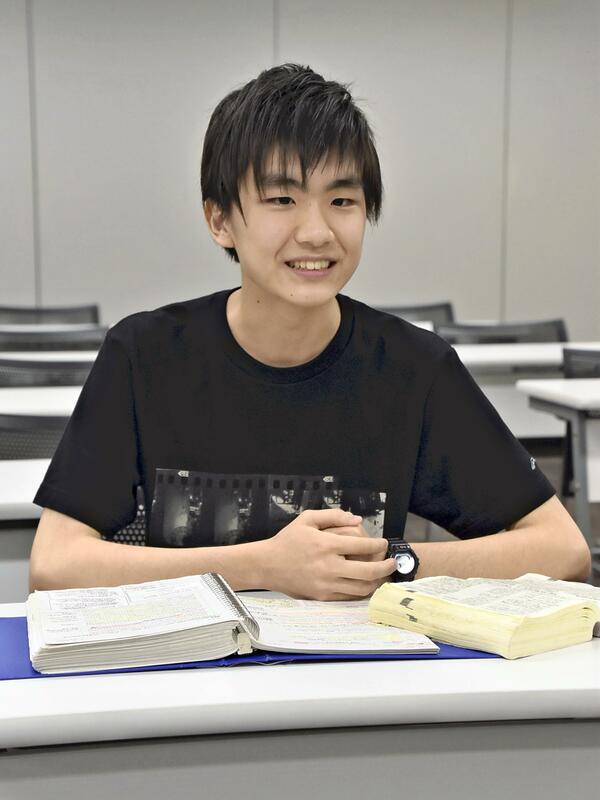
An 18-year-old college freshman was among those who passed the latest National Bar Examination, a list announced on Sept. 7.
Rin Otsuki, a student at Keio University, became the youngest person to pass the test since 2006, the year people who have completed a law school curriculum began taking the bar exam under the current system.
Otsuki has observed courtroom proceedings since he was a first-year student in junior high school. When he became a first-year student at high school, he decided to sit for the bar exam, in the hope of "taking part in the judiciary."
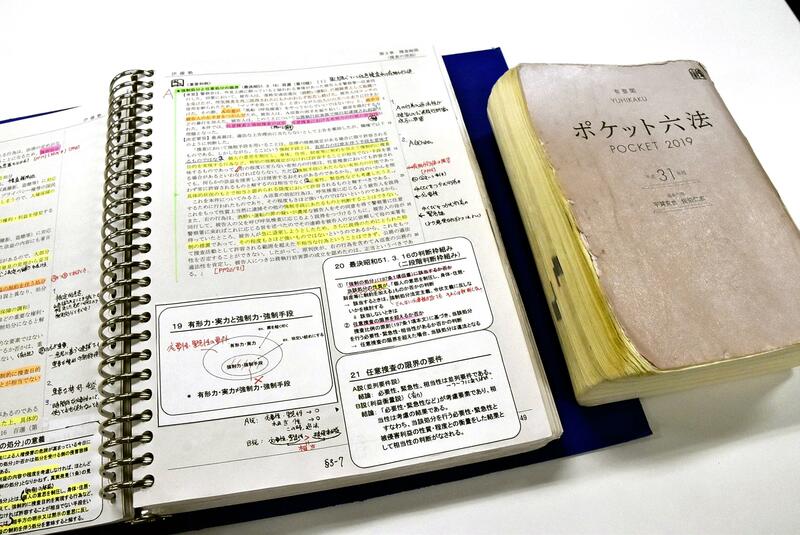
Asked how he succeeded at passing the bar exam in two-plus years, he said, "It was the result of working hard at what I'm interested in."
-- Observing hearings since the age of 12
"One human being was being judged by the law. I was stunned when I witnessed real-life, frontline judicial proceedings," said Otsuki, recalling the first time he observed courtroom proceedings.
He was 12 years old, and it was the autumn of his first year in junior high school. Otsuki had special classwork presented by a lawyer, giving him the opportunity to watch courtroom proceedings in a case involving alleged violation of the Stimulants Control Law at the Tokyo District Court.
"The accused was a man in his 30s or so. I thought various things about him, wondering if such an ordinary-looking man had committed a crime, and what sort of life he had led."
Although Otsuki belonged to a lacrosse club at his school, he began to observe courtroom proceedings of cases he was interested in during summer recess. He would even record in detail verbal exchanges in court, and draw courtroom illustrations.
At the Tokyo High Court, he came across a judge he admired. The judge was by nature an even-tempered individual, talking frankly with the accused and even smiling at them.
-- Studying law in high school
After entering Keio Senior High School, Otsuki began to feel impatient that there were things he saw during court proceedings but could not understand. It wasn't long before he realized that he wanted to "take part in the judiciary" and "become a jurist." He made up his mind to take the bar exam.
Shortly before becoming a second-year student, he began taking an online course offered by Itojuku, a Tokyo-based preparatory school for people who will take the bar exam.
He listened to a three-hour lecture three times a week, and spent the same amount of time reviewing the lectures. Every week he allocated a total of about 18 hours to studying law.
One of his study methods was a "self-lecture," which involved opening a textbook and speaking such words as "Let's move forward such and such a unit today," and "The definition of this word is such and such." He continued employing this study method, which he learned during the first online lecture.
-- 4% success rate
People who have not completed a law school curriculum must pass a preliminary test in order to take the bar exam. The percentage of successful applicants for the preliminary test is only around 4%, but Otsuki passed the test given in 2020 when he was a third-year high school student. Among the about 15,000 examinees who sat for the preliminary test that year, there were 32 high school students. Otsuki was the only one to pass.
As his high school was closed from April to around June last year due to the COVID-19 pandemic, he was able to concentrate on studying law, he said. Thanks also to the postponement of his exams by roughly three months, Otsuki was able to catch up on his studies.
In May this year, shortly after he began to study law at Keio University, he sat for the bar exam and passed on his first try. "I was relieved," he said. The average age of successful applicants was 28.3.
He has yet to decide which profession he will pursue: judge, prosecutor or lawyer. "I've chosen this career because I was stunned by the real exchanges of words in courtrooms. I want to become a jurist who will never forget to deal sincerely with the concerned parties right in front of me."
Otsuki has 3-1/2 years before he will complete his study at the university. "I want to study the laws that were on the bar exam from different angles, and to broaden my education, too. I'll also study English, and, of course, do some part-time work."
Read more from The Japan News at https://japannews.yomiuri.co.jp/