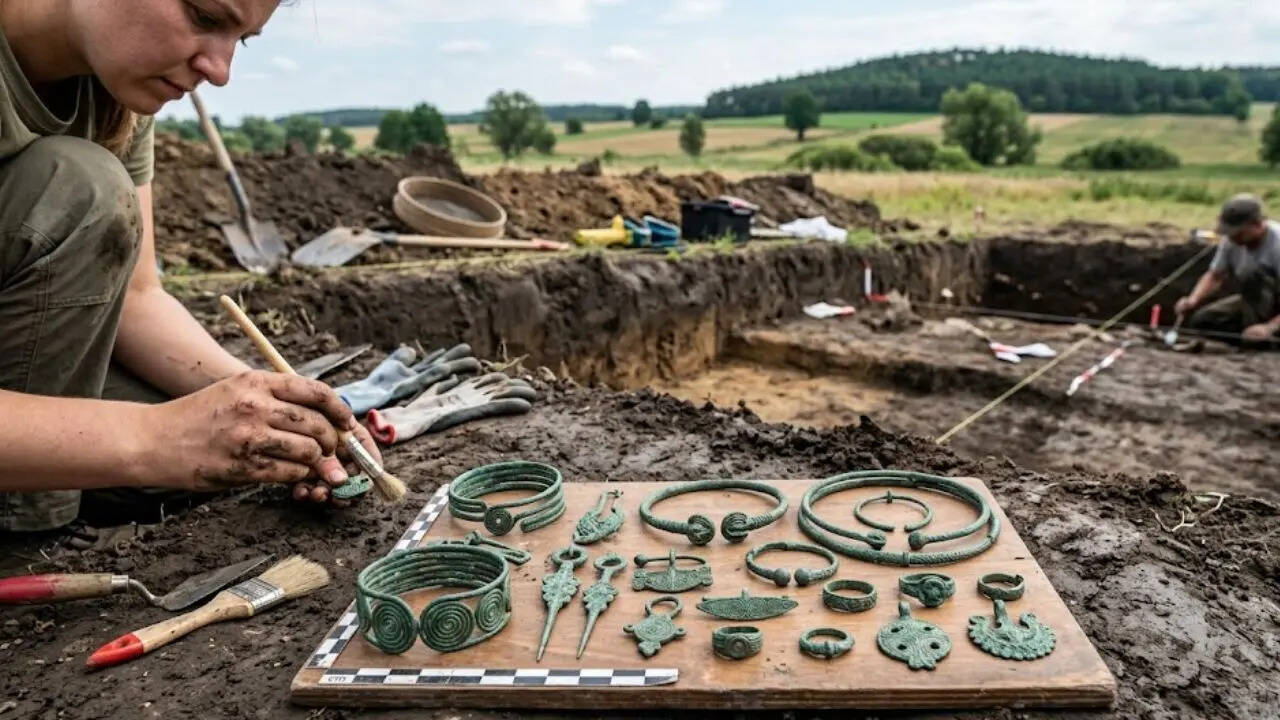
In southeastern Poland, archaeologists have discovered 18 bronze ornaments, offering a rare insight into the social dynamics of the Lusatian culture. Near the Śniatycze village, they found this collection in a small pit, which includes large spiral anklets and bracelets that together weigh about 3.6 kilograms. These items date back to the Hallstatt D period, around 550-400 BCE, and represent one of the largest decorative bronze finds in the Lublin region.
The way these beautifully made objects were buried suggests it might have been part of a ritual or perhaps hidden during times of cultural change. This discovery gives scholars important information about ancient metalworking and regional trade practices. Analysing these artefacts offers a profound understanding of prehistoric craftsmanship and the spiritual significance of treasures.
How 18 Bronze Age ornaments are unlocking Lusatian Culture secrets
According to a state administrative body in Poland, the Lublin Voivodeship Conservator of Monuments, in Śniatycze, archaeologists found 18 unique bronze items. These included heavy spiral anklets and bracelets with geometric designs. They belong to the Lusatian culture, which thrived in Poland, Germany, and the Czech Republic during the Late Bronze and Early Iron Ages. The pieces weigh almost 4 kilograms in total. This suggests the owner had a high status, or they were used for an important community sacrifice.
How 2,500-year-old Bronze ornaments were crafted
These ornaments are about 2,500 years old, originating from the Hallstatt D period as noted by the Lublin Voivodeship Conservator of Monuments. During that time, people had advanced skills in working with metal. They used techniques like lost-wax casting and chasing to make ribbed patterns and unique ends on their creations. Finding these items in southeastern Poland indicates that this area played an important role in distributing bronze items. The designs show influence from both northern European and Mediterranean styles, highlighting a blend of cultures and ideas at the time.
The reason for burying the hoard
The objects were found in a concentrated cluster just 30 centimetres below the surface, suggesting they were placed in a single organic container that has since decayed. In Lusatian archaeology, such hoards are often interpreted as ‘votive offerings’ made to deities or buried during times of conflict. The preservation of these items allows for a deeper analysis of the Scythian influence that began to permeate the region during this time, marking the twilight of the Bronze Age in Poland.
Scientific analysis of the Śniatycze Bronze hoard
After a licensed detectorist discovered the items, they ended up at the Zamość Museum. The main goal right now is to stop bronze disease, which is corrosion, by stabilising the bronze. Later on, experts plan some metallurgical tests. They want to use X-ray fluorescence (XRF) to figure out how much copper and tin are in there. This information might reveal where those ancient smiths got their raw ores.