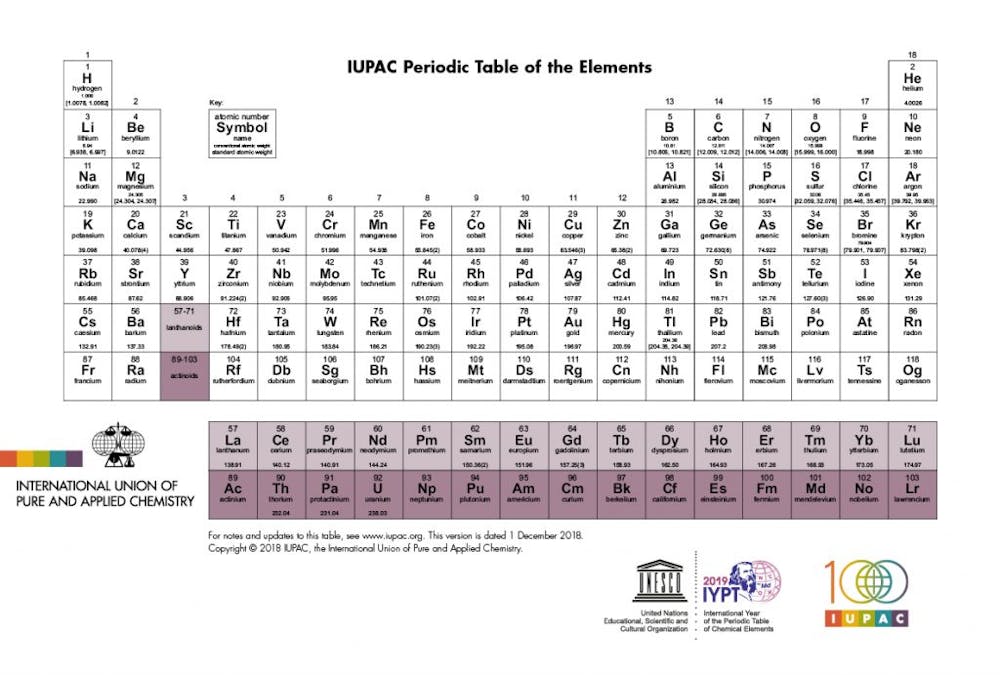
The United Nations announced 2019 as the International Year of the Periodic Table of the Chemical Elements to highlight its first publication in 1869. The periodic table as we know it today was first designed by the Russian scientist Dmitri Ivanovich Mendeleev.
The periodic table is not just a typical wall decoration in high school science classrooms, it is also an exceptional tool for scientists to understand, and even predict, the properties of all the elements.
The announcement by the United Nations will help to raise the profile of how chemistry can provide solutions to global challenges in agriculture, education, energy and health.
Read more: What does a chemical do? Addressing misconceptions about chemistry
The sesquicentennial
This year marks the 150th anniversary of the first publication of the periodic table by Mendeleev. Since its creation, the periodic table has been at the centre of a lot of vivid debates and is now considered as “one of the most important and influential achievements in modern science reflecting the essence not only of chemistry, but also of physics, biology and other disciplines.”
Mendeleev’s genius lies in the acknowledgement that at the time, not all the elements were known yet, so he left gaps in the table for undiscovered elements. At that time, only 63 elements had been identified. Still the properties of five other elements (the gaps brilliantly added to complete the table) could already been determined using the table.
Other versions
Mendeleev’s table has been in the spotlight for decades, but a few other scientists had tried before him to organise all the known elements. As early as 1789, Antoine Lavoisier established a list of 33 elements and tried to unlock the secrets of chemical elements and classify them according to their properties.
Scientists like Alexandre-Émile Béguyer de Chancourtois, John Newlands and Julius Lothar Meyer each proposed a different way to arrange the elements. A helix, chart, cylinder and even a spiral were proposed to visualise the arrangement of the elements, but none seemed to be a perfect fit.
Read more: The periodic table is 150 – but it could have looked very different
Saving some spot
The discovery of some of these elements in the following years confirmed Mendeleev’s predictions, and revealed the brilliance of the Periodic Law, as Mendeleev called his table.
Fifty five elements have been discovered since Mendeleev’s first scheme, and they were all incorporated to the existing classification according to their atomic mass. Of course, they have the properties foreseen by the uncomplete table which explains why Mendeleev’s attempt to order the elements was so successful and has survived the centuries.
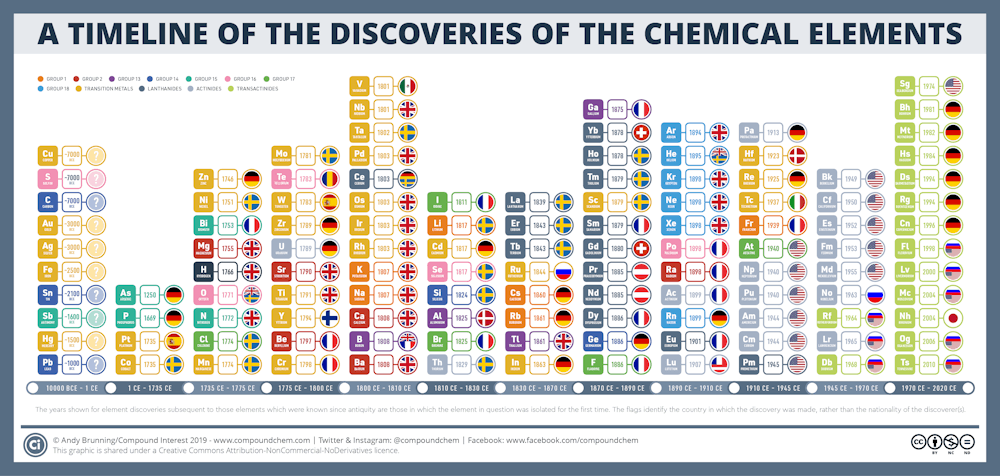
Element 101 was named mendelevium to honour Mendeleev’s contributions. This is actually an even rarer distinction than winning the Nobel prize: only 50 scientists have elements named after them, while 180 chemists have received a Nobel prize in chemistry.
In 2016, four elements still had to be discovered according to the gaps in the periodic table. With the addition of nihonium, moscovium, tennessine and oganesson, the periodic table is now complete.
Or is it?
Read more: The race to find even more new elements to add to the periodic table
Naming 2019 as the International Year of the Periodic Table may bring the public’s attention to the importance of chemistry in our lives, stoke our curiosity for science and encourage scientists’ interest in uncovering even more elements.

Alexandra Gellé does not work for, consult, own shares in or receive funding from any company or organisation that would benefit from this article, and has disclosed no relevant affiliations beyond their academic appointment.
This article was originally published on The Conversation. Read the original article.