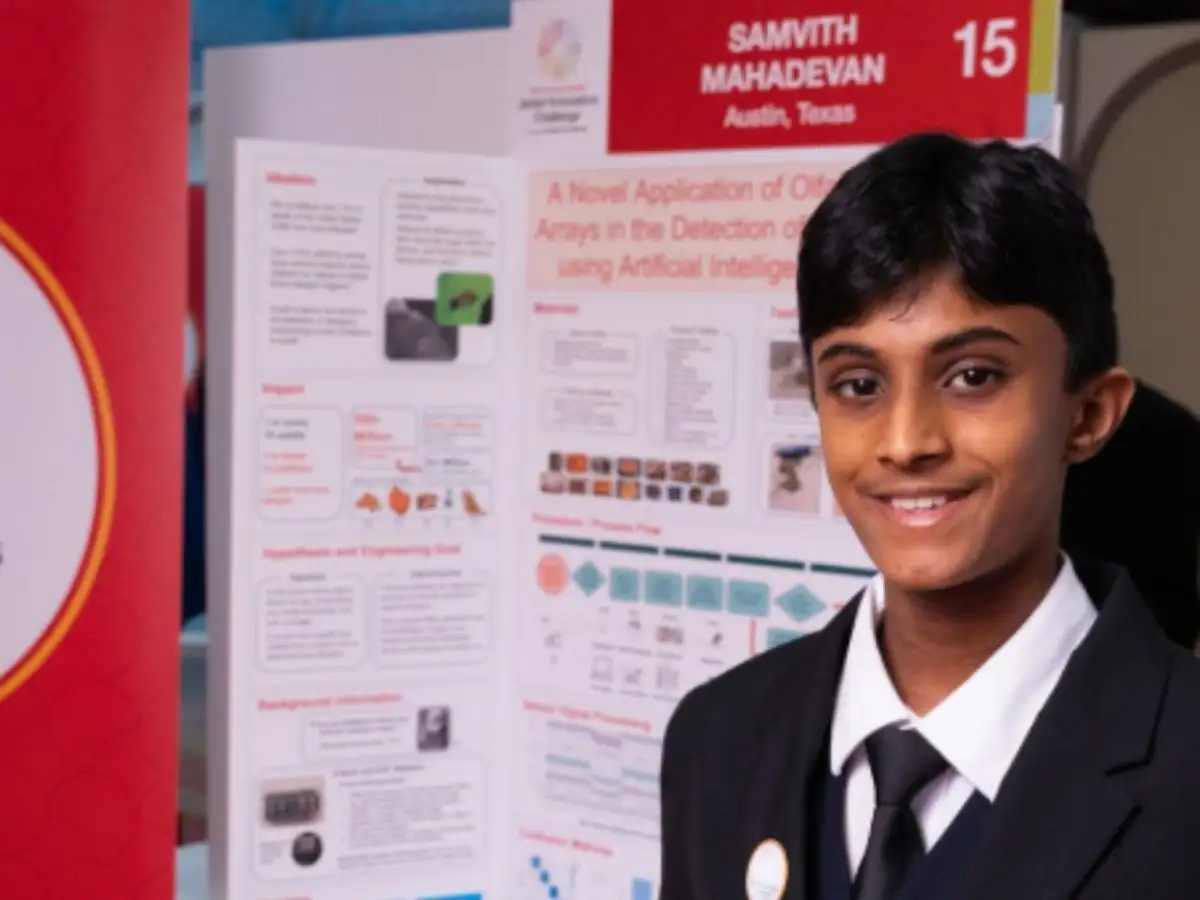
For people with serious food allergies, a meal can come with an invisible risk. A 14-year-old Texas school student has taken that everyday problem and turned it into a science project: a small device designed to “smell” traces of common allergens before someone takes a bite.
Samvith Mahadevan, 14, from Austin, Texas, developed the device after dealing with food allergies himself. His invention, called The Allergent, combines a chemical sensor with machine learning to identify possible allergens in food. His work earned him the $10,000 Lemelson Foundation Award for Invention at the 2024 Thermo Fisher Scientific Junior Innovators Challenge.
Also Read: Siemens CEO Roland Busch gets 200 emails a day but keeps his inbox below 100. He shares how physics shapes the way he solves problems
Also Read: 11-year-old Florida boy makes history by reading 100 hours to shelter cats and dogs s
A personal problem became a science project
Mahadevan was looking for a way to make eating unfamiliar food less risky for people with allergies. Existing allergen detection systems can be expensive and some require direct contact with the food, according to the Society for Science. That led him to consider a different approach: detecting chemicals released into the air around food. Inspired by the way ants can locate food through chemical signals, he began experimenting with a volatile organic compound (VOC) sensor.
How the ‘chemical nose’ works
The device uses a low-cost industrial VOC sensor containing an array of metal-oxide sensors. Mahadevan connected it to electronics that allow the system to communicate wirelessly. When food is placed near the sensor, tiny chemical compounds released into the air interact with the sensor. Those interactions produce changes in electrical signals.
Mahadevan then used machine learning to teach the system how different signal patterns correspond to particular allergens. The results can be sent to a phone, where the prediction can be displayed.
It was trained on nuts and eggs
For the project, Mahadevan trained his system to recognize several common allergens, including peanuts, eggs, pistachios, almonds, cashews and walnuts. He conducted more than 2,000 rounds of testing before moving on to real-world foods. The device was subsequently tested on products including cookies, muffins, curries and other foods containing allergens.
According to the Society for Science, the system identified allergens in those tests with an accuracy of about 94% to 97%.
A safer way to check food?
The idea could eventually offer another tool for people who need to be cautious about what they eat. Instead of relying only on labels or asking about ingredients, a portable sensor could potentially provide an additional warning when an allergen may be present.
However, Mahadevan's invention is still a research project rather than a medically approved replacement for established food-allergy precautions. More testing would be needed before such technology could be relied upon for everyday safety.
Mahadevan hopes to continue developing the device and expand the range of allergens it can recognize. The Lemelson Foundation said he wants to explore detecting ingredients such as gluten, dairy and soy and eventually turn the concept into a product that can be used more widely.
The teenager has also said he wants to pursue biomedical engineering.
For now, his project shows how a problem faced at the dinner table can become the starting point for an unusual piece of engineering, one that uses chemistry, sensors and artificial intelligence to give food a digital sense of smell.