Show government the value of civil society, and vice versa: Civil society organisations (CSOs) share a symbiotic relation with government. A strong civil society can only exist within a democratic framework guaranteed by government. CSOs need to acknowledge that law-making should be the domain of elected representatives in a democracy, rather than un-elected ones. Similarly, civil society’s role as a facilitator of democracy and development and a watchdog must be acknowledged by the government.
Saket Mani, youth representative,World We Want 2015, Pune, India, @SaketMANI
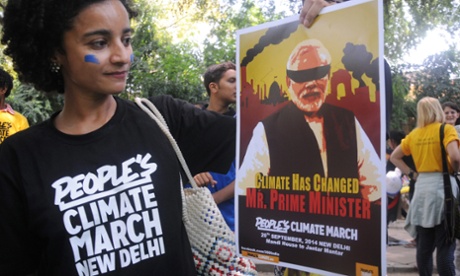
Open lines of communication: Dialogue is key. It takes two to dialogue. While it is still early days to assess what the prime minister’s office thinks about the development sector, the only real engagement with civil society so far is via leaked reports. That’s not the best way to have an healthy dialogue.
Divya Raghunandan, programme director, Greenpeace, Bangalore, India, @draghuna
Make friends in high places: Identify your allies within the government and ask them how to present data and information. Taking a confrontational stand only complicates matters. This is what we’ve learned, as LGBT citizens deemed criminals by some in this country.
Pallav Patankar, programmes director, The Humsafar Trust, Mumbai , India, @pallav01
Engage the public: NGOs need to take outreach to a wider audience. The middle class and youth need to be engaged. There is a link between economic and political capture by a small group and projection of certain kind of development.
Parvinder Singh, campaigner and civil society activist, New Delhi, India, @parvindersingh1
Support other organisations: NGOs are a divided community in India and have failed to make a compelling case for themselves, not just in the public eye, but also with government. There has been too little solidarity in the community for those who are prosecuted by the government.
Biraj Patnaik, principal adviser, Office of Supreme Court Commissioners on Right to Food, New Delhi, India
Campaign for more government transparency: There is still a lot of information on legal and financial compliance that the NGOs don’t have easy access to. This causes quite a few issues. There is a real need for transparency on the processes and decision making by the government. This information should be easily accessible to NGOs.
Rujuta Teredesai, co-founder and director, Equal Community Foundation, Pune, India, @RujutaTH
Don’t be complacent: The Delhi High Court order was brilliant and it will certainly have an impact on the brazenness of state impunity in so far as restricting foreign funding of Greenpeace. But there is no room for complacency and I do see a trend of growing intolerance towards all sections of society who dissent and not just NGOs. The battle in my view has just begun, and we have a very long way to go.
Biraj Patnaik
Work in political and public spheres: CSOs should also learn to work more strategically with political parties. As CSOs operate in the space between public and political arenas, government responsiveness is improved by engaging both arenas.
Saket Mani
Create a counter-culture: It is important to recognise that we live in an age of political capture where the power – economic and wealth – is more concentrated than it has ever been, with this impacting how policies function. We need to create a popular narrative with a clear vision of what change looks like – in terms of poverty, gender and social inclusion. We have stopped working on creating a counter-culture which is fundamental to allow people to ingrain the idea of democracy and equality.
Parvinder Singh
Improve the sector’s reputation with the upper class: Many sections of Indian society view NGOs with suspicion, particularly the upper echelons. While it is true that a few black sheep have tarnished the image of the sector, much of the opposition is because it clashes with the class interests of the elite in India. NGOs need to work much harder to convince people of their motivations.
Biraj Patnaik
Take responsibility for accountability and transparency: Businesses have been accused of using NGOs for money laundering. NGOs should account for the money they spend while working within the parameters of national governing frameworks and laws. The best NGOs strategise about how they can be accountable to the communities for whom they work.
Saket Mani
Convince the middle class that poverty affects them too: Highlight to the middle class that in the long run governments focusing on the interests of the top 1% is detrimental to their interests, not just that of the poor. This is a challenge in the UK as much as it is India. Globally we need to work harder on scripting a new narrative and as the recent elections in Greece demonstrated, it is possible.
Biraj Patnaik
Read the full Q&A here.
Join our community of development professionals and humanitarians. Follow@GuardianGDP on Twitter.