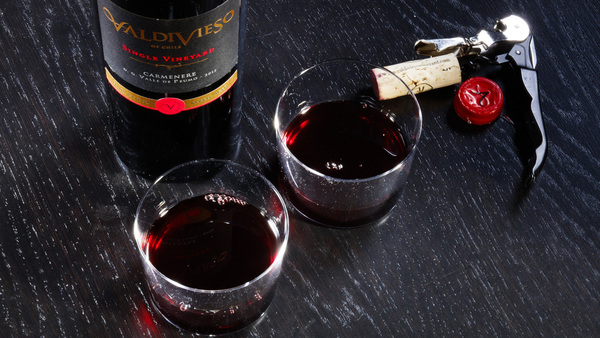
Recently, following a night of tasting (and drinking) several bottles of Chilean carmenere, it was brought to my attention that one of my fingers appeared to have been smudged with ink. I did not even have to look down. I simply said, "It's wine."
I had noticed that stain and some others the night before, after tasting through several bottles and then drinking portions of a few favorites. We don't have to get into what my teeth looked like or why I kept getting wine on my hands, but suffice to say that my fingers looked as if they belonged to a printing-press operator or someone who had just been booked and fingerprinted by the police. Despite my scrubbing, some semblance of a ghost image appeared on at least one of my fingers the next day. Call it a smudge of honor.
Carmenere is quite the inky wine, its deep and concentrated ruby-to-purple hue a well-known sight to folks down in Chile. The grape variety hails from France _ the offspring of cabernet franc and gros cabernet _ and it was a big player in Bordeaux at one time. Not so much today. Now carmenere's most hallowed ground is in Chile, where it is used not only in blends but also for single varietal wines. Nowhere in the world is more carmenere grown and turned into wine than in Chile.
Medium- to full-bodied, with relatively low acidity and medium tannins, carmenere often has a silky and rich mouthfeel, sometimes offering notes of plum, blackberry, dark cherry and cocoa, among others. Sound familiar? These are some of the reasons that Chileans once thought they were growing, vinifying and drinking merlot. It was not until the 1990s, when science stepped in and cleared matters up, that Chileans (and the rest of the world) realized that what they had thought was merlot was actually carmenere.
This most certainly set in motion the eventual Chile-carmenere love affair _ when Chile claimed this adopted grape variety and wine style as its own. It sort of looks like a Spanish word, doesn't it? Don't put a tilde over that "n," though, and don't bring any "y" sounds into the mix. Just pronounce it: "car-meh-NAIR."
Even today, now that Chilean carmenere is very clearly Chilean carmenere, it can show flashes of both merlot and cabernet sauvignon. You might encounter notes of blueberry, raspberry, herbs, baking spices, tobacco, mocha, black pepper, licorice, smoke and spice, and because it is a late-ripening grape variety, it can also offer green notes, from being picked a bit too early. Those might include green bell pepper notes, or even a touch of spicy chile pepper.
Pair carmenere with meaty pastas, chicken, pork, grilled vegetables, pizza, stews, lamb, foods with a little spice, and lean cuts of beef. Although carmenere was not born in Chile, its once and future home is there, between its cool windswept western coast and the snow-capped peaks of the Andes mountain range.
Chile is still a land of decent wine bargains, and carmenere varietals are included in those bargains. But the wine style can also demand prices that soar well past $50 per bottle. Most carmenere does not have the ability to age very long, though some of the pricier versions can improve in the bottle for years. For the most part, though, drink carmenere when it is young and fresh.