It is not a question of either/or: Healthcare is an ecosystem that depends on both public and private sector players to reach all consumers. In Kenya, the private sector actually dominates, accounting for 62% of healthcare spending according to the latest World Development Indicators. Ron Ashkin, team leader, PSP4H, Nairobi, Kenya, @PSP4H
Public-private partnerships (PPP) should be a win-win: Private sector providers (PSP) are interested in profit and high-client load, whereas the public side is more interested in quality and outcomes. A private-public collaboration would need to contain a mix of regulatory policies with effective training for private providers. The regulatory aspects can control prices and reduce inappropriate sales of medicines, while training can increase quality and the popularity of providers. Karin Kallander, senior research adviser, Malaria Consortium, London, UK, @fightingmalaria
PPPs don’t have to include the government: They can be driven by civil society. During the Ebola Open Data Jam in October, 110 volunteers gave their time to search and inventory disparate sources of open information about Ebola to centralise the information. This is a new form of data-driven activism that can powerfully enhance the activities of governments and aid organisations. Steve Adler, chief information strategist, IBM, New York, USA, @IBM
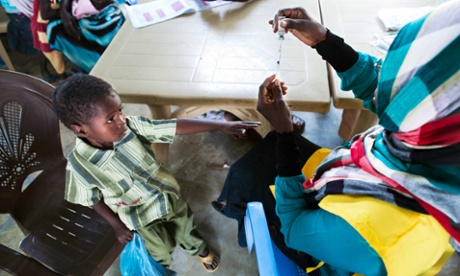
The private sector can deliver healthcare where the public sector cannot: We found that shopkeepers chose to buy and sell Kit Yamoyo Anti-Diarrhoea kits for profit, but they were also happy to improve their community’s access to medicines. They took great pride in their training on childhood diarrhoea. Private does not always mean just profit. To classify private as “bad” – unregulated, unscrupulous, exploitative – means closing down a lifeline to the poor. Jane Berry, project manager, ColaLife, London, UK, @colalife
Private healthcare workers should be easy to identify: Our community health promoters wear a uniform and sticker, carry a bag and have other tools that make them easily recognisable in their communities. This builds trust and keeps patients coming back to our agents. Carey Carpenter, partnerships associate, Living Goods, Kampala, Uganda, @Living_Goods
Approach collaboration with open attitude: We found that an open, listening, questioning, participative process with a wide range of actors in Zambia and internationally, helped to “flush out” opportunities and willing partners. That process was expensive in time (we did most of it as volunteers), but was an absolutely essential process for building trust and commitment. Each opportunity is worth investing in to identify win-wins. Keep an open mind on the unlikely alliances you can forge. Jane Parry
Be vigilant about fake drugs: Counterfeit medicines present a very real threat. Evidence shows that one third of all anti-malarial drugs in Africa are counterfeit. In Asia, where artemisinin resistance is spreading along the Thai-Cambodia border, counterfeit medicines containing low levels of anti-malarial drugs can pose a particularly dangerous threat, as they contribute to the growth in resistance. This has the potential to reverse the progress in malaria control. Karin Kallander
Monitor drug stocks: One technological solution could be through the use of bar coding of medicines, to track and trace stocks, sales, brands across geographies in real time. Karin Kallander
Keep training healthcare workers: We deliver monthly refresher trainings that focus on key health topics or new product launches, with topics timed strategically. During the rainy season this year, we partnered with the Clinton Health Access Initiative to deliver refresher training on diarrhoea. Carey Carpenter
Healthcare workers are accountable to their communities: Responsible patient care can translate into enhanced status in the community, not to mention greater sales opportunities for agents (with new and recurring customers). This, along with visits by field supervisors to patient homes, helps hold our CHPs accountable to the communities they serve. Carey Carpenter
Private sector organisations can help improve regulatory standards: In Kenya, members of the Kenya Pharmaceutical Association (KPA) run half of the neighbourhood pharmacies, and they are forming a network of accredited pharmacies called Pharmnet. To be a KPA member you must be licensed and registered and Pharmnet is an attempt by the private sector to drive the quacks out of business. Ron Ashkin
Read the full Q&A here.
Read more stories like this:
• Child health: delivering improvements through community-based care
• Just how do you get health services to every woman and every child?
• Getting medicines to the poor: solving the logistics challenge
• Advertisement feature: Harmonisation: improving support for malaria control
Join our community of development professionals and humanitarians. Follow@GuardianGDP on Twitter.





.png?w=600)