1. Origins
The modern tabloid newspaper is a strange marriage of Edwardian England and the wild west. The formula was American, but was perfected in London by a couple of technical geniuses in the new field of printing photographs in the run-up to the first world war.
One of them, Harry Guy “Bart” Bartholomew, was illiterate, the other (Hannen “Swaff” Swaffer) claimed to be psychic, and specialised in interviewing recently deceased celebrities such as Chief Sitting Bull and Florence Nightingale. Both were violent drunks with colourful private lives who conducted legendary feuds, both with each other and everyone else in the newspaper business.
Together they produced the original media goldmine – the Daily Mirror. It was set up by a former small-town shyster lawyer called Alfred Harmsworth, as the latest in a string of get-rich-quick schemes. In later life, Harmsworth was so paranoid that lived in a tent on top of his Mayfair mansion for reasons of security/insanity. Then he shot his butler, mistaking him, as one does, for a Bolshevik assassin. By this time he was, naturally, in the House of Lords (as Lord Northcliffe).
2. Dead monarchs sell papers
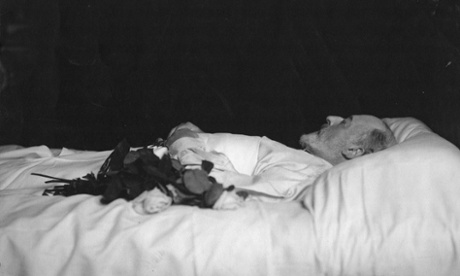
Bart and Swaff’s first, genre-defining scoop was to print the stolen private death-bed pictures of King Edward VII. Swaff bribed palace flunkies (nothing is new) to get the pictures.
That edition of the Mirror sold a world record 2 million copies (roughly 100 times normal circulation levels at the time). The paper cost a halfpenny, but was changjng hands on the black market for a shilling.
Journalists associated with this and the increasing number of similar death-bed intrusion escapades were described as “ghouls”, “criminals” and “animals beneath contempt” in the Times, later to become part of Rupert Murdoch’s stable of UK papers.
3. Sinking the Titanic
The second huge scoop involved the sinking of the Titanic, which Swaff managed to promote as pictures of the sinking ship itself. Thus was born the tabloid art of building up reader expectations on a tiny grain of truth.
When Swaff got the news of the accident on the newswires he bought the rights to all existing pictures of the ship. Up went the “read all about” posters displaying the slogan EXCLUSIVE – LAST EVER PICTURES OF TITANIC. All rival papers ran the story of the sinking.
What readers found in the paper were promotional pictures of the ship in Southampton harbour, not the dramatic scenes of watery horror they might have been anticipating.
4. Death, New York style
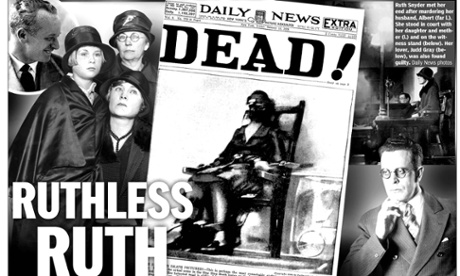
By the 1920s the tabloid formula had been re-exported across the Atlantic and taken further. The 13 January 1928 edition of the New York Daily News had the headline DEAD! In huge type above a full-page picture of a woman in the electric chair, back arched in agony at the moment of her death.
Ruth Snyder had been executed the previous day for the murder of her husband. The paper had paid one of the jury who witnessed the execution to smuggle in a camera strapped to his ankle, operated by a pneumatic bulb. Some cynics believed that the paper framed Snyder just so it could get the picture, and a leaked version of the suitably lurid police account of her supposed crime.
5. Fear eats the soul
Alongside the News, the New York Post also thrived by digging new standards for insensitivity in the reporting of murder and judicial vengeance. The Post was acquired by Murdoch in 1976. He imported journalists from the Sun in London, then in its super soaraway heyday. The “Brash Brits” of the Murdoch empire led the way with headlines such as HEADLESS BODY FOUND IN TOPLESS BAR and the legendary KILLER BEES HEAD NORTH.
6. It was the Sun what won it
The Sun’s support for Margaret Thatcher in 1979 was recognised by her team as having been crucial in reaching a mass audience of skilled workers. The Sun headline: THIS IS THE WINTER OF OUR DISCONTENT entered the language and earned the paper the hatred of the political left for a generation. In 1992, Conservative party chairman Lord Thorneycroft said that the Sun had delivered that year’s election to his party. Few doubted him.
7. Don’t go overboard to buy the Mirror
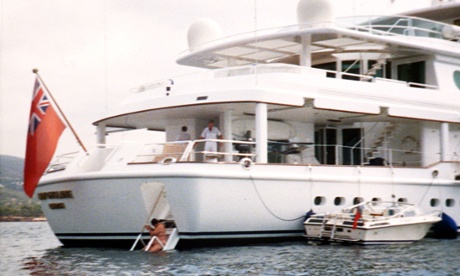
The Sun’s cruel headline marked the death at sea of Robert Maxwell, the bizarre criminal who had taken over the fading Daily Mirror and reduced it to ruins. Thereafter the SHOCK AND AMAZE ON EVERY PAGE approach pioneered by the Mirror would be inherited, and moulded to his own purposes, by Murdoch’s Sun. The immense success of the Sun owed a lot to the implosion of the Mirror.
8. Di-land in the Sun
The profitable obsession with the royals dated back to the snatched death-bed pictures of Edward VII, but the Sun was relentless, exploiting the constitutional convention that the royals cannot use their own courts to sue. A high/low point was the printing of telephoto lens pictures of a pregnant Princess Diana sunbathing on a private Caribbean beach in 1982. The Sun’s photographer had to spend a day crawling through dense jungle to get the picture and then destroyed the only fax machines on the island to make sure that rivals could not scoop them.
9. The insanity of crowds
Once you have 12 million readers (as claimed by the Sun in its heyday), intellectual subtlety gives way to the rampant exploitation of gullibility, superstition and ignorance.
Newspaper bingo and cash prize competitions are one example, another is astrology, the tabloids’ specific and emphatic refutation of the scientific method. A classic was THE SUN TAKES ON THE CURSE OF THE CRYING BOY PICTURE – where readers were encouraged to take down and send in a mass market print supposedly responsible for starting house fires. Thousands arrived. They were then ceremonially burnt in a bonfire that resembled a Nazi book-burning festival. The reporter was bylined “Fine Art Correspondent”.
10. Stick it up your pun-ter
It is customary to mention the comedy aspect of headlines such as ZIP ME UP BEFORE YOU GO-GO (on the arrest of George Michael in a public toilet); TATA TUTU (the pre-prepared and yet to be printed gloating headline anticipating the death of Archbishop Desmond Tutu) and THE ION LADY (Margaret Thatcher undergoes electrolysis – the only tabloid headline known to me to feature its own asterisk and lengthy footnote explaining the joke).
11. Worst ever story
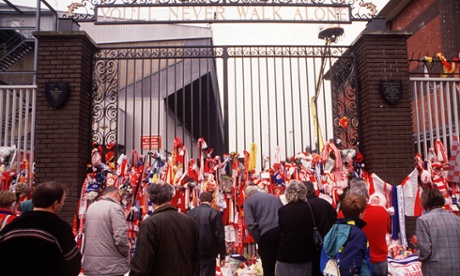
For many the worst tabloid headline yet was the Sun’s THE TRUTH, published in the wake of the Hillsborough tragedy, which libelled the people of Liverpool based on nothing but prejudice and a police cover-up. Over at the Mirror, editor Piers Morgan’s printing of a faked front-page photo of prisoner abuse by British soldiers in Iraq was another dark episode, which eventually led to his dismissal. With stunts like these, it is little wonder that the tabloids are increasingly unpopular with the underdog audience they claim to champion.
Chris Horrie is the co-author of Stick It Up Your Punter!: The Uncut Story of the Sun Newspaper, recently updated and republished by Faber and Faber
Great Britain transfers to the Theatre Royal, Haymarket, London, on 9 September 2014.