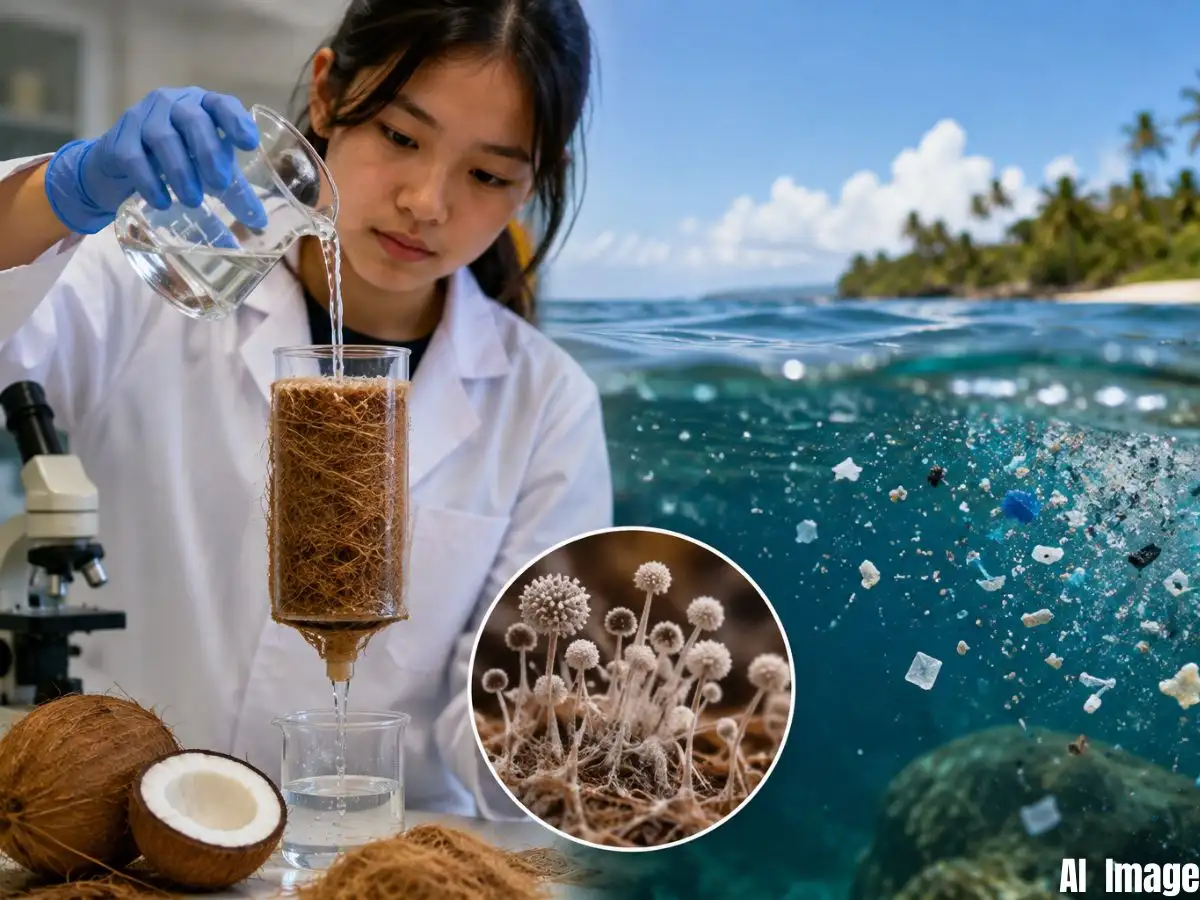
A school science project aimed at cleaning polluted seawater has led to a potentially important discovery. Hawaii high school student Vera Wang found that fungi naturally growing in coconut husks may be able to break down microplastics and sunscreen compounds. Her research, carried out with scientists at the University of Hawaiʻi at Mānoa, has now earned major recognition at the 2026 Hawaiʻi State Science & Engineering Fair.
Wang first began studying coconut waste as a natural filter when she was in 10th grade. What started as an attempt to trap pollutants in seawater eventually led her to a different question: what happens to those pollutants after they are captured?
That question pushed the project from filtration into the world of microbiology.
From coconut husks to ocean cleanup
Wang's original project focused on developing a filter made from coconut byproducts. The idea drew inspiration from Polynesian weaving traditions and looked at whether coconut fibres could remove microplastics and sunscreen from surface seawater.
The material had two advantages. Coconut fibres could physically trap pollutants, while the use of agricultural waste offered a more sustainable alternative to conventional filtration materials.
But capturing pollution does not necessarily solve the problem. Once microplastics and chemical compounds are collected, they still have to be dealt with. Wang began looking beyond the filter itself and became interested in the organisms living within the coconut material.
That change in direction became the turning point in her research.
Why coconut husks caught her attention
Coconut fibres have a porous structure through which air and water can move. Wang considered whether this environment could support microorganisms that might interact with the pollutants trapped by the fibres.
Working in the laboratory of Anthony Amend at the University of Hawaiʻi at Mānoa, she began examining fungal communities naturally found in coconut husks.
The research explored whether these fungi could grow in the presence of plastic and sunscreen compounds and whether they could help break down those substances.
In effect, Wang's project began connecting two different approaches to pollution control: first capturing contaminants and then looking for biological processes that could help degrade them.
Fungi show ability to break down pollutants
The research produced one of its most notable findings when naturally occurring fungi associated with coconut husks showed an ability to biodegrade sunscreen and plastic.
Biodegradation refers to the breakdown of substances through biological activity, often involving microorganisms.
The finding could be significant because plastic pollution remains difficult to manage. Removing plastic from the environment generally requires it to be collected and processed, while chemical compounds such as sunscreen can spread through marine water and become harder to remove.
Naturally occurring organisms capable of breaking down such pollutants could therefore become an area of interest for further environmental research.
Researchers also found that tannins in coconut fibres could help identify fungi capable of working with plastic and sunscreen.
“The tannins in coconut fibers may be helping to support the growth of these specialized fungi,” said Kaylee Christensen, a graduate student in the Marine Biology Graduate Program who worked closely with Wang.
Could the fungi be previously unknown?
The research produced another surprise when scientists examined the fungi genetically.
Some of the fungal species found in the coconut husks did not appear in the world's largest reference database of known genes and genomes. That raises the possibility that some of the organisms could be previously uncharacterised species.
For Wang, this meant the project had moved beyond studying coconut fibres as a filtration material. It had also opened a window into the microscopic organisms living inside them.
However, the findings are still at the research stage. Scientists need to establish exactly which fungi are involved, understand how they break down the pollutants and determine whether the process could work beyond laboratory conditions.
Student's research wins at state science fair
Wang's work received several honours at the 2026 Hawaiʻi State Science & Engineering Fair.
Her project won first place Best in Category for Microbiology and third place Best in Fair. She also received a special award from the Friends of Hanauma Bay and another from the Association for Women Geoscientists.
The project additionally earned her a scholarship from the McInerny Foundation and a place at the International Science & Engineering Fair.
The awards highlight how a student research project developed into a broader investigation involving environmental science, microbiology and marine pollution.
One question changed the direction of the project
Wang's research began with a relatively straightforward goal: find a sustainable material that could help remove pollutants from seawater.
But instead of stopping after finding a way to trap the contaminants, she asked what should happen next.
That question led her to investigate the organisms living in coconut husks. The work then pointed toward fungi that may have the ability to break down some of the very pollutants the coconut material was designed to capture.
The discovery does not yet offer a ready-made solution to marine pollution. But it shows how an everyday agricultural waste product can lead researchers toward unexpected biological possibilities.
What began with coconut husks and a school project has now opened a much bigger question: whether naturally occurring microorganisms could eventually become part of the fight against plastic and chemical pollution in the oceans.