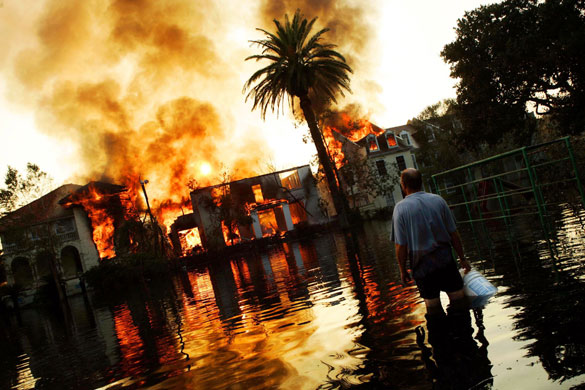
2006, New Orleans On September 4, 2005, nearly a week after New Orleans’ flood defences failed under the impact of Hurricane Katrina, much of the city remained underwater and deserted. To add insult to injury, fires continued to burn as a result of gas leaks, fallen power lines and in some cases, arson. Photograph: Michael Appleton/AP

2006, Antalya, Turkey
The most serious of bomb blasts in Turkey in the late summer of 2006 was in the southern city of Antalya, where this picture was taken. Ten Britons, including four children, were hurt in another blast on a bus in the popular south-western coastal resort of Marmaris. Photograph: Dogan news agency/REUTERS

2005, London
One of the key images to have remained in people’s consciousness since the 7/7 bombings on London Underground, this camera-phone image – taken by someone involved in the disaster – has forced a reconsideration of the way in which press images are both produced and circulated in the 21st century. Photograph: Alexander Chadwick/AP

2004, Basra, Iraq
For British troops, Basra is the first big battle of the Iraq war. For this girl, like the other estimated 100,000 children in the city aged under five, the chaos spells sheer terror as families flee across a bridge over the Shatt al-Arab. Photograph: Dan Chung for the Guardian

2003, Baghdad, Iraq
"One morning, during the 2003 invasion of Iraq, I got my driver to take me to an affluent suburb of central Baghdad. The rumour was that there had been a meeting of senior Iraqi military in one of the houses and so it had been hit the night before … When I arrived, I tried to hang back, hoping someone would appear. Then suddenly a kid, who I had seen around before, came back. This time he was carrying a rabbit." Photograph: Sean Smith for the Guardian
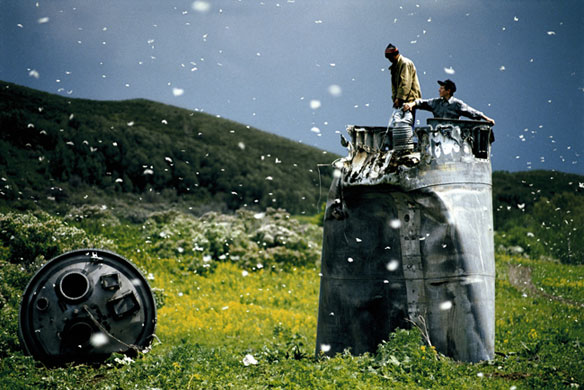
2000, Russia
"The picture was taken in the Altai territory of Russia, right in the border regions of Kazakhstan. It shows the second stage of a Soyuz rocket in the crash zone where they come down to earth. You can see them fall during the day, and usually hear the big bang as they hit the ground. These things are made out of pretty good metal too, so a lot of the locals make a living chasing rocket parts, before selling them as scrap. If you look very carefully, you can see that the white things all around them are butterflies or moths." Jonas Bendiksen is a Norwegian photographer based in New York. Photograph: Jonas Bendiksen/Magnum

1999, Kukes, Albania
Refugees from the war of secession from Serbia in Kosovo. Guzy, a working-class American, clearly empathises with the ethnic Albanian children savouring freedom from fear in the northern Albanian mountains. Photograph: Carol Guzy/TWP

1998, Spain
Gaumay grew up close to the bay of Biscay and later, as a Magnum photographer, made several voyages with fishing fleets. The foredeck is like a jumbled factory floor; fishermen in oilskins move carefully; men and the rusty boat they sail in are frozen in a tableau, dwarfed and imperilled by the mobile, threatening majesty of the sea. Photograph: Jean Gaumy /Magnum

1998, Phnom Penh, Cambodia
Nhan, a 25-year-old Vietnamese former prostitute living with Aids in Cambodia, poses for her portrait behind a veiling mosquito net that seems to suggest the distances and ordeals that separate her from us. Photograph: Paolo Pellegrin/Magnum

1994, Dudley, UK
Alastair Campbell: “I remember the day vividly. It was the Dudley West by-election … We were in the corner of a bar or restaurant in Dudley. We only had 10-20 minutes set aside for the local press but there were lots of people from our party chatting away at the bar. I didn’t want to tell them to shut up, so I just gave them an angry look …” Photograph: Don McPhee for the Guardian

1992, Sarajevo
“This was not the story of a mum who was crying because she was sending her son away … I was actually going with him on the bus … Instead, I was trying to hold back my tears because I knew that I was leaving my beloved country, which had been ruined by the folly of the war …” Gordana Burazor, evacuated from Sarajevo in 1992. Photograph: Tom Stoddart/Getty Images/Hulton Archive

1992, Ulverston, UK
A surreal image created when Fleur Laverack and Jem Hulbert were rehearsing juggling and unicycling on a frosty morning on the hills overlooking Morecambe Bay above Ulverston, Cumbria. Photograph: Denis Thorpe for the Guardian

1986, South Pennines, UK
Saddleworth Moor is saddled for ever with the terrible secrets of Ian Brady and Myra Hindley. In 1986 when Hindley was taken there and the moor sealed off by 200 police, McPhee crept through and caught these officers and their dogs in this chilling shroud of mist. Photograph: Don McPhee/Guardian

1986, Washington
Perhaps mindful that, to most people, his acting career boiled down to the comedy, Bedtime for Bonzo, in 1985 Ronald Reagan picked up a snowball and reminded everyone of his role as legendary Philadelphia Phillies pitcher Grover Cleveland Alexander in the 1952 bio-flick, The Winning Team. Photograph: MIKE SARGENT/AFP

1984, Wath, UK
There’s not much to laugh about, but it’s Christmas Day and the pitmen of Wath and their wives are preparing dinner. Wath was one in a chain of South Yorkshire pits which came out on strike before the unions had declared it official. Photograph: John Sturrock/reportdigital.co.uk

1979, San Ysidro, California
“I was working on a feature about the US-Mexico border when this image was taken. It was a long job and I was on the road for about a month and a half. That day I was driving along with a border patrol officer, looking out of the window to my right at this field. This scene developed in front of me …” Photograph: Alex Webb/Magnum

1974, Belfast
The Guardian’s McPhee catches Enoch Powell addressing a meeting in King's Hall, Belfast, in the year he left the Tories after falling out with the Heath leadership. Photograph: Don McPhee/Guardian

1972, Manchester, UK
Robert’s sympathetic eye captures an abstract image through the reeded-glass panel in a door at Manchester employment and benefits office. The caption in 1972 read: “Waiting for the payout”, when the numbers of unemployed were expected to top one million. Photograph: Robert Smithies/Guardian

1968
Words shed their power before the majesty of this view of Earth from the moon; “Earthrise,” the Apollo 8 mission commander Frank Borman named it. Anders actually shot it from his position in orbit, that is, with the moon’s surface vertical. Time Life Pictures/Getty Photograph: William Anders/Time & Life Pictures/Getty Image

1968, Prague
Josef Koudelka’s images of Russian tanks rolling into Prague in 1968 are an extraordinary chronicle of the mass protest that greeted their arrival. Devoid of movement, this image of an anonymous passer-by, whose watch records the exact time of the invasion, records a moment in which time seems to stand still. Photograph: Josef Koudelka/Magnum

circa 1962-63, Rome
A comic irreverence, with a hint of the harsher satire of Catholicism in the films of his contemporary Federico Fellini, make Giacomelli's series Pretini (Little Priests) beautifully evocative of an Italy that was enjoying its postwar economic “miracle" and no longer so awed by the miracles of faith. Photograph: Mario Giacomelli/AP

1952, Koje Do, South Korea
Captured soldiers are surrounded by textile phantoms in Swiss photojournalist Bischof's subversively beautiful glimpse of a detention camp for captured North Korean troops. Photograph: Werner Bischof/Magnum

1951, Haengju, South Korea
A young girl carrying her brother passes a stalled US M-26 Pershing tank. Communist North Korea had invaded South Korea 12 months earlier. The UN sent a force to combat the communists and China sent a force to back the North. What might have blown up into the third world war ended with truce in 1953. Photograph: RV Spencer/AFP/National archives

1951, Deleitosa, Spain
Eugene Smith’s reputation as “the father of the photo essay” is founded on the seminal series of stories he shot for Life magazine in the 1950s which included this powerful image of life and death from “Spanish Village”. Photograph: W. Eugene Smith/Magnum

Jews being rounded up for the death camps became an almost commonplace sight during the Holocaust. This picture was taken just after the three-week uprising in the Warsaw ghetto in spring 1943, which severely shocked the Nazis. Thousands of Jews had fought the good fight against the Germans and won a bloody moral victory before these survivors were rounded up. Photograph: Corbis

1941, New York
The looks on these young spectators' faces are more troubling than if he had shown the bleeding body they are staring at. The bleak facades of buildings behind them establish their social context: they are growing up in a tough world and this is their tough response to it, to treat a murder scene as entertainment. Photograph: Weegee/Getty

circa 1940, Oklahoma, US
Glistening reddened faces start out of the wine-tinted shadows as colour photography reveals the blushing and flushing reality of a country dance one night in the midwest long ago. The rawness of colour makes these people live on forever in their love and awkwardness. Photograph: Russell Lee/© Library of Congress, Washington DC.
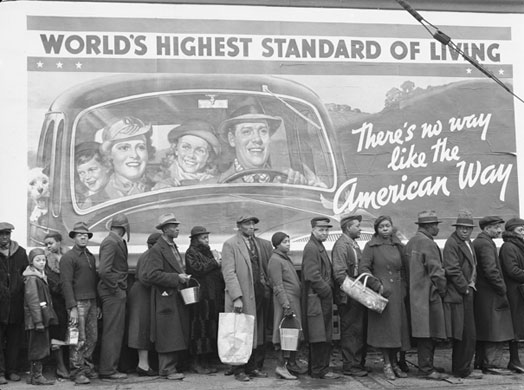
1937, Kentucky, US
Bourke-White captures one of America’s principle contradictions following the 1937 Ohio flood. Against a backdrop of wholesome affluence, the reality of American life is not quite as advertised, as African-Americans line up for relief. Photograph: Margaret Bourke-White/Time & Life Pictures/Getty Image

1937, New Jersey, US
Robert Buchanan, 90, was working as civilian ground crew beneath the Hindenburg when it caught fire: “I was on the ground, directly under the fire when it started. Engine number one was roaring at full throttle … and I could see sparks and flames coming out of it. I thought at the time: Oh boy, I’m standing under 7m cubic feet of hydrogen …” Photograph: MURRAY BECKER/AP

1936, California, US
Lange’s most famous photograph was taken in a pea-picker camp in Nipomo, California. The woman’s name was Florence Thompson. She is the mythical mother, the unshakable fortress-refuge of our childhood fantasies, the one to whom we can turn when there is no one else. Photograph: Dorothea Lange/Hulton Archive/Getty

1922, Dublin
An Irish Free State soldier crouches behind the window of a bank in O’Connell Street that is under attack from the hotel opposite. The hotel is occupied by republican insurgents fighting a civil war against the new state. Behind the soldier is the Guardian’s first staff photographer, Walter Doughty, working under fire with a heavy glass-plate camera. Photograph: Walter Doughty for the Guardian

1911, Antartica Scott’s ship, Terra Nova, seen through a grotto in the Antarctic: the most famous of the photographs by Herbert Ponting from the ill‑fated expedition. Sadly the drama of Scott’s death obliterates interest in Ponting’s work. Photograph: HG Ponting/Popperfoto/Getty

1910, Bradford, UK
These women passing Popplewell’s grocery shop on Seymour Street are dressed for work in a mill: in 1910 the wool industry was heavily dependent on female and child labour. Pratt was a Methodist industrialist who created a rich photographic record of Bradford life. Photograph: Christopher Pratt/Tim Smith