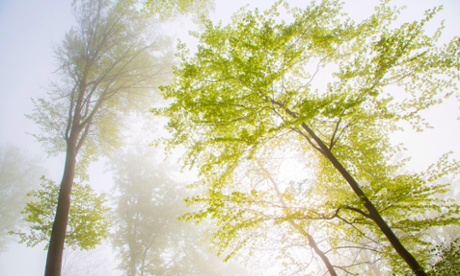
In the broad spaces between the woods at Dunham about noon a warm sun drew the young grasses upright as small, lifted spears, and made a transparency of the opening birch and sycamore leaves. The sycamore is perhaps the more forward; you could almost fancy that its foliage was broadening out before your eyes. The beeches are green; the buds have burst from their ruddy spikes, which now hold them at the base as with a small red tie. The upper part of the wood itself was enveloped but not hidden by a shimmering haze through which the sky appeared of a greyish blue. In the height the plumage of the birds was dimmed; there was no light of colour on a pair of woodpigeons that flew away across to a seeded field. Further south, however, out of the mist, half a dozen homers soaring about in circles came often into view like great flakes chased in various directions, or like small bunches of the white bloom that is covering the fruit trees. Linnets and finches were singing, but not loudly; clearer and at first stranger than all came the cuckoo long “cuck,” then a lower “oo,” repeated seven times while the ear refused to take in any other sound; then quiet for a space; five minutes later on the other side of the wood in a threefold note “Cuck-oo-oo,” the last very faint indeed. Some miles away along the course of the Mersey, above Northenden, hours later swallows were whirling up and down; one saw them first here three days ago.