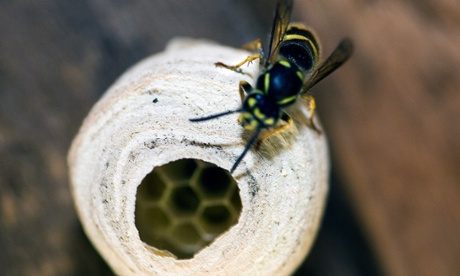
I have often wondered how operations for the year were started by those wasps and bees that hibernate solitarily and have the heavy duty of building the nucleus of the nest and rearing its first inmates alone. No doubt it is all written down and explained with diagrams in books by the score; but for me those books have remained on shelves and in libraries. However, in the course of digging the other afternoon, I turned up a quaint little structure in thin, rough, grey-green paper, somewhat resembling in shape one of those Medusa jellyfish which swimmers avoid, or still more like a Japanese lantern upside down and with a small round hole where the candle should have been. Out of this hole there shortly flew, in a somewhat menacing frame of mind, a large queen wasp, but luckily she did not associate me with this unfortunate disturbance of her privacy. She is still looking for her nest in the place where I threw it up so many hours ago; the nest itself is on my table.
Peering through the hole in the top I can make out the ends of a score or so of hexagonal cells, of which about half a dozen are closed at the top, and no doubt contain wasps in the pupa state. In about half a dozen more the bland white tips of fat, well-developed larvae are to be seen. The rest seem to be empty, but they are at the edges of the ring, and to examine them I should be obliged to tear open my treasure. It is something curious and marvellous, and also rather horrible; something to be exhibited and shuddered at. It is a home, and yet it inspires none of the feelings which rise in us irresistibly at the sight of the nest and eggs of a bird.