
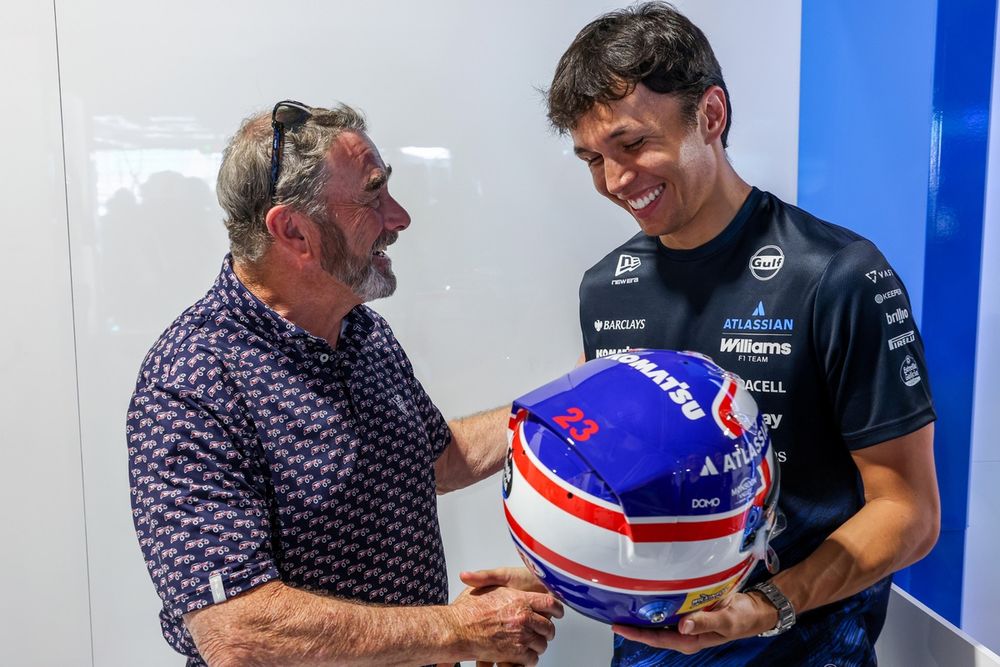
At this year’s Hungarian Grand Prix, Alex Albon became the first driver to complete 100 races with Williams, a few rounds after eclipsing Nigel Mansell as the team’s most ‘capped’ driver. It’s an interesting stat, one that perhaps denotes F1’s current race inflation and former attitude to drivers. Yet this also illustrates how important Albon has become within Williams’s modern-day hierarchy.
In the days of Sir Frank Williams and Patrick Head, drivers were disposable; why pay more for a driver when that money could be spent on engineering? It explains why Sir Frank was reluctant to hand Mansell the lucrative contract he desired on winning the 1992 championship, or why Damon Hill was let go for 1997. Williams had an idea of what a driver was worth and wouldn’t budge if the demands exceeded that value.
That’s not to say that Williams and Head didn’t value drivers at all but, today, Williams under James Vowles views its drivers as an integral part of its structure. It’s wholly unsurprising that Vowles wants to maintain continuity in his line-up for 2027.
The car arrived late, missing the Barcelona shakedown. It was too heavy. Downforce was not as forthcoming as hoped
For his part, Albon has found a home at Williams. Into his fifth season with the team, the Anglo-Thai ace has settled into his role as an elder statesman, although hasn’t had the chance to build on last year’s step up in performance. For all Williams’s commitments to starting 2026 on the best foot possible, sacrificing development of a speedy, well-engineered car in 2025 to focus on the next one, it hasn’t been plain sailing.
This year’s FW48, dressed in an attractive azure shade of blue, hasn’t delivered on those expectations. The car arrived late, missing the Barcelona shakedown. It was too heavy. Downforce was not as forthcoming as hoped. It’s forced the team to reassess and plant its hopes on the ‘B-spec’ car arriving at the Azerbaijan GP in September.
“It feels like a home,” reflects Albon. “But at the same point as any home, everyone who’s been at Williams for longer than three or four years, there’s a sense of responsibility and desire to bring this team to where we want it to be. And so, yes, it’s a home, but it makes sometimes even the start of this year even more frustrating because you feel partly responsible and also, just as anything, this team means a lot to me and I want to see it in a better position than it is.”

The bottom line is that points have been in scarce supply over 2026, exacerbated by the step in performance that the likes of Alpine have taken. On the occasions where it has been possible to get them, Williams has generally taken advantage; on other occasions, the team has been effectively running an in-season test programme. After a clash with Ollie Bearman at Silverstone, Albon reverted to putting mileage on its updated front wing – resulting in six visits to the pitlane amid a hastily revised run plan, while everyone else raced around him.
Williams’s performances over 2026 have been something of a bitter pill for its drivers to swallow, particularly with its best-of-the-rest form last year. Although the weight has been a concern and has contributed to a general pace disadvantage, Albon explains that most of the difficulties at the reins of his FW48 stem from the overall lack of downforce.
Add to that some of the bottlenecks that the team has faced with its internal processes in its efforts to produce a more advanced car, and it’s no wonder that Albon feels that the team is playing “catch-up”.
“Everything is a compromise at the moment. We’re yet to go to a race track and be like, we feel good in low speed, medium speed and high speed” Alex Albon
“Generally speaking, when you’re down on downforce, you bring a lot of balance issues with it,” he says. “Balance generally becomes more extreme with the more balance limitations that you have in the car. Funnily enough, the car is still kind of similar to last year, it’s just that we’re so far down on downforce.
“With the regulation changes and also to our rivals, we’re going race to race finding a compromise. Everything is a compromise at the moment. We’re yet to go to a race track and be like, we feel good in low speed, medium speed and high speed.”
Among those issues is the tendency to ‘three-wheel’ in the corners. Carlos Sainz has spoken previously about the car’s difficulties in handling “combined” corners, something that was partially a carry-over from last year. Albon says that this tends to occur most at low speed – or “anywhere where you’re combining the brake and the steering wheel generally means it wants to three-wheel”.
This tends to compound; at reduced downforce levels, the car relies more on its mechanical grip. When turning through a right-hand corner, for example, the right-rear wheel jacks up as the car rolls in the opposite direction, giving the sensation of less grip. The car then wants to slide to the outside, which makes it very difficult to drive the corner optimally.
It hasn’t been easy, but Williams and its drivers have had to take the disappointment on board and press on with finding solutions. The updates for Baku in late September will be a marker of progress here.
Albon says that the team’s approach, in the face of an inauspicious start to the year, encapsulates the progress that he’s seen since joining Williams in 2022. At the time, the team had been under Dorilton Capital’s ownership for over a year, but it seemed that initial investment was scattergun at best. It lacked the figurehead with recent F1 experience to lead the team; Jost Capito has been incredibly successful in motorsport, but much of his then-contemporary experience was based in rallying. It needed Vowles to come in and pinpoint what was missing versus his former employers at Mercedes.
“This year, we are obviously further back than we want to be, but you feel like this is not right. There’s this, ‘What are we going to do now to get back to at least where we were last year?’” Alex Albon
A couple of recent additions, Dan Milner and Claire Simpson, have been brought over from Brackley. Furthermore, Williams has lured Piers Thynne from McLaren – which should have a significant impact on improving the team’s manufacturing processes.
“I think the biggest thing is a culture shift, a willingness, a desire to be here,” Albon says of his time at the team. “I’ll give you an example in 2022 [compared] to now. In terms of performance, we’re not so different, but in 2022, well, we are better this year than we were in 2022.
“But, relatively speaking, in 2022 it felt as if this is just where we are. It’s almost an acceptance of it. This year, we are obviously further back than we want to be, but you feel like this is not right. There’s this, ‘What are we going to do now to get back to at least where we were last year?’ And that kind of desire and that self-confidence from the team is the single biggest difference.”

To a degree, this assessment might mirror Albon’s time at the team. Williams, even in its former state of near-death and extended period at the back of the grid, was an opportunity for Albon to earn an F1 reprieve. His time at Red Bull was at an end. Although his spell at the team started brightly on replacing Pierre Gasly mid-2019, it became increasingly troubled as he struggled to handle a car designed for Max Verstappen’s low-latency driving approach.
Williams may have been viewed as a last-chance saloon then, but Albon has grown with the team as it continues to plot its course back to the front. The hope is that 2026 is all a temporary inconvenience and a learning experience for a more fruitful 2027 season.
Now, a few years into his Williams journey, Albon knows where he wants the team to be. As he puts it, there is no longer that acceptance of its erstwhile status as back-row occupants; there is a raw and real desire to vanquish this year’s ills.
Albon knows where he wants the team to be. As he puts it, there is no longer that acceptance of its erstwhile status as back-row occupants; there is a raw and real desire to vanquish this year’s ills
For Albon, now 30, there’s a feeling that this needs to arrive sooner rather than later. Although the likes of Lewis Hamilton and Fernando Alonso have stayed on the grid until their forties, the cachet of world champion status allows such longevity. Albon, for all that he’s achieved, hasn’t got that on his side.
The ability, however, is there. When this writer first encountered Albon, he was about to embark upon his second season of F2 – albeit somewhat fortuitously, as his DAMS team initially gave him the ride for free on a race-by-race basis as his personal sponsors wavered. Eventually, Albon gathered enough support to stay on for the year, and he found himself in a good-natured three-way fight with George Russell and Lando Norris for the 2018 crown.
The three were evenly matched through the year, Norris later snatching second from Albon in the Abu Dhabi finale when both DAMS drivers – Albon and future Williams team-mate Nicholas Latifi – stalled their Dallara-Mecachromes, which were prone to that.

Since those halcyon days, Norris has won a title with McLaren and Russell is in the thick of this year’s championship battle with Mercedes team-mate Kimi Antonelli. And, although Albon found himself in a top team much faster than his F2 title counterparts, he had to start again when the Red Bull sojourn didn’t work out.
Back then, we ask, did he see the success of Norris and Russell emerging?
“I did, to be honest – I’ve always rated George,” Albon reckons. “I mostly raced Lando less than George, but equally rated Lando. And generally, yes, I think that that was an interesting year, that F2 year, because it was almost like a mini golden wave where you could argue even the drivers that didn’t make it that year into Formula 1, they’ve still gone on to do great things: Antonio Fuoco, Nyck de Vries, etc.
“I think it was a great period of racing. We all pushed each other along and most probably got the most out, more out, of each other by racing each other, which only helped us when we entered Formula 1. I look at that time fondly – and I look at Lando’s performances and George’s performances as a supporter as well in many ways.”
“We all pushed each other along and most probably got the most out, more out, of each other by racing each other, which only helped us when we entered Formula 1” Alex Albon
Their closeness that season, Albon says, gives him the motivation to succeed with Williams and replicate the success of his friends in higher places.
“We were on different career paths in many ways. I probably had my chance at a top team earlier than I was ready for in many ways. I’ve got a different project on my hands now and that’s bringing this team forward. Not that I don’t relish it. I don’t look at those two and I’m not jealous of them. We’re on our own journey and hopefully, in the not-too-distant future, we can race each other again.”
And it’d be just like old times if they did, just as long as it’s at the front of the field.
This article is one of many in the monthly Autosport magazine. For more premium content, take a look at the Summer 2026 issue and subscribe today.