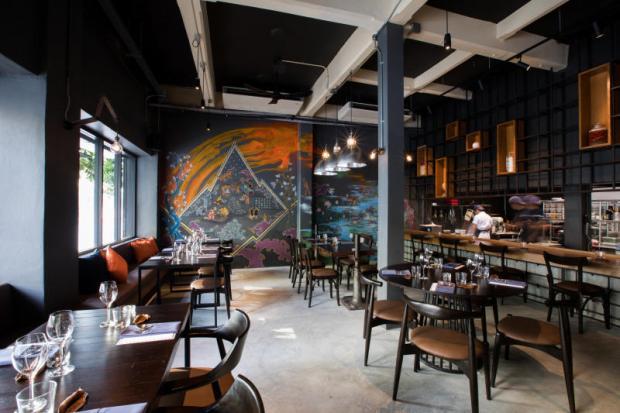
A familiar pok-pok sound greets me as I enter the newly-renovated Charoen Krung favourite, 80/20. This is intentional, I later learn, intended to remind diners that 80/20 is a Thai kitchen serving Thai cuisine. The expanded space has a wall with murals by local artist Luke Satoru and Khun Rose, the mother of one of 80/20's chefs.
Husband-and-wife team Napol "Joe" Jantraget and Saki Hoshino have kept themselves busy in the four months since 80/20 underwent its facelift and it shows in their nine-course tasting menu (3,000++ per person with optional wine pairing of 1,400++ per person). The chefs' travels around Thailand, Taiwan, Malaysia and Japan have culminated in a reinterpretation of classics on the menu.
With a fresh approach -- 80% local and 20% regional -- the new menu starts off with "snacks", the first being chilli roulette. If you like living on the edge, this dish is for you. A basket of chillies is brought to your table (Yes, you read that right.). Among the chillies of all colours lurk two special ones: luk chup in disguise. This is where the roulette comes into play. Pick one and decide your fate. I got lucky and picked a spicy one first, a mix of mung bean and rendang curry paste, inspired by Saki and Joe's time in Malaysia. "We wanted to create memories for the diners of being here. What better way than to start off a fun dining experience with a little game?" chef Saki said.
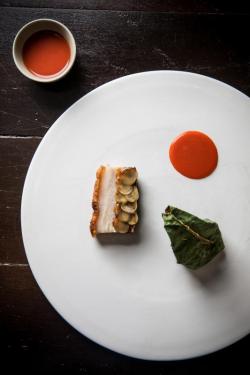
Trang barbecued pork. 80/20 Bangkok
The spicy luk chup is paired with a whey yoghurt drink, inspired by the banana leaf curries of Malaysia where buttermilk is served with the meal. Kombucha, fermented in-house, is paired with the sweet luk chup. "80/20 has a fermentation room. Rose apple works the best with this dish," said chef Joe. My favourite of the two was the spicy chilli, which awakens the mouth and gets it ready for what's to come. A delicious trick of a first snack.
Anyone who knows chef Joe, knows he is a meat man. So seeing tartare on the menu comes as no surprise. What is a surprise is the choice of meat. Goat is rarely found in Thai fine dining. The meat is dry-aged for two days and smoked to get rid of its pungent smell. It is then seasoned with uncooked curry, masala aioli and fish sauce caramel. This is paired with a fermented rice coconut crepe and eaten like a taco.
"Because rice is so abundant in Thailand, I've always wanted to transform it in different ways," says chef Joe. Hence the use of the fermented rice crepe-like taco. 80/20 is also working on their own sourdough, which should be ready next year.
Next came a bouquet of seasonal herbs and greens, a very local dish akin to nam phrik plaa thu. The dip is made with coconut and sato leaf relish, topped with shredded cured king mackerel. This was followed by an homage to Charoen Krung institution the Curry Puff. Banana blossoms are paired with fermented black banana and garlic sauce for added sweetness; the perfect accompaniment to the spicy filling of the curry puff.
Hidden from view to the casual diner is the tiger prawn tank under the kitchen counter. This forms the basis of the Tiger Prawn Crudo. The inspiration came from chef Joe's visit to an omakase restaurant in Japan where they processed the prawn at the last minute. He found the texture so amazing that he decided to replicate the dish. Since oranges are in season, 80/20 uses five varieties, including som saa, to create a nam chim seafood of sorts for its winter citrus vinaigrette. And boy, it does work. Chef Joe's love for the South is apparent in the plating: prawn shell and head made to look like a flower on the sand. A bit of prawn oil soaks up the sauce. Fresh, light and an utter delight.
"When I think about crab, I think about black pepper," says chef Joe.
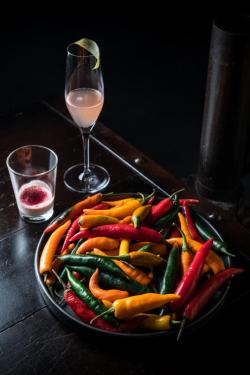
Chilli roulette. 80/20 Bangkok
This is highlighted in the lightly steamed crab. Sichuan peppercorns are made into an oil, for a peppery dashi-like broth. The slow poached winter melon, upon which the crab is placed, is seasoned with white okra seeds blended with okra skin and made into an emulsion. It's a dish to warm and comfort the soul.
The menu had smoked marble goby as my next dish, but I was instead served red tail since it was fresher at the market that morning. The dish comes on a beautiful orange "scaled" plate and the kale on the fish is reminiscent of the jagged rocks under the sea where fish hide. Chef Joe says he wanted to include elements of Thai art in the plating, reflecting the concepts of "lamiad lamai" and "lamoon lamai", which roughly translates as "the little details" or "attention to detail". The kale comes in the form of picked stems and crisps. Chef Joe has been carefully documenting what's in season during the years 80/20 has been open, and this informs his thought process when creating a menu; the menu comes after the ingredients, not before.
Grilled oysters from Surat Thani was the next course, served with a seepweed butter, pickled blood cockles, spicy black garlic glaze, jicama and cauliflower. The pickled blood cockles are an ode to chef Joe's father, who comes from Ratchaburi, which is known for its hoy dong (pickled shellfish). The black garlic glaze gives the dish umami and the jicama gives it crunch.
"A dream of Trang BBQ pork" is inspired by chef Joe's fascination with Trang barbecued pork since childhood. "However, when I finally tasted it last year, I was disappointed," he explained. "It was sweet and fatty -- not what I was expecting. So, I've made my own version of it." Barbecue pork in the South is usually eaten with dim sum and chilli sauce, and served with ba chang (steamed sticky rice) infused with seasonal mushrooms and a fermented chilli sauce. To wash it down, 80/20 gives you a taste of their in-house sato, made from southern khao sok (black sticky rice), fermented for two months with anka or red koji to get the colour. Pro tip: save the crackling for the last bit and wash it down with the sato.
The final main shows what 80/20 can do with a whole duck. After being butchered in-house, it is brined, smoked and finished off in their new grill, which is on prominent display in the open kitchen. Smoked duck breast and duck sausages made with offal (which reminded me of sai oua) are served with a rice salad, preserved vegetables and duck jus infused with long pepper curry. The salad makes use of khao hom nin (black jasmine rice), which has a sweet finish. A fitting lead into the sweeter part of the menu.
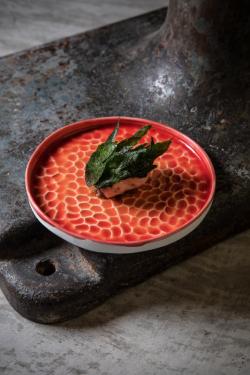
Smoked red tail, fish mousse, fermented coconut cream, pickled kale stems, kale crisp, fried betel leaves. 80/20 Bangkok
Palate cleansers need to be refreshing and pastry chef Saki delivers. Her guava and roselle is based simply on the fact that roselle is in season and she pairs it with guava so as to "trick the mind". A job well done.
"I wanted the desserts to be more Thai. When we were researching during our months of renovation, we went to different places and I tasted Thai desserts and learnt how to make them. I wanted to showcase those skills; hence the lack of Japanese components this time around," she said.
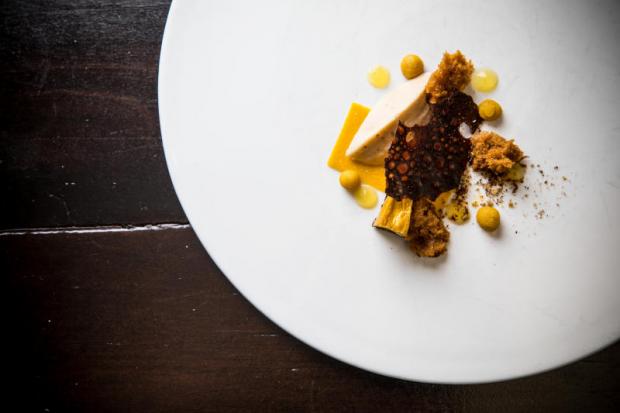
Duck egg custard, roasted pumpkin, compressed pumpkin, pumpkin kombucha, ganache and praline make up the delicious fak thong sang-ka-ya, a variation on the celebrated dessert from Isan. The chocolate log uses two types of chocolate, both from Malaysia. Served with chocolate powder, jujube, salted egg ice cream (salted in-house) and aerated chocolate, the dessert is adorned with wild lantana flowers and is bitter, sweet, salty and intense all at the same time. Yum!
The menu is bolder and more refined than any of 80/20's previous efforts, its chefs cooking with more precision. "We want to give diners a complete experience," chef Joe explains. "It is the same direction though. We have to ask ourselves what it is to be a Thai chef in 2019; are we those chefs who preserve only authenticity and look back, or are we chefs besides penang or green curry? What else can we bring to the table? We cook Thai food by understanding the fundamentals of Thai flavours. We don't follow recipes, we create them. We use different techniques to discover new things about Thai ingredients. We know who we are -- a re-interpenetration of Thai cuisine. Rethink, re-approach, rediscover and re-envision is our approach."