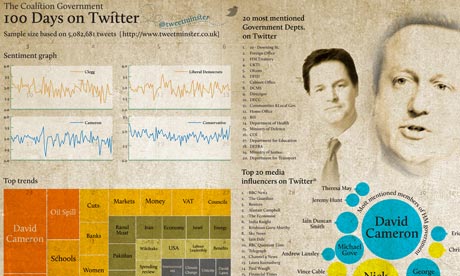
To mark the coalition's first 100 days tomorrow, Tweetminster – which organises and displays political Twitter messages – has analysed five million tweets about the new government.
Its most interesting conclusion largely backs up what conventional opinion polls have found, and will add to Nick Clegg's worries as he attempts to recapture some of his pre-election popularity while David Cameron is on holiday:
Since the election, sentiment around the Conservatives has remained stable, while for David Cameron it has slightly risen. Sentiment around the Liberal Democrats, and for Nick Clegg especially, has dropped.
Cameron was the most mentioned member of the government in the tweets, with Clegg second, while schools, the BP oil spill, Afghanistan, Iraq, jobs, cuts and the prime minister's "big society" plans were some of the most popular topics.
NHS reform, immigration, crime, climate change and electoral reform "had a smaller volume of mentions than one would possibly expect", a spokesperson for Tweetminster said, ascribing this to "the fact that media focus on these issues has been concentrated around announcements and news stories and not sustained over time", although perhaps the results simply show bias towards certain topics among users of Twitter. A spreadsheet of the topics analysed can be viewed here.
The research also seemed to show that reports of the death of the mainstream media have been somewhat exaggerated. Seventy-three per cent of the political links shared on Twitter were from traditional news sources. The top "media influencer" ("calculated by looking at a ratio between activity, mentions and retweets") was the BBC, followed by a slightly eclectic list of the Guardian, Reuters, Alastair Campbell and the Economist.
Apart from 10 Downing Street, the Foreign Office was the most mentioned and retweeted government department – despite that slightly sinister first message it always sends its followers: "The Foreign Office is now following you". If MI5 or MI6 were on Twitter, they might have the same problem.
More details of the Tweetminster research can be found here.