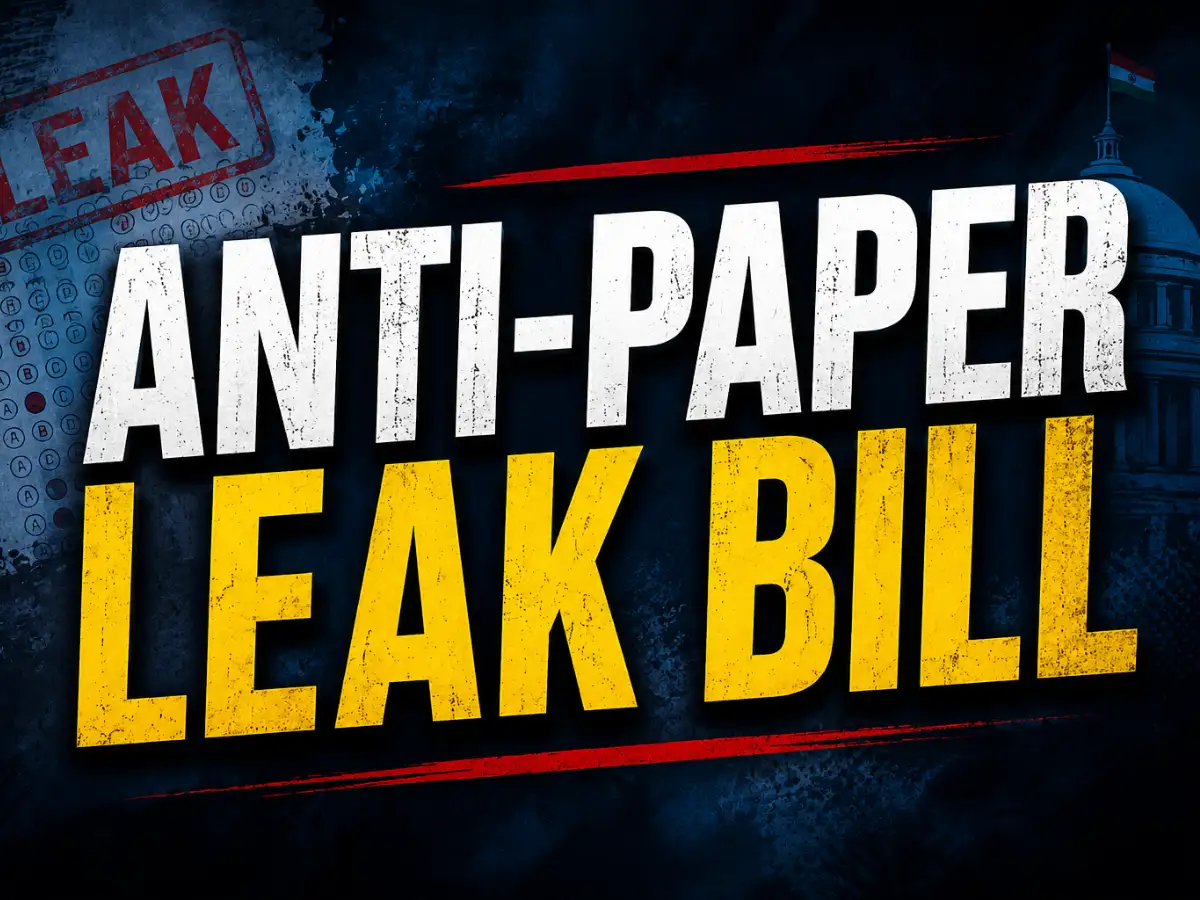
The Union Cabinet on Friday approved amendments to the Prevention of Paper Leak law, proposing tougher punishment for those involved in examination paper leaks as the Centre moves to strengthen the integrity of competitive examinations.
According to sources quoted by TOI, the proposed amendments provide for a maximum prison term of 10 years and a fine of up to Rs 10 crore for those found guilty of leaking examination papers.
The proposed legislation also seeks to raise the minimum imprisonment for those convicted in paper leak cases from the existing three years to five years.
The Cabinet's decision comes amid nationwide protests over irregularities in the NEET examination and increasing demands for stronger legal safeguards to prevent paper leaks.
What are the proposed changes to the Prevention of Paper Leak law?
As per a TOI report, the proposed amendments introduce significantly harsher penalties for those involved in examination paper leaks.
If passed by Parliament, the law will:
- Increase the maximum punishment to 10 years' imprisonment
- Raise the maximum fine to Rs 10 crore
- Increase the minimum jail term from three years to five years
The move also builds on the Public Examinations (Prevention of Unfair Means) Act, 2024, which was brought in following earlier paper leak controversies.
What is the Public Examinations (Prevention of Unfair Means) Act, 2024?
The Centre had already enacted the Public Examinations (Prevention of Unfair Means) Act, 2024 after facing widespread criticism over examination paper leaks.
President Droupadi Murmu gave her assent to the legislation in February 2024, while the bill was notified in June 2024 amid the controversy surrounding the alleged NEET and UGC-NET paper leaks.
Before the Act came into force, there was no dedicated central legislation specifically dealing with unfair means and organised offences committed during public examinations conducted by the Union government and its agencies.
Which examinations are covered under the 2024 law?
The Act applies to several major public examinations conducted by central agencies, including:
- Union Public Service Commission (UPSC)
- Staff Selection Commission (SSC)
- National Testing Agency (NTA)
- Railway recruitment examinations
- Banking recruitment examinations
- Other examinations conducted by the Central Government and its agencies
What punishments does the 2024 law provide?
The existing law introduced strict penalties for examination-related offences.
It provides:
- A minimum prison term of three years, extendable to five years, for offences involving unfair means.
- Five to 10 years' imprisonment and a minimum fine of Rs 1 crore for organised examination fraud.
The newly approved draft Bill is expected to further strengthen these provisions by increasing the penalties for paper leak offences.
What other provisions are included in the law?
Apart from prescribing punishment, the Act also lays down measures to improve the security and transparency of public examinations.
These include:
- Engagement of other government agencies by examination authorities where required.
- Preparation of norms, standards and operational guidelines.
- Mandatory reporting of incidents involving unfair means or examination-related offences.
Security protocols covering the entire examination process, including:
- Pre-audit of examination centres.
- Candidate check-in and biometric verification.
- Security screening.
- Seat allocation.
- Question paper setting and secure loading.
- Examination invigilation.
- Post-examination procedures.
- Guidelines for providing scribes to eligible candidates.
Which acts are considered illegal?
The 2024 law identifies 15 prohibited acts connected to public examinations.
These include:
- Leaking question papers.
- Tampering with OMR answer sheets.
- Creating fake examination websites.
- Issuing fake admit cards.
Other organised activities intended to compromise the integrity of public examinations.
Government to introduce anti-paper leak Bill in Parliament soon
Parliamentary Affairs Minister Kiren Rijiju said the government would introduce the legislation in Parliament shortly, adding that Prime Minister Narendra Modi had instructed that there should be no delay in bringing the Bill.
"We are preparing to present the bill, but after you receive the briefing on our Cabinet decision, we will inform you about our timing. The Prime Minister has said that there should be no delay in the bill we are bringing regarding students," Rijiju said.
He added that the proposed legislation reflected the government's commitment to students.
"The country also wants what the Prime Minister has said, so it would not be right to resort to any tactics to obstruct it," he said.
Taking a swipe at the Congress, Rijiju said the Opposition should not create obstacles to discussions on student-related issues.
"Congress will fall into this if they continue to disrupt the parliamentary proceedings. We are taking important steps for the future of the students. If the Congress party continues to create all kinds of hurdles to prevent parliamentary discussion, then they will have to face the brunt of the youth of this nation and, in fact, the entire nation," he added.
Rijiju accuses Opposition of blocking NEET paper leak debate
The minister also accused the Opposition of preventing a discussion on the NEET paper leak issue in Parliament despite repeated requests from the government.
"For five days, we were unable to discuss the NEET paper leak. So, we appealed today as well. Our minister will brief us on the important Cabinet decision. Rahul Gandhi was in the House today, so we asked that the debate begin immediately," Rijiju said.
He claimed the Congress was unwilling to debate the issue despite demands from protest leaders.
"Now, the Congress party has shown that it's not interested in debate. Those who were protesting, and Sonam Wangchuk, the most prominent figure among the protesters, also broke his hunger strike and said that the discussion should take place now," he added.
Rijiju said the issue should not be politicised and called for long-term reforms.
"I don't think there's any benefit in politicising this. We should focus on how to take concrete steps and the future of the students," he said.
Centre urges Parliament to focus on examination reforms
Appealing to Opposition parties to allow Parliament to function, Rijiju said ensuring a robust examination system should remain the top priority.
"The future of the students and how we can ensure a proper and very strong system in place for the future of the students; this has to be our priority," he said.
He argued that disruptions in Parliament would not help resolve the issue.
"By disrupting the parliamentary procedures and the House, it will not yield any result," he added.
The minister also urged Opposition leaders to participate in discussions instead of stalling proceedings.
"I would like to request once again Rahul Gandhi and all the opposition members that better sense should prevail. You cannot indefinitely create trouble in Parliament to prevent discussion. It is wasting the time of all the members," Rijiju said.
He further added: "It is very critical to let Parliament function when all matters are to be discussed. Why the Congress Party and some of their allies are disturbing the parliamentary proceedings, I do not understand. It would be nice if they could make their demands during their intervention."
Cabinet decision follows talks with protesting students
The Cabinet's decision came a day after Union ministers held talks with representatives of the Cockroach Janata Party (CJP), which has been leading protests over the NEET paper leak controversy.
Following the meeting, CJP leaders said the Centre had sought time until Saturday afternoon to decide on their demand for Education Minister Dharmendra Pradhan's resignation.
They also claimed the government had given in-principle approval to two other demands, including compensation for the families of NEET aspirants who died by suicide and the withdrawal of FIRs and legal cases filed against protesting students.
Sonam Wangchuk ended hunger strike after Centre's assurance
The Centre initiated dialogue with protest leaders after social activist Sonam Wangchuk ended his 26-day hunger strike following written assurances from the government on reforms to the competitive examination system.
Ahead of the Cabinet meeting, Prime Minister Narendra Modi had announced that the government would consider a draft Bill providing for fast-track courts and stricter punishment for paper leak offenders.
Announcing the move, the Prime Minister had said: "More strict actions against paper leaks to come in tomorrow's Cabinet!"
Inputs from TOI