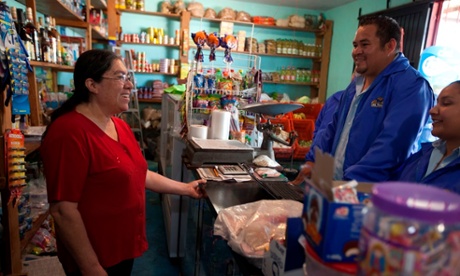
70% of the population in Latin America and the Caribbean – more than 400 million people – live on less than $10 (£6.44) a day. Even though their income is low, this segment of the population still demands goods and services, and represents a market of $760bn per year. Hundreds of pioneering companies see opportunities in this market to do profitable business while improving the quality of life of low-income people. But where should they start?
There aren’t one-size-fits-all recipes for successfully serving those at the base of the pyramid (BoP). However, there are some basic principles that can help companies and entrepreneurs to understand the financial and social returns at the BoP. You can learn more during the IDB’s BASE III Forum from 29 June to 1 July, 2015 at the Centro Banamex in Mexico City.
Don’t start from scratch. Leverage existing capabilities
Aligning business opportunities with the company’s existing capabilities and expectations can increase (pdf) the likelihood of success when entering a BoP market. It not only allows companies to innovate and create business models that target low-income clients’ real needs, but also generates the dynamics necessary to deal with the complexities of the BoP segment.
Creativity against risk
Serving a low-income market segment requires entrepreneurial spirit and managerial willingness to innovate. Since innovating is equivalent to making mistakes, entering BOP markets demands patience. While it is impossible to eliminate risk, it can be minimised by sharing, or outsourcing it, or establishing alliances with other organisations that have the know-how or intelligence that the company lacks.
Alliances, alliances and more alliances
The best approach for meeting and overcoming obstacles to implementing business models at the BoP is establishing strategic and complimentary partnerships. They can help companies to overcome challenges related to distribution, access in remote areas, customer financing, the workforce, technical assistance and local brand recognition to name a few.
More observation, less assumptions
It can be counterproductive to make assumptions about the needs and preferences of people at the BoP. This segment is like any other commercial target. Behavioural economics and ethnography are useful tools for understanding behaviours and decision-making patterns in BoP markets. No product or service is going to be successful with low-income consumers in the long term unless companies understand what it is like to live on less than $10 (£6.46) a day.
The economic return must be tangible
Unless they perceive that goods or services can provide tangible economic benefits, BoP families – and particularly those family members who make the spending decisions – will not purchase them. Therefore, it is important to carefully consider how the product or service is offered and how the benefits are being promoted.
It’s not just about low prices
For low-income communities, a cheap product or service may not be enough of an incentive to make a purchase. It is imperative that they feel they are getting the best quality for their money. Building a relationship of trust with consumers and minimising the perception of risk is crucial.
The BoP market is not a monolithic block
Not all of the more than 400 million people at the BoP have the same income. Within this base, the segment of those earning between $4 and $10 (£2.50 - £6.50) is quite large. Family income and the budget available for discretionary expenses determine how low-income consumers prioritise their spending and give hints on the factors (ie risk, price, a simple social aspiration, etc.) that influence their purchasing decisions.
The BoP is not static
Between 2000 and 2010, significant economic growth in Latin America and the Caribbean benefited BoP people. Millions overcame poverty and the segment earning between $4 and $10 grew considerably. As a result, millions of low-income people are now beginning to prioritise their spending on education and health. While this segment is not always predictable, it has transformed in the last decade and is likely to continue evolving and presenting new challenges to those who serve it.
The power of connectivity
Today, more than 90% of the BoP people in Latin America own a mobile phone. On average, they use it seven times a day. Most of them are standard phones, revealing the huge potential market for low-cost smartphones. The field of action is very broad, and developers could achieve much greater market penetration if broadband was enhanced in Latin American countries. The combination of broadband access and smartphones or tablets could trigger hundreds of applications related to healthcare, financial services and agriculture.
It’s not a matter of margin
C.K. Prahalad, father of the term base of the pyramid, wrote that the BoP is not a “market that allows for the traditional pursuit of margins; instead, profits are driven by volume and capital efficiency. Margins are likely to be low, but unit sales can be extremely high.” It is critical that BoP business models have massive impact or have the potential to be scalable.
Lina Salazar Ortegón works on corporate engagement & communications at the Inter-American Development Bank’ Opportunities for the Majority sector.
Launched at the United Nations, the Business Call to Action (BCtA) is a global alliance hosted by the United Nations Development Programme. BCtA is supporting the IDB’s BASE III Forum; register here to attend.