1. Waste less food
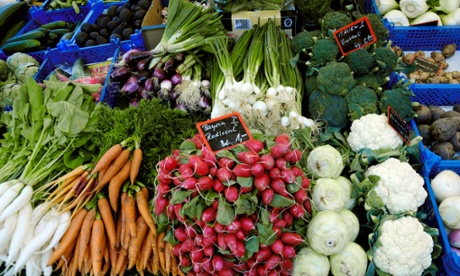
We’re getting better: avoidable household food waste dropped 21% between 2007 and 2012 in the UK according to the Waste & Resources Action Programme (WRAP). The average UK household still throws away the equivalent of six meals every week, but public concern with food waste has grown to be a useful entry point for talking about sustainability more generally. “It’s a lens to look at other food sustainability issues, and an opportunity to start joining things up,” said Mark Barthel, special adviser at WRAP.
2. Look beyond waste
There’s no silver bullet for achieving a sustainable food system. Diets, health, land use, labour conditions, energy, water, trade rules and farmer livelihoods all play a part. Reducing food waste is an easy win – too easy, perhaps.
“If you’re a company keen to improve your image, food waste can be a tokenistic way of doing that without looking at other sustainability issues,” said Tristram Stuart, founder of Feedback.
3. Meat matters
The resources embedded in meat dwarf other foods. Beef is particularly resource-intensive, with one recent study estimating that it requires 28 times more land to produce than pork or chicken. Compared to plant staples such as potatoes, wheat, and rice, the impact of beef per calorie is even greater, requiring 160 times more land and producing 11 times more greenhouse gases. But global demand for meat is growing, and taxing burgers isn’t a vote winner. Can we change our diets?
4. Reduce post-harvest losses
The FAO estimates that as much as 50% of harvests are lost before reaching the market usually because of poor harvesting techniques and a lack of suitable storage. This contributes to high food prices and means the inputs are wasted too. “Around 95% of donor funding for food security is focused on production, but encouragingly we’re seeing more investment in reducing post-harvest losses now,” said Jim Stephenson, sustainability and climate change manager at PwC.
5. Revisit crop specifications
Crops are lost in developed countries too, not because of a lack of infrastructure but because so much is rejected for cosmetic reasons. WRAP has been working with retailers and farmers to address this and found that some specifications – such as the permitted circumference of a potato – were arbitrarily set decades ago. Re-assessing those specifications, and finding secondary markets for outgraded produce, can make farmers’ livelihoods more sustainable.
6. Strengthen governance
Food retailers are powerful. They can drive global food sustainability, but have also long had a reputation for some unfair practices, such as cancelling orders at the last minute. Last year, the UK appointed Christine Tacon as its first Groceries Code Adjudicator to oversee the Groceries Supply Code of Practice, which was introduced in 2010 to address such practices. Strong governance can support a sustainable food system in lots of other ways too. “It includes planning laws, trade rules, standards, land grabs, as well as the buying practices of supermarkets,” said Vicki Hird, senior campaigner at Friends of the Earth.
7. Shorten supply chains
Food supply chains have become global and complex over the past few decades. Producers at the end of those chains can find themselves subjected to unscrupulous buying practices or poor conditions, in violation of standards set by governments or private sector players higher up the chain. That needs to change, and it already is, with retailers recognising that shorter supply chains with direct engagement are more transparent. “Risk moves back up the chain, but that’s part of doing business properly,” said Tim Smith, group quality director at Tesco.
8. Include restaurants and catering
The UK public sector spends around £2bn on food and catering services a year, and the eating-out market is expected to reach £52bn in value by 2017. Consumers increasingly want sustainability on their nights out, but restaurants need to catch up, according to Mark Linehan, managing director of the Sustainable Restaurants Association. “In our consumer survey last year, food waste and health and nutrition were the top two issues, and that came out of nowhere. But it’s not a sexy thing for waiters to be promoting.”
9. Focus on emerging middle classes
Asia’s middle class has been forecast to triple to 1.7 billion by 2020. In the past three decades, the number of obese people in the developing world has tripled with twice as many now living in poor countries as in rich ones. Rapidly changing consumption patterns are creating new environmental and health pressures in countries such as China, Brazil and India, and any effort to drive global sustainability in the food system must take these trends into account.
10. Allow cultural change to set in
The change in attitudes to wasting food may be partly to do with a general austerity trend. But can it trigger more widespread efforts to make our food system more sustainable? Some say a cultural shift is happening. “In other areas, such as transport, the connection young people have with their cars is diminishing,” said Trewin Restorick of Hubbub. “The financial crisis has shifted consumers’ psyche, and that’s a massive opportunity for wider sustainability issues. Gradually, you do shift societies.”
Read more like this:
- How much food does the UK waste? - quiz
- From vegan beef to fishless filets: meat substitutes are on the rise
-
Advertisement feature: Five ways to cut food waste and save money
This in focus series is funded by Tesco. Content is editorially independent except for pieces labelled advertisement feature. Find out more here.
Join the community of sustainability professionals and experts. Become a GSB member to get more stories like this direct to your inbox