The unprecedented 10-day Golden Week holiday was not problem-free, with service disruptions occurring at some online banks, municipal governments and bullet trains, though there were no major disturbances directly linked to people's lives.
The aftermath of the surge in visitors during the long holiday was evident at shrines with a connection to the new era name on Tuesday, the first workday in the Reiwa era.
Can't log in
Users of Rakuten Bank's online banking service were unable to log in to their accounts from smartphones and personal computers from about 12:30 p.m. on Tuesday. Transactions could not be processed due to a system failure. Service was mostly restored by 11:15 p.m. that day, a representative of the Tokyo-based bank said.
Rakuten Bank allowed bank transfers to be performed online throughout the 10-day holiday and experienced no problems, the company said. The problem may have occurred when a large number of users tried to access their accounts after the holiday. The bank said it is investigating the matter.
Users of Tokyo-based Japan Post Bank Co.'s smartphone app found it difficult to view their balances starting around 9 a.m. Tuesday. The overlapping of the beginning of the month with the end of the holiday led to an increase in the number of users checking their balances, which is thought to have caused the problem.
For about 30 minutes starting just after 7:30 p.m. Tuesday, customers were unable to use their credit cards at some of the supermarkets run by Aeon Co. Problems with the charge function of Aeon's electronic money card WAON were also reported. The company is investigating what caused the problems and how extensive they were.
Some municipalities also experienced service failures. A mistake when updating a program meant that all 16 of the Nagoya city government's ward offices were temporarily unable to process National Health Insurance applications and other procedures.
The cause of the problem was that a program that converts data from the Western calendar had set the year as "Heisei" until Dec. 31, 2018. The problem was fixed by Tuesday afternoon, but about 240 documents could not be issued and will be sent by mail at a later date.
Records on land, air
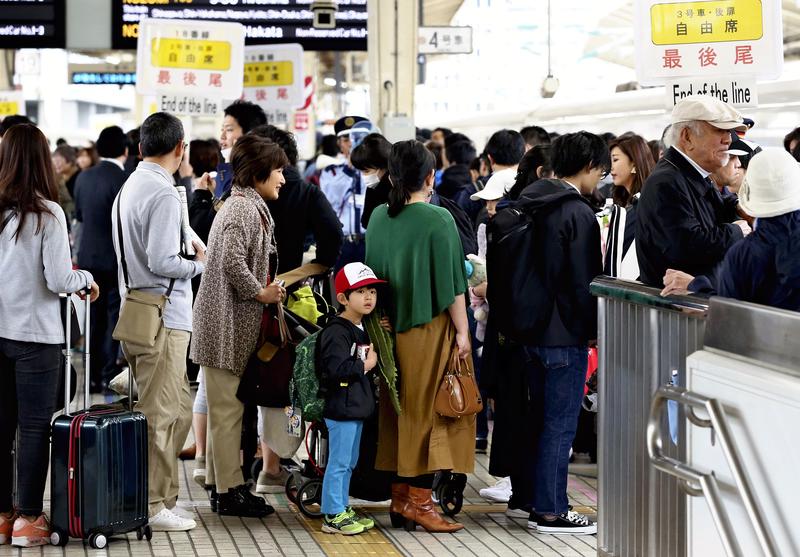
The six Japan Railways companies reported a 19 percent increase in passengers on the main 46 Shinkansen bullet train and limited express routes from April 26 to May 6, compared to the previous year. The 15.17 million riders was the largest figure since 2001, from which records are available. "The lack of workdays during the holiday period led to more people taking trips," a JR official said.
A problem at a substation on the Joetsu Shinkansen line on April 28, the peak of when people were traveling to visit their families, led to delays of about 3 hours 40 minutes, affecting more than 40,000 people.
In the air, domestic routes had occupancy rates exceeding 80 percent. All Nippon Airways and Japan Airlines reported their highest occupancy rates of the last 10 years.
On the road, traffic levels on the 40 major expressway sections nationwide were up 17 percent from the previous year, with more than 50,100 vehicles per day on average. There were 51 traffic jams of at least 30 kilometers long, double the number from last year and the highest number for Golden Week figures since 2006.
Packed shrines
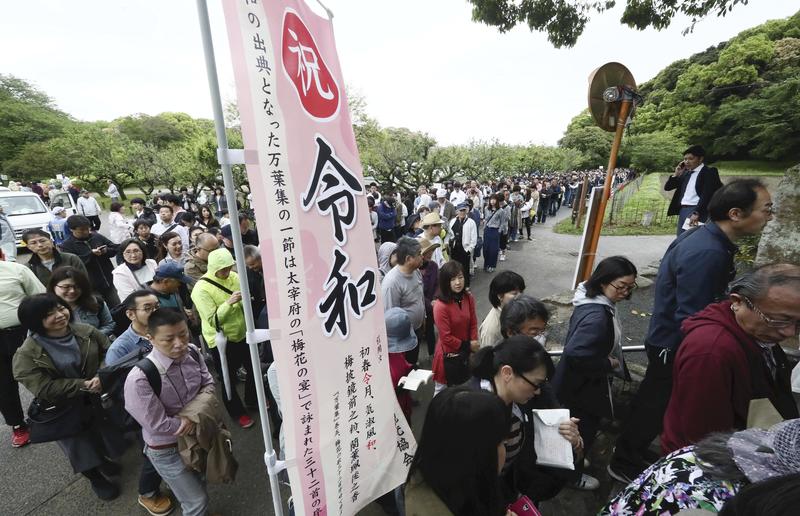
Shrines with connections to the Imperial family or the new era name were popular destinations during the holiday period. The possible remains of what is thought to be the home of Otomo no Tabito, who wrote the introduction to "Umenohana no Uta 32 Shu" in the "Manyoshu," which is the source of the new era name, are located on the grounds of the Sakamoto Hachimangu shrine in Dazaifu, Fukuoka Prefecture. While the shrine usually gets about 20 visitors per day, during the 10-day holiday more than 5,000 people came, fatiguing the elderly parishioners and others who dealt with the surge in visitors without a break.
On Tuesday, the parishioners committee announced it would stop providing services at the shrine for the time being. "It was delightful but overwhelming and we are beyond tired. We need to recover so we can welcome people again," said the 79-year-old committee chairperson.
Ise Grand shrines in Ise, Mie Prefecture, which honor Amaterasu Omikami, the deity from which the Imperial family is said to be descended, received about 880,000 visitors, more than double compared to the same period last year. Atsuta Jingu shrine in Nagoya, which houses the sword that is among the Three Treasures that are passed from emperor to emperor, had about 230,000 visitors, about 130,000 more than the previous year.
Read more from The Japan News at https://japannews.yomiuri.co.jp/