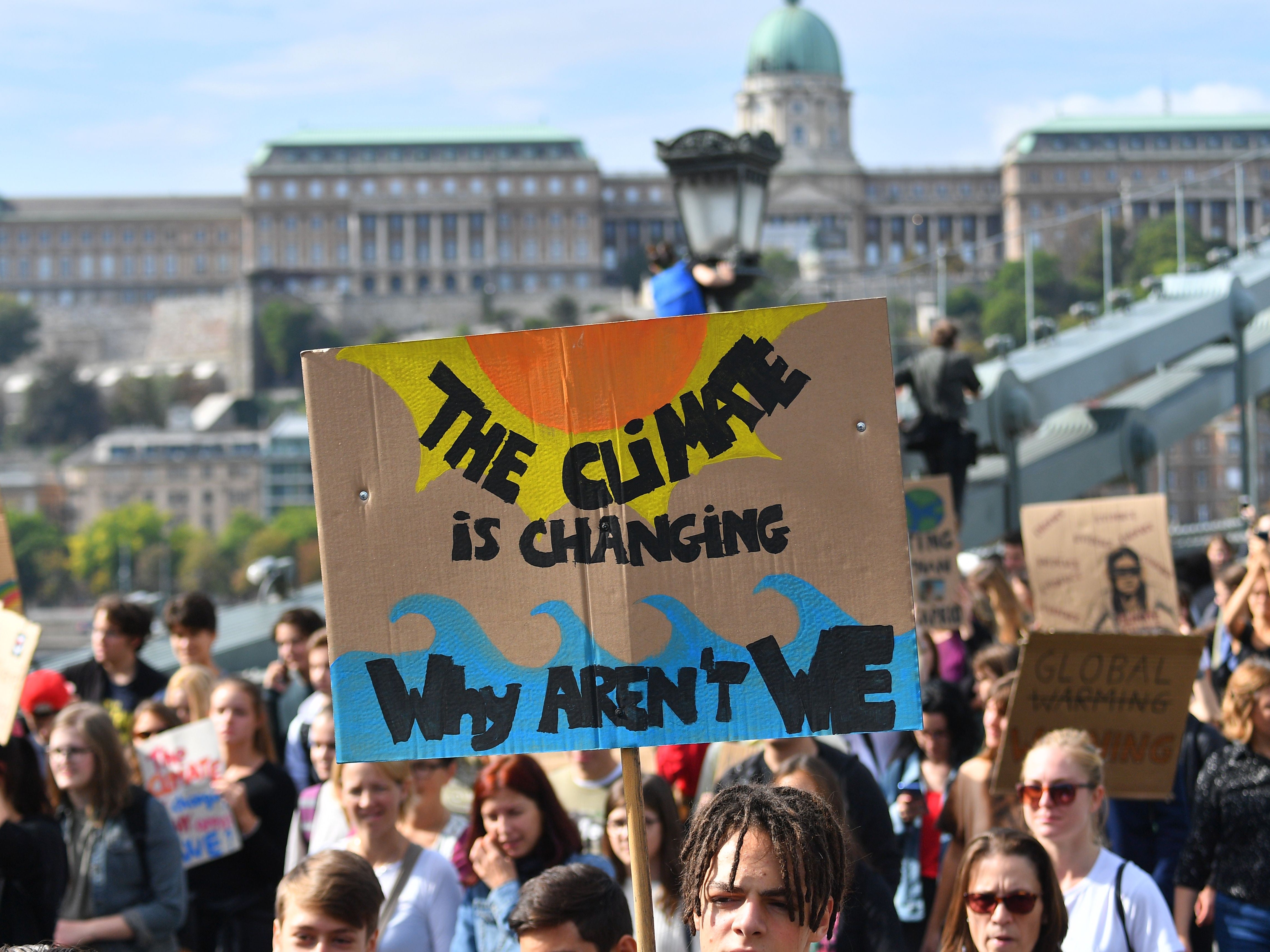
Natural disasters and crises are occurring three times more often than they were fifty years ago.
(Picture: AFP via Getty Images)It’s clear that climate change is a problem.
A recent UN Food and Agriculture Organization (FAO) report found that natural disasters and crises are occurring three times more often than they were fifty years ago, severely impacting agriculture and food security across the globe. But it doesn’t take a scientist to acknowledge that something is very wrong.
Former U.S. President Donald Trump, however, didn’t — and doesn’t — buy it. An avid climate change-denier who contemptuously claims that climate change is a “hoax,” The Apprentice star was determined to walk the U.S. back on its previous climate-change commitments, vowing to withdraw from the Paris Climate Agreement as far back as early as 2017.
The Paris Climate agreement is an international treaty adopted by 196 countries in 2015 and put into action the next year, requiring “major emitting” countries to commit to substantially reducing their greenhouse gas emissions in a universal motion to combat climate change. But Trump — or at least his supporters — wanted none of that.
Since, we’ve witnessed thousands of climate-change induced natural disasters, breaking all sorts of climate records — but not in a good way.
The following is (some of) what’s occurred so far.
2020 tied with 2016 for warmest year ever recorded.
Trump officially withdrew from the Paris Agreement at the tail end of 2020, which ended up being the warmest year ever recorded, barely tied with 2016.
Per NASA’s Goddard Institute for Space Studies (GISS), the average temperature in 2020 was 1.84 degrees Fahrenheit (1.02 degrees Celsius) warmer than the mean of 1951 to 1980, beating’s 2016 increase just slightly. The difference was within the margin of error, however, essentially putting the years at a tie.
2020 was the hottest year in the global temperature record, going back 140 years. 2020 statistically tied with the previous record holder, 2016 - a year when El Niño, a cyclical climate pattern, gave temperatures an above average boost. pic.twitter.com/Ght03Sl2VQ
— NASA GISS (@NASAGISS) January 14, 2021
“The last seven years have been the warmest seven years on record, typifying the ongoing and dramatic warming trend,” Dr. Gavin A. Schmidt, Director of GISS said of the findings. “Whether one year is a record or not is not really that important – the important things are long-term trends. With these trends, and as the human impact on the climate increases, we have to expect that records will continue to be broken.”
2020 also had the active Atlantic hurricane season on record.
The Atlantic hurricane season produced more storms than ever before. Per EcoWatch, a record-breaking 30 named storms took place in 2020 — the highest ever on record. There were also 13 hurricanes, which is the second highest number recorded, as well as six major hurricanes, a number currently tied for second highest as well. These numbers are than twice as much as the average hurricane season, which customarily contains 12 named storms, 7 hurricanes, and just 3 major hurricanes.
Last year was the most active hurricane season on record with 30 storms in total. Well, 2021 is keeping pace with that historic year. Danny was our fourth storm, and our fifth looks to outpace 2020’s Edouard. @YOURWEATHERMAN takes a closer look. https://t.co/qcHAWyRStX
— WCNC Charlotte (@wcnc) July 1, 2021
It’s looking like 2021 is well on its way to beating 2020, though.
As well as the hottest “reliably” measured temperature in history.
On August 16, 2020, Death Valley California peaked at 129.9 degrees Fahrenheit (54.4°C) at 3:41 Pacific Standard Time, and was rounded up to 130 degrees by the NWS Prediction Center. The last time Death Valley exceeded this number was in 1913, though Christopher Burt, author of “Extreme Weather,” says the 1913 number are “bogus.”
Per the climate data in xmACIS2, this is the first time since 1913 that Death Valley has reached 130F. In July 2013, it last reached 129F. If valid, it would be the hottest August temperature at the site by 3F. @NWSVegas pic.twitter.com/gZNBW4NXI4
— NWS Weather Prediction Center (@NWSWPC) August 16, 2020
“The old Death Valley record from July 1913 is 100% bogus (not just 99.9% such), as are all other temperature readings of 130 degrees Fahrenheit or higher from Africa in the past,” Burt explained, via Yale Climate Connections.
Hundreds died in the Texas winter storm.
In February 2021, the North American cold wave brought freezing cold temperatures to a large portion of the United States, Canada and Mexico, but most severely impacted the Southern Plains region which includes Oklahoma, Arkansas and Texas. Texas fared the worst of all, as the record-breaking cold caused millions to lose power, heat and waters. Hundreds of Texans literally freeze to death in darkness as emergency services were completely overwhelmed.
Our analysis, reviewed by three leading experts in excess deaths studies, suggests that between 426 and 978 more people than expected died in Texas in the week ending February 20 alone. Our best estimate is that 702 people were killed by the storm in that week. pic.twitter.com/EjmJdHNamD
— BuzzFeed News (@BuzzFeedNews) May 26, 2021
The state claims only 151 people died in the storm, but a report by BuzzFeed news found the number is likely much closer to 700.
Followed by more fatal weather in Tennessee.
In March 2021, record-breaking thunderstorms and torrential rains caused severe flooding across Tennessee. Seven inches of rain fell on Nashville in just 48 hours, leaving at least four people dead.
This radar loop shows the supercell thunderstorm, which produced at least one deadly tornado in Nashville, tracking across the state of Tennessee from 10 p.m. on March 2 to 4 a.m. on March 3: https://t.co/hHPRNOvJz7 pic.twitter.com/wGkKV6onJB
— AccuWeather (@accuweather) March 5, 2020
Typhoon Surigae was the strongest Northern Hemisphere cyclone to form before May.
In April 2021, Typhon Surigae rapidly escalated from a Category 2 storm to Category 5, intensifying at a record pace — literally overnight. Per Yale Climate Connections, Surigae was the strongest strongest typhoon, cyclone or hurricane to ever before the month of May, and only four tropical cyclones have been recorded with higher wind speeds.
Wow- the western Pacific Supertyphoon #Surigae is turning into a monster. Looks like a category 5 on satellite now- that’s in rarified air for April. 👀 pic.twitter.com/DQ1EgUf1Z8
— Eric Blake 🌀 (@EricBlake12) April 17, 2021
Jim Kossin, a climate researcher at the National Oceanic and Atmospheric Administration, told The Washington Post: “In the early 1980s, the chance of having a hurricane intensification event of 35 mph or more in a 24-hour period was about 1 in 100. Thirty years later, the chance has gone up by a factor of five to about 1 in 20.”
Louisiana flooded.
In May 2021, a state of emergency was declared when torrential rains flooded parts of Louisiana still suffering the effects of the 2020 Atlantic Hurricane season. Over a foot of rain fell on Lake Charles, Louisiana in only 24 hours.
Heavy flooding hits Lake Charles, Louisiana 🇺🇸 May 17 2021 pic.twitter.com/WssVZGtIVl
— #كابتن_غازي_عبداللطيف (@CaptainGhazi) May 18, 2021
Per the Climate Science Special Report, severe weather of the sort isn’t going away anytime soon, as “both the frequency and intensity of heavy precipitation events are projected to continue to increase over the next century due to human-caused climate change.”
The Western U.S. and Canada suffered a record-breaking heatwave.
In June 2021, the Western United States and Canada experienced a record-breaking heatwave. Per Climate.Gov, all-time maximum temperature records were broken in seven different states from June 15 to 20, during which Phoenix, Arizona maintained a temperature of over 115 for the entire five days.
The Pacific Northwest was especially hard hit, seeing as the region isn’t prepared for such extreme heat — it doesn’t need to be — many households don’t even have air conditioning. Over the course of the heatwave, Portland broke records three days in a row, hitting 108, then 112, then 116 degrees.
In case you're wondering why we're canceling service for the day, here's what the heat is doing to our power cables. pic.twitter.com/EqbKUgCJ3K
— Portland Streetcar (@PDXStreetcar) June 27, 2021
The heat was so intense it began to damage the PNW’s infrastructure, literally causing pavement to soften and power cables to melt. Several businesses closed up shop to wait out the heat.
Temperatures in the Canada area also broke records, hitting 121.3F degrees (49.6 Celsius) in Lytton, British Columbia.
State Route 544 milepost 7 near Everson, Wa is currently closed. The asphalt roadway is buckling and unsafe for travel. WSDOT is advised and detours are currently being set up.
— Trooper Rocky Oliphant (@wspd7pio) June 28, 2021
BL pic.twitter.com/5Yb9UYzbDc
Per CNBC, at least 486 sudden deaths were reported in the Vancouver area during the heatwave, a number they expected to increase. In Oregon, at least 63 people were reported to have died.
…then a wildfire.
As if the heatwave wasn’t bad enough — then came the wildfires.
Per NPR, the entirety of Lytton, British Columbia was forced to evacuate after a heat-induced wildfire spread hit the town on June 23.
#DEVELOPING: New footage shows structures burning in the city of Lytton, Canada as numerous wildfires continue to rage across British Colombia. Video credit: 2 Rivers Remix Society on Vimeo. pic.twitter.com/RiFMPJbjYx
— UA News (@UrgentAlertNews) July 1, 2021
…then another wildfire.
Less than a week after the Lytton wildfire, “lava fire” erupted in Northern California, burning over 17,000 acres of land. 10,000 local residents to evacuate and seek shelter in a nearby school. Per LA Times, lightning sparked the blaze.
The raging Lava fire in Northern California grew to more than 17,000 acres by Wednesday morning, forcing thousands from their homes and offering a preview for the fire season ahead.https://t.co/fWJkgk5uA2
— Los Angeles Times (@latimes) June 30, 2021
And it’s only July 1. We’re, sadly, just getting started.