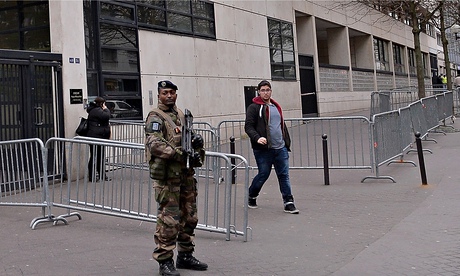
An unprecedented mobilisation of French troops on its own soil is under way as 10,000 personnel stand ready to take their positions at locations deemed vulnerable after last week’s terrorist attacks.
From Tuesday morning, the troops will reinforce nearly 5,000 police officers providing security at Jewish schools and cultural centres, as well as railway stations and other possible targets.
France is entering a further day of mourning, during which the funerals of four Jewish victims killed in a kosher supermarket on Friday will take place in Israel, and policeman Ahmed Merabet – killed by the Kouachi brothers outside the Charlie Hebdo offices on Wednesday – will be buried at the Muslim cemetery in the Paris suburb of Bobigny.
A solemn ceremony will also take place at the police headquarters in Paris, where President François Hollande will pay homage to Franck Brinsolaro, 49, and Merabet, 40, who were killed by the Kouachi brothers during the attack on the office of the satirical magazine, as well as Clarissa Jean-Philippe, 27, who was killed in Montrouge by their accomplice, Amédy Coulibaly.
The ceremonies come before the publication of Wednesday’s edition of Charlie Hebdo, which has a cartoon of the prophet Muhammad on its front page.
The cover shows the prophet shedding a tear and holding up a sign reading “Je suis Charlie” in sympathy with the dead journalists. The headline says “All is forgiven.”
The two gunmen who attacked the magazine’s offices last Wednesday, Chérif and Saïd Kouachi, killed five of the country’s top cartoonists, saying they wanted to avenge the prophet for Charlie Hebdo’s satire of him.
The grieving journalists who survived the murderous assault promised that it would be business as usual at the weekly publication. A record 3m copies are to be printed, in 16 languages, after the massacre triggered a worldwide debate on free speech and brought more than 4 million people on to the streets of France in a unity march on Sunday.
The eight-page edition went to press on Monday night, according to Libération, the newspaper that offered Charlie Hebdo staff temporary working space following the attack.
Police in France continue to search for possible accomplices of the gunmen who carried out the terrorist attacks, after video footage was released of the partner of one of the attackers arriving in Turkey with another man.
The video shows Hayat Boumeddiene, now France’s most wanted woman, passing through immigration at Istanbul airport on 2 January, six days before her partner, Amédy Coulibaly, killed a police officer in Paris. Coulibaly went on to murder four hostages at a kosher supermarket, before being killed in a shootout with police. On Monday, the French government said it was clear that he had help.
In the Istanbul footage, Boumeddiene is accompanied by Mehdi Sabri Belhouchine, a 23-year-old French national whose name had not appeared in connection with the attacks, and who was not on a terrorist watchlist. After crossing Turkey, the pair are said by Turkish authorities to have gone into part of Syria controlled by Islamic State (Isis), to which Coulibaly declared his allegiance before his death.
There are reports that the Kouachi brothers had help. Some witnesses have talked of a third person at the scene of the attack on the magazine. French police officials said on Monday that as many as six members of the terrorist cell involved in the attacks might still be at large, including a man who was seen driving a car registered to Boumeddiene.
Two French police officials said authorities were searching the Paris area for the Mini Cooper registered to Boumeddiene.
The prime minister, Manuel Valls, has warned that “the threat is still present”. He told BFM television: “The work on these attacks, on these terrorist and barbaric acts, continues … because we consider that there are most probably some possible accomplices. The hunt will go on.”
Valls referred in particular to Coulibaly, who may have had help from accomplices apart from Boumeddiene, with whom he lived in Paris. Someone A video of Coulibaly justifying his actions was edited and posted on Sunday morning after his death in Friday’s shootout. At least one segment of the video, in which Coulibaly swears allegiance to Isis, was evidently filmed after the wave of attacks began last Wednesday as the noise of news reports can be heard in the background. That was five days after Boumeddiene left France for Turkey.
“This is the first time that our troops have been mobilised to such an extent on our own soil,” said the French defence minister, Jean-Yves Le Drian, after a national security crisis meeting attended by Hollande, Valls, the interior minister, Bernard Cazeneuve, and heads of the police and security services.
“The threats remain and we have to protect ourselves from them. It is an internal operation that will mobilise almost as many men as we have in our overseas operations.”
Valls announced that new measures to tackle extremism – including the possibility of separating extremists while in prison – would be made this week. “We’re making war against terrorism, against jihadism and against radical Islam,” Valls said in an interview on RMC Radio. “One of the individuals probably had an accomplice.”