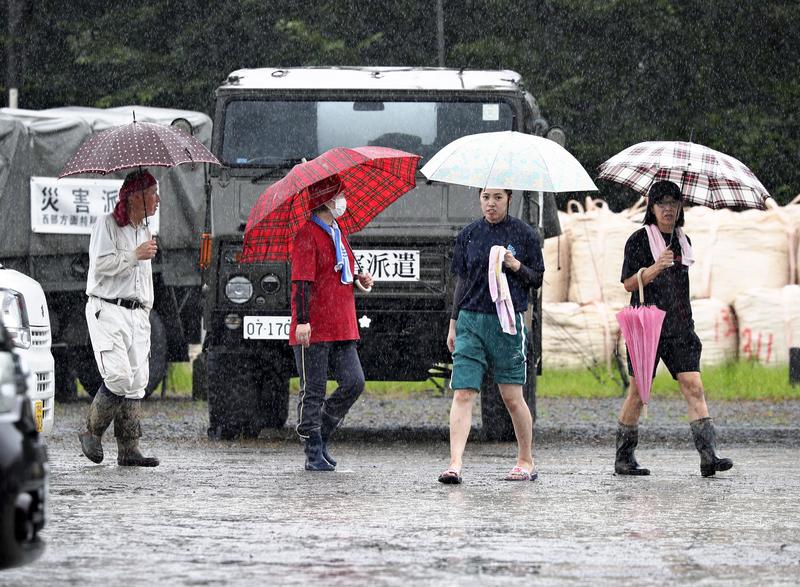
Saturday marked one week since a special heavy rain warning was issued in Kumamoto and Kagoshima prefectures, but people in the Kyushu region remained on the alert against heavy rain that has already caused serious damage.
On Saturday, people in Kumamoto Prefecture could be seen praying for the victims of the disaster and laying flowers for them while heavy rain continued to fall. Search operations also continued.
A seasonal rain front and low pressure system was expected to approach the Tohoku region, and a massive amount of rain is likely to fall in a wide range of areas from northern Kyushu to the Tokai and Tohoku regions through Sunday.
As of 11 a.m. Saturday, the death toll from the heavy rains was 60 in Kumamoto Prefecture, two in Fukuoka Prefecture and one in Oita Prefecture. The number of people missing was nine in Kumamoto Prefecture, five in Oita Prefecture and one each in Nagasaki and Kagoshima prefectures.
At the Sakura Dome, a multipurpose facility used as the headquarters for disaster measures in Kuma, Kumamoto Prefecture, about 50 people, including village officials, offered a moment of silence for the victims at 7:30 a.m. Saturday.
At around 9 a.m., the water level of the Kuma River surged and the village government called on residents over the community wireless system to evacuate to higher ground. Residents headed for the dome one after another.
In the city of Hitoyoshi, Kumamoto Prefecture, where 19 people died, the city government also urged residents to evacuate.
'Atmospheric river' caused rain
Yoichi Kamae, an assistant professor of climate and atmospheric science at the University of Tsukuba, said in a report that a phenomenon called an "atmospheric river" was moving over Japan when the Kuma River flooded on July 4. This phenomenon is a narrow, elongated corridor of concentrated water vapor.
When the moisture in the atmospheric river turned into water, it is estimated that it was about 800 times the amount of water in the Shinano River, the largest in Japan, and this is believed to have led to heavy rainfall across a wide area.
An atmospheric river is characterized by a belt of water vapor stretching more than 1,500 kilometers, and it transports moisture that becomes the basis for continual rain. It apparently occurred in the torrential rains in western Japan in 2018.
Kamae analyzed data on the volume of moisture, wind direction and other factors provided by the Japan Meteorological Agency. He estimated that the atmospheric river was about 3,000 kilometers long, about 600 kilometers wide and about three kilometers deep, and that at 3 a.m. on July 4 it was sitting about 1.5 kilometers above the ground in areas across western and eastern Japan.
Read more from The Japan News at https://japannews.yomiuri.co.jp/