Capsule hotels, net cafes, karaoke rooms for one person: There are many places in urban areas where people can spend time alone. To learn why we seek out these spaces, The Yomiuri Shimbun interviewed Yoshikazu Nango, an associate professor at Meiji University and author of the book "Hitori Kukan no Toshiron" (Urban theory of the one-person space).
The Yomiuri Shimbun: You have a unique perspective of discussing the state of being "one person" based on the concept of space.
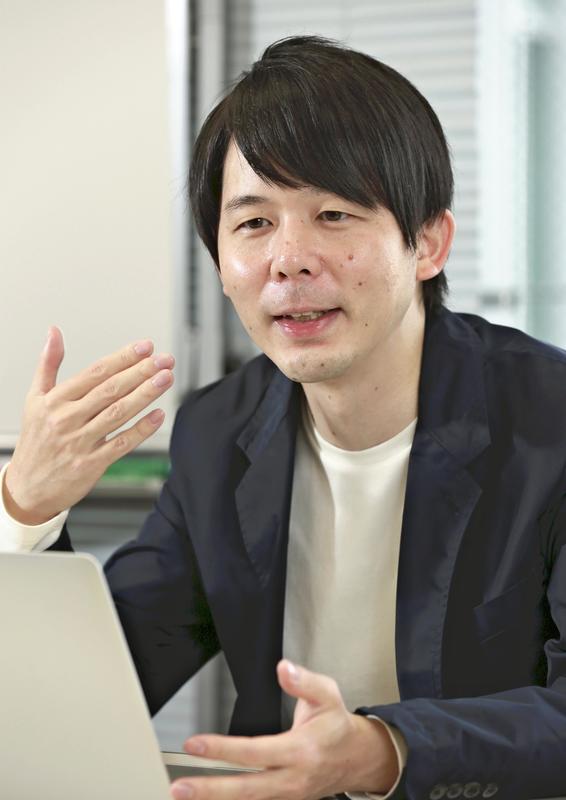
Nango: Since the time [the book was published in January 2018], there have been a lot of books on singles and loneliness, but many were written from the point of marketing and worldviews. My specialty is the sociology of urban areas and architecture, so I thought I'd focus on how issues related to being one person are expressed through space, rather than discussing the pros and cons of being one person or human relations.
Q: You define the "one-person space" as a "space separated by a partition of some kind in which the 'one person' state is secured." Is this peculiar to urban areas in Japan?
A: Primarily, urban areas are a place where people gather from various regions, temporarily stay and eventually leave. Therefore, it's only natural that there are a lot of spaces for people to spend time alone. Hotels are a typical example. In a single hotel room with a key, your privacy and anonymity are ensured. The one-person space did not suddenly emerge but appeared as a result of the transformation of urban areas in modern times. The old city of Edo [present Tokyo] also used to be an urban area with many single-person households.
Q: It's a common global phenomenon that there are many "one-person" people in urban areas, isn't it?
A: In London and New York, the one-person space does not appear in the same manner as it does in Japan. It's interesting to see how the one-person space appears in original ways in these large overseas cities. In Japan, there is a large number of one-person spaces and many different types, and they have their own specific characteristics.
One characteristic is that there are many partitions. At the Ichiran ramen noodle shop, for example, customers' seats are separated by partitions. I've never seen seating like that at restaurants in Europe and the United States.
American cultural anthropologist Edward Hall said Japanese people are sensitive to how they are viewed by others but insensitive to sounds. Partitions serve as a tool to block other persons' eyes [in Japan]. For example, at many izakaya Japanese-style pubs, spaces for customers are separated by partitions, and if a group of customers next to you makes a large noise, you don't mind so much.
Q: Fusuma room partitions and shoji sliding doors also serve the same kind of function.
A: Another characteristic [in Japan] is that one-person spaces are commercialized. In London and New York, in public spaces like parks, people behave as if they are staying in their own space. However, in Japan, people can't do that because they're sensitive to how they're seen by others, so instead they pay to secure a one-person space for themselves and obtain the right to relax freely. This is a big difference [compared with those in Europe and the United States].
Q: I hear that when people see a middle-aged man like me sitting on a bench at a park during the daytime [in Japan], they treat him as a suspicious person.
A: It's changing, but lifestyles are basically homogeneous in Japanese society, so people tend to be highly sensitive even to small differences. Therefore they respond excessively to things that are different from them and become hostile toward them. They have strong solidarity within the groups that they belong to, but they don't know how to interact with others outside the groups.
So, people tend to desire a place for one person more strongly. The fact that there are many one-person spaces in front of railway stations highlights the characteristics of Japan. A train station is a space for people traveling in a one-person state between two places they belong to -- "workplaces or schools" and "homes."
On the other hand, the Japanese have long valued the aesthetics of narrow and small spaces such as a tea room, or the small hut that appears in "Hojoki" by Kamo no Chomei. People don't feel poor in such spaces, they feel their minds expand. So, they actually find it comfortable being in narrow, small one-person spaces.
Living alone together
Q: What sort of effects have been brought about by the spread of the internet and mobile media?
A: Improved telecommunications have created a society in which people are constantly connected with others through social media and other means. At the same time, because it's a society in which people are mutually under surveillance, they've come to want time they can spend by themselves, to escape from the stress. In that sense, the one-person space is related not only to single persons, but to all kinds of people.
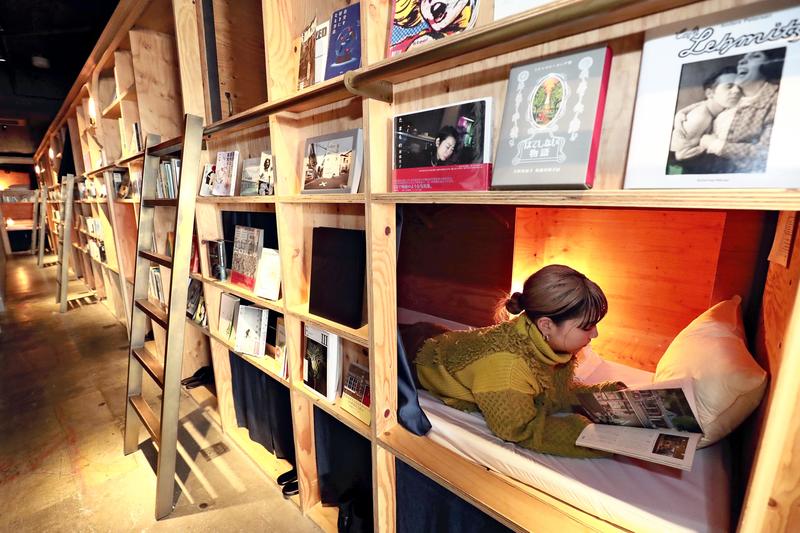
The concept of spaces has also been changing a little. For instance, at the Book and Bed Tokyo accommodation facility, beds are installed in bookshelves containing volumes selected by the facility, and people fall asleep while reading books. Pictures of the interior design and other elements have been shared through social media, and people with similar tastes and preferences are gathering at the facility. Although they don't actively get involved in conversations, the facility has become a place where people who can share feelings can enjoy being alone.
Q: This facility provides one-person spaces for relatively young people. What's the future of "spaces" for the increasing number of elderly people?
A: Single lives in urban areas are possible because living functions like making meals and washing can be done outside the home. However, everything can be delivered to people's homes through services like Amazon.com and Uber Eats, so people don't have to go out. In public spaces, it is important that people can see each other's behavior and feel each other's presence, even though they live separately. How to get people to go out of their houses is vital.
Conventionally, urban areas were a place for matching up. People who went there for their own purposes interacted with each other and encountered others with whom they have something in common. But currently, the use of social media has increased the accuracy of matching.
Elderly men who have reached their retirement age tend to become isolated in their communities, as they have no connection with local people. Information technology is expected to help match the skills developed by these elderly people to their communities.
Q: What's the future image of the one-person space?
A: Talking about the one-person space, we tend to imagine a single room for one person, but there's a possibility that we can use other various ways to live alone. From now on, if vacant houses increase in rural areas and self-driving operations and other means of public transportation develop, it will become easy for even single persons to live in two bases in urban and rural areas that they go back and forth between.
Many people can also "live alone together," as in share houses. I want to examine how the image of the one-person space will change through such new lifestyles.
Read more from The Japan News at https://japannews.yomiuri.co.jp/