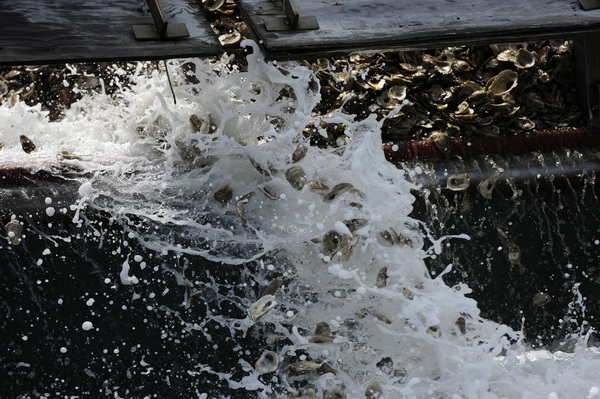
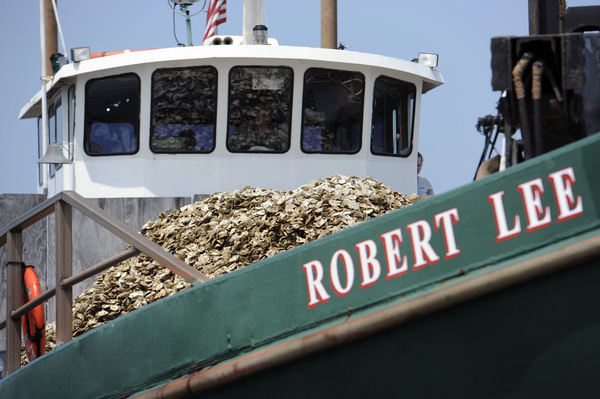
CAMBRIDGE, Md. _ Shells carrying millions of lab-grown baby oysters tumbled down the sides of a boat, and the $35,000 investment sank into the Choptank River where it widens to meet the Chesapeake.
The oysters, planted last month, will grow there for two or three years before watermen scoop them back up and restaurants serve them fried or on ice.
Nearby, other oyster reefs are restocked in the same manner but are off-limits to harvesting. Those sanctuaries across bay tributaries help the shellfish recover from decades of disease outbreaks, and overfishing before that, and have been expanded in recent years to cover nearly a quarter of the bay's 36,000 acres of oyster bars.
Watermen could soon reclaim some of that territory.
The administration of Republican Gov. Larry Hogan is reconsidering strategies begun in 2010. The approach cordoned off some of the bay's oyster population from dredges and oyster tongs, built new habitats atop artificial reefs and also provided a reproductive boost by artificially growing oysters and spreading them in the bay.
Scientists and environmentalists emphasize that sanctuaries boost reproduction rates and foster disease resistance, because harvesting takes the largest and hardiest oysters out of the gene pool.
But watermen who know the oyster bars intimately question whether the bivalves multiply and thrive any better in the sanctuaries, and whether the work to build artificial reefs amounts to dumping money into the water. They say the harvest restrictions have challenged an industry that already has serious problems.
State officials have assigned an advisory panel _ which six watermen recently joined _ to evaluate how oysters are faring both inside and outside sanctuaries, and whether some areas could be reopened to commercial harvest.
In what could signal a new direction, state officials plan to decide within two weeks whether to restart a oyster restoration project that the Hogan administration put on hold in a Choptank tributary. The state and federal government have put $44 million into three such projects.
Watermen are skeptical of the efforts, while proponents say the state could be passing up millions of dollars in federal funding if they scrap the latest one.
Maryland's goal has been to increase the oyster population for its ecological benefits. The creatures once filtered all of the water in the bay in a matter of days, and could do much to help clean up the Chesapeake. The reefs are also a vital habitat for crabs, fish and other creatures.
State officials say science will guide decisions, but environmentalists worry that a renewed emphasis the Hogan administration has put on the oysters' value to the seafood industry could influence outcomes.
"Oysters are very political," said Kelton Clark, a commission member and director of Morgan State University's Patuxent Environmental and Aquatic Research Laboratory. "Every stakeholder seems to feel their use of the bay is the most important use of the bay."
For watermen, the fight for their way of life dates back generations, said Ben Parks, who has spent his life crabbing and oystering around the Choptank.
"It's been like oyster wars since back in the early 1900s."
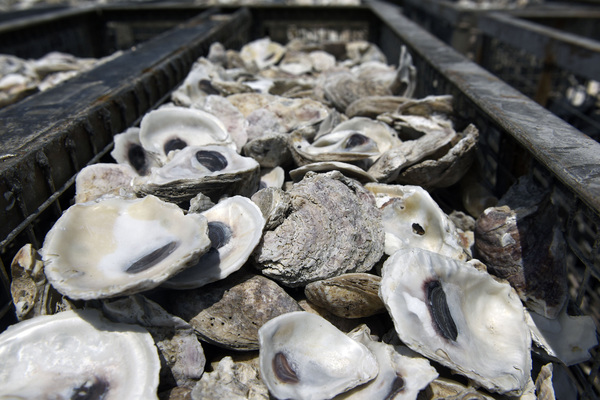
Through the late 1800s, watermen annually harvested as many as 15 million bushels of oysters from the bay, but since then overfishing and disease have diminished the population to less than 1 percent of historical levels.
As the country grew _ and the seafood industry with it _ harvests fell to a few million bushels a year by the early 1900s. Plagues of disease in last quarter of the 20th century reduced harvests to a record low: less than 30,000 bushels by 2004.
Harvests have since rebounded to as many as half a million bushels, thanks to broader bay cleanup efforts and oyster bar "seeding" since the 1990s.
Oyster larvae are grown at the University of Maryland Center for Environmental Science's Horn Point Laboratory in Cambridge, or are imported from Virginia, then poured into tanks so they can attach to shells, at which point they become known as spat. Some are dropped into sanctuaries; others into reefs that can be harvested.
The Maryland-grown spat is raised with money from a $1-per-bushel fee charged to seafood processing companies and distributors, and a $300 annual surcharge on oystering licenses.
The latest strategy followed decades of debate among policymakers, environmentalists and the seafood industry over how to best increase the oyster population.
Under Republican Gov. Robert L. Ehrlich Jr. in the early 2000s, the state nearly adopted a strategy that would have introduced Asian oysters to the bay, which environmentalists criticized as potentially disastrous.
Gov. Martin O'Malley, a Democrat, abandoned that idea, instead betting on sanctuaries. The protected areas, sometimes marked with buoys or just as shaded polygons on maps, covered 9 percent of the state's oyster bottom when O'Malley announced a plan in 2010 that he declared "the turning point" for the shellfish species.
Today, there are more than 50 sanctuaries covering 24 percent of oyster habitat in the bay, including half of what scientists and watermen consider the most productive oyster bars.
In the sanctuaries of three tributaries, the efforts are more aggressive. President Barack Obama has charged Maryland and Virginia with restoring oyster populations to historical levels in five bay tributaries each.
The directive prompted the millions of state and federal dollars to be spent on 400 acres of artificial reefs seeded with more than 2 billion spat in the Tred Avon and Little Choptank rivers and the Harris Creek, all part of the larger Choptank River complex.
Five years into the work, a scheduled review is due, and the Hogan administration has hinted that policy changes could be ahead.
Watermen hope the process to guide Hogan's oyster policy goes differently than the one that began in 2010.