
About 1,500 years ago, there lived a man in Europe without a left foot. Instead, he wore a wooden prosthetic limb.
Archaeologists digging in southern Austria's Hemmaberg found the man's grave in 2013 but only recently revealed details about the prosthetic. The findings will be published in the International Journal of Paleopathology.
"This represents one of the oldest examples of prosthetic limb replacement associated with the skeleton of its wearer in Europe to date," the study authors write.
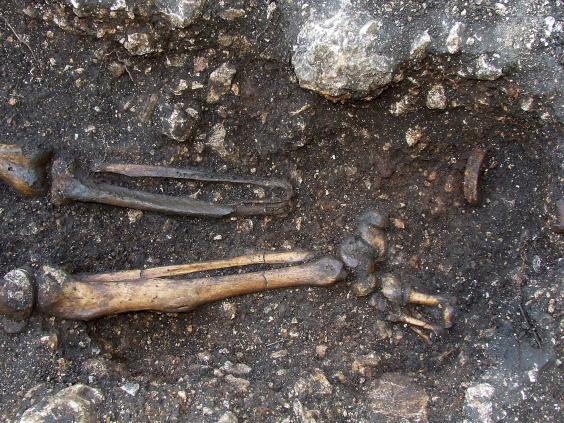
The middle-aged man's left foot was missing, and in its place was an iron ring and pieces of wood, according to the researchers. They used radiography and CT-scanning to determine that the man had a lesion that had healed.
"He appears to have got over the loss of his foot and lived for two more years at least with this implant, and walking pretty well," Sabine Ladstätter, of the Austrian Archaeological Institute, told the AFP.
Why this particular 6th century fellow lost his foot is unclear, but he likely belonged to a higher social class, especially given that he was buried close to a church and with a sword, Michaela Binder, a bioarchaeologist with the Austrian Archaeological Institute, told Atlas Obscura.
“Losing a foot—and especially when it’s not cut through the joint but through the bone—would have lacerated a lot of blood vessels and caused an extensive amount of bleeding,” Binder told Atlas Obscura. “It would have very prone to infection. This is probably another reason why we see so few prostheses or amputations. Most people simply died quite quickly afterwards. So, finding an injury like that healed and finding ways that allowed the person to function at that time period to me is always mind-blowing."
This wouldn't be the oldest use of a prosthetic device, according to the researchers. It's believed they were used in ancient Egypt and in the Greco-Roman world, but "archaeological evidence for this practice prior to 2nd millennium AD is very scant," the researchers write.
© Washington Post