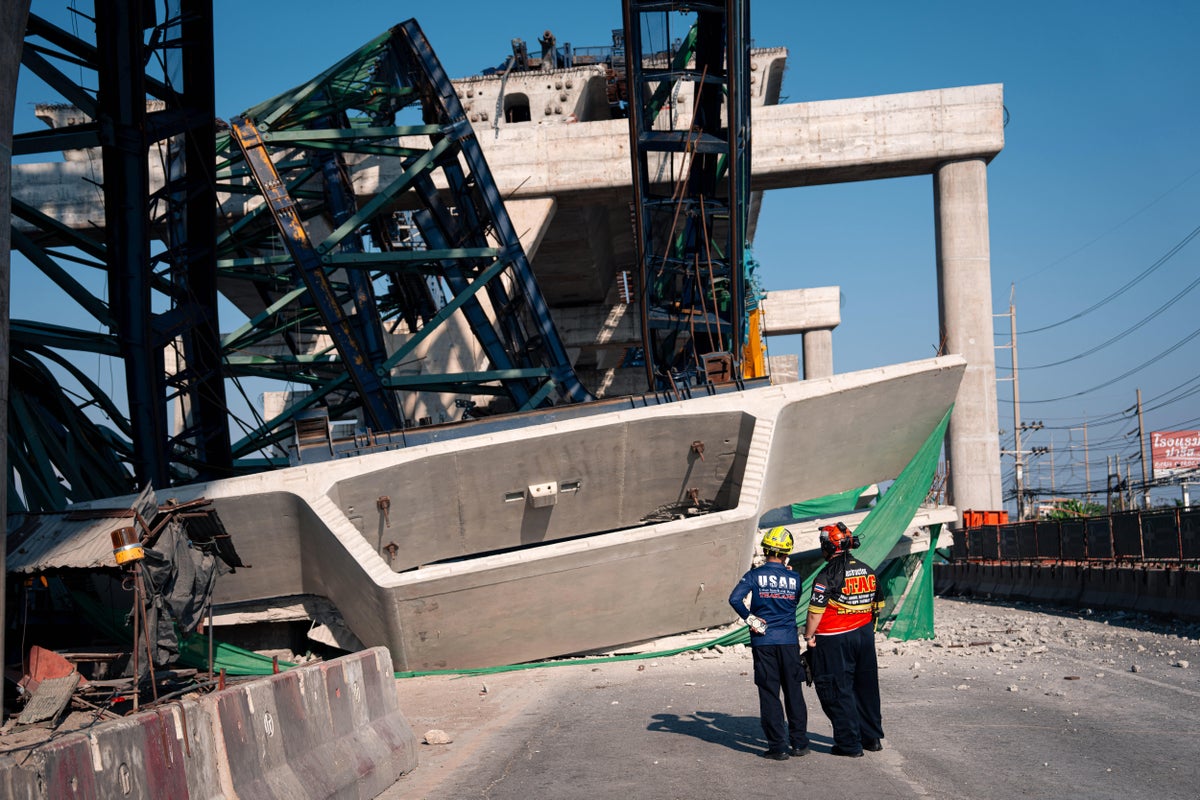
Thailand’s construction industry is under intense scrutiny following a series of high-profile deadly accidents. These include a crane falling onto a moving passenger train this past week and the collapse of an office tower a year ago that killed nearly 100 workers.
Public concern is particularly high in Bangkok due to the frequent and sometimes fatal construction accidents on major road projects. In the latest case, a construction crane collapsed on Thursday, killing two people, just a day after the train tragedy in which 32 people died.
Contractor has safety failure records
Public outrage has centered on Italian-Thai Development, the contractor responsible for both sites where the past week's accidents occurred. The company, also known as Italthai, was also the joint lead contractor for the 33-story State Audit Office building, which toppled while under construction in March, killing about 100 people.
It was the only major structure in Thailand to collapse from an earthquake whose epicenter was in Myanmar, more than 1,300 kilometers (800 miles) away.
Twenty-three individuals and companies were indicted in that case, including Italthai’s President Premchai Karnasuta, on charges including professional negligence causing death and document forgery. Italthai, a major developer in Thailand which has won many government projects, has denied wrongdoing in that case as well as the more recent crane crashes.
Prime Minister Anutin Charnvirakul has responded to the latest incidents by ordering the Transport Ministry to terminate contracts with, blacklist and prosecute the companies involved. Unfinished projects will be funded by seizing performance bonds and bank guarantees, with the government reserving the right to sue for extra costs. Additionally, a “scorecard” system to keep track of contractors’ performance records should be enforced by early February.
Troubles in the system
Investigators can often find the technical cause of accidents, such as human error or equipment failure.
But critics say construction safety faces broader systemic problems, pointing to lax regulation, poor enforcement, and corruption. A lengthy investigation determined that the building collapse in March, though triggered by an earthquake, was fundamentally caused by flawed structural design and effort to evade regulations.
“I don’t think Thailand fails in terms of the body of knowledge in engineering or even in the technical aspects,” said Panudech Chumyen, a civil engineering lecturer at Bangkok’s Thammasat University. “I think there’s a failure in our system; there are so many gaps that I don’t know where we should begin to close them.”
He said the safety challenges range from laxity in law enforcement to red tape and the lack of integration in safety policies among different stakeholders in projects. He also pointed to a shortage of independent assessors without conflicts of interest, which often results in performance reports that do not reflect reality.
Concern about the Chinese connection
The involvement of Chinese companies in the building collapse, as well as troubled rail and road projects, has also drawn attention.
Wednesday’s train accident took place on a line that is part of a Thai-Chinese high-speed railway project linking the capital to northeastern Thailand. It is associated with an ambitious plan to connect China with Southeast Asia under Beijing’s Belt and Road Initiative, which has caused controversy in many of its activities around the world, including corruption scandals.
Concern over Chinese construction practices increased after the collapse last year of the State Audit Office project, in which the Chinese company China Railway No. 10 was co-lead contractor with Italthai. Its Bangkok representative, Zhang Chuanling, was charged with violating Thailand’s Foreign Business Act by using Thai nationals as nominee shareholders to hide Chinese control of its local affiliate.
The collapse stunned Thais, with many taking to social media to vent their outrage. Images of so-called “tofu buildings” – a nickname for flimsy structures built with substandard materials – have gone viral, with users highlighting other projects linked to Chinese contractors. The phrase was popularized to describe such a damage after the 2008 earthquake in Sichuan, China.
China’s ambassador to Thailand, Zhang Jianwei, said Thursday that China requires its companies to follow the rules when participating in overseas projects, and that Beijing is willing to “guide Chinese companies to actively cooperate with the Thai authorities’ investigation.”
—
AP researcher Shihuan Chen in Beijing contributed to this report.
In their words: Greenlanders talk about Trump's desire to own their Arctic island
At top UN court, Myanmar denies deadly Rohingya campaign amounts to genocide
Asian shares are mixed and US futures edge higher after Wall Street steadies
Trump floats tariffs on countries that ‘don’t go along’ with his plans for Greenland
West Midlands Police chief to retire after Maccabi Tel Aviv fan ban criticism
British police force chief behind decision to ban Maccabi fans from Aston Villa match retires