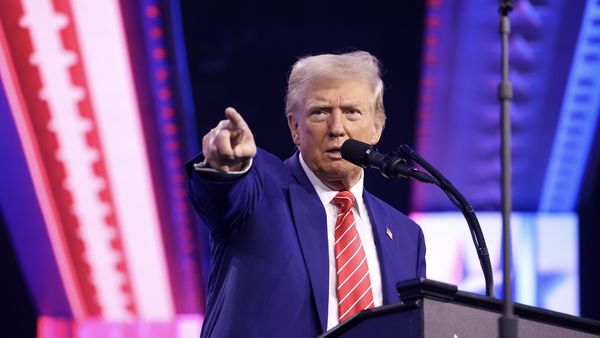
Soon after Donald Trump’s removal of Venezuela’s president, Nicolás Maduro, last weekend, he quickly moved on to the subject of Greenland, renewing calls for a US takeover of the Arctic territory.
The US president said on Sunday that he needed Greenland “very badly”, prompting a ramping up of tensions between the US, Greenland and Denmark.
Greenland is part of the Danish kingdom. Denmark formerly ruled it as a colony and today still controls its foreign and security policy.
Mette Frederiksen, the Danish prime minister, has said that an attack by the US on a Nato ally – in this case Greenland as part of Denmark – would mean the end of the alliance. Greenland’s prime minister, Jens-Frederik Nielsen, has urged Trump to give up his “fantasies about annexation”. European leaders have also given Denmark and Greenland their backing, saying “Greenland belongs to its people”.
But according to Stephen Miller, one of Trump’s top aides, the administration is determined to acquire Greenland and believes it will do so without the need for military intervention.
Why is Donald Trump so fixated with Greenland?
Greenland has long been on Trump’s agenda but the reasons behind it have changed over time. In 2019, during his first term, he confirmed reports that he had been urging aides to find out how the US could buy the vast Arctic island, describing a sale as “essentially a large real estate deal”. Last January when Trump, then president-elect, said he needed control of Greenland he said it was for “economic security”. But in recent days he has said he needs Greenland “from the standpoint of national security” – despite the risk this would pose to the future of Nato.
Strategically positioned between the US and Russia, Greenland is viewed as increasingly important for defence and is emerging as a geopolitical battleground as the climate crisis worsens.
As well as oil and gas, Greenland’s supply of multiple in-demand raw materials for green technology is attracting interest from around the world – including from China, which dominates global rare earth production and has threatened to restrict the export of critical minerals. By acquiring Greenland, the US could keep China out.
The rapid melting of the island’s huge ice sheets and glaciers could open up oil drilling (although Greenland stopped granting exploration licences in 2021) and mining for essential minerals including copper, lithium, cobalt and nickel.
Melting Arctic ice is also opening up new shipping routes, providing alternatives to the Suez canal through the Arctic that shorten the journey from western Europe to east Asia by almost half. China and Russia agreed in November to collaborate on developing new Arctic shipping routes.
Greenland is already an important military base for the US and its ballistic missile early warning system. The US has had a military base at Pituffik (previously Thule) since the cold war.
What has Denmark got to do with it?
Inuit people are understood to have lived in Greenland since as early as 2,500BC and it was reached by Norse seafarers in the first millennium AD, who established settlements lasting several centuries. Modern colonisation began after the arrival of Hans Egede in 1721, acting with the support of what was then Denmark-Norway. During the second world war, when Denmark was occupied by Germany, Greenland was occupied by the US and was returned to Denmark in 1945.
It became part of the kingdom of Denmark in 1953, and in 1979 home rule was introduced. But Denmark still controls Greenland’s foreign and security policy. It has its own parliament, Inatsisartut, and two MPs in the Danish parliament, Folketing. But calls for independence have been growing.
Tensions have escalated significantly between Greenland and Denmark in recent years. There is intense anger in Greenland over investigations into the forced contraceptive (IUD) scandal of the 1960s and 70s, prompting the former Greenlandic prime minister to accuse Denmark of genocide. There have also been protests in Copenhagen and Nuuk over the separation of Greenlandic children from their parents.
Since Donald Trump Jr’s high profile visit to Nuuk last January, escalating Denmark’s fears over US plans in relation to Greenland, Frederiksen’s government has made efforts to restore relations with Greenland.
Denmark has banned the use of highly controversial “parenting competency” tests on Greenlandic people that have resulted in Greenlandic mothers being separated from their children. In September, after years of failing to acknowledge the violations, Denmark officially apologised to the victims of the IUD scandal, in which thousands of Greenlandic women and girls were forcibly fitted with contraceptive coils without their knowledge or consent. And in December, victims won a legal fight with the Danish government to receive compensation.
In recent years there has been growing support for Greenlandic independence. But amid the spectre of Trump’s threat, Greenland in March formed a new four-party coalition government in a show of national unity, with the first page of the coalition agreement stating: “Greenland belongs to us.” The pro-independence party, Naleraq, which is the most US- and Trump-friendly party, came second in the election and is now in opposition.
According to a 2009 agreement with Denmark, Greenland must hold a successful referendum before declaring independence.
What do Greenland and Denmark make of Trump’s advances?
Frederiksen has said that any US attack on a Nato ally would be the end of “everything”.
“If the United States decides to militarily attack another Nato country, then everything would stop – that includes Nato and therefore post-second world war security,” Frederiksen told Danish television network TV2.
Nielsen has said that “threats, pressure and talk of annexation have no place between friends” and that “enough is enough”.
In his new year’s speech, King Frederik praised the “strength and pride” of Greenlanders during what he referred to as a “turbulent time”. The previous year he unveiled a new Danish royal coat of arms that more prominently featured the autonomous territories of Greenland and the Faroe Islands, in what was seen by some as a rebuke to Trump.