Alberto’s eyes shifted nervously. His chin trembled.
His slender hands fumbled with a manila folder containing his family’s documents, which he was waiting to present to staff of the Human Rights Ombudsman in the north-eastern Colombian city of Cúcuta, in the hope of receiving humanitarian aid.
Like more than 2,000 people, Alberto, his wife, and his seven-year-old son arrived in Cúcuta in recent days, fleeing a guerrilla offensive in one of the country’s most violent regions along the border with Venezuela, known as Catatumbo.
“We can’t take it any more,” said Alberto, who asked his real name not be used for fear of retribution from the guerrillas that drove his family out of their home in the village of Pacelli.
The battle for control of Catatumbo – an area rich with coca crops and cocaine laboratories, and a large porous border with Venezuela – is being waged between two groups: the National Liberation Army (ELN) and a dissident faction of the now demobilised Revolutionary Armed Forces of Colombia (Farc) guerrilla group.
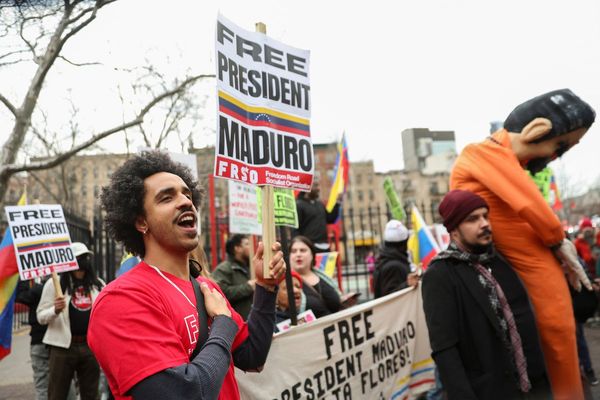
The most recent offensive has come in the run-up to and aftermath of the 3 January US operation in Venezuela to capture Nicolás Maduro. He now faces criminal charges in New York federal court, including “narco-terrorism conspiracy” for allegedly providing “law enforcement cover and logistical support” to major drug trafficking groups.
While the two events are apparently unrelated, the shake-up in Caracas could eventually affect Catatumbo, given the well-established links between the ELN, which operates in both countries, and some elements of the Venezuelan National Guard.
“We don’t understand about those things,” Alberto, in his thirties, said as his son slumped in the seat beside him, watching cartoons on a mobile phone. “We just know things in our region are bad. We couldn’t stay.”
The Cúcuta city government had registered the arrival of 2,048 displaced people from Catatumbo since 22 December and expects more in the coming days. Residents of the region say many of their neighbours have fled to the city of Ocaña. At the start of 2025, more than 60,000 people were forcibly displaced from the region by combat and selective killings.
This time around, both groups are reportedly using armed drones to target their enemies and anyone suspected of collaborating with them. “People tell me they are nervous working their fields, constantly on the lookout for the drones,” said Eliana Zafra, a member of the Permanent Committee on Human Rights in Cúcuta.
Juliana, a 50-year-old farmer from a village known as Filo Gringo (Gringo’s Edge) in the municipality of El Tarra, said the humming of the drones kept her and her husband on edge. The pressure, she said, contributed to his fatal heart attack a week ago. A few days later members of the Farc dissident group ordered her to leave her parcel of land immediately.
“I didn’t even have time to pack some clothes,” she said at the ombudsman’s office in Cúcuta next to a door marked with a makeshift sign that read “Victims.”
Juliana, who also asked that her real name not be used, said that since the US raid in Caracas, Venezuela’s National Guard troops on the other side of the border would not allow civilians to cross into the neighbouring country.
But Javier Flores, a security analyst who monitors the region for the Ideas for Peace thinktank in Bogotá, said he doubted there would be any immediate shift in criminal border dynamics.
“Everything changed, but it has remained the same,” he said, noting that the majority of Maduro’s government team is still in place, with his vice-president, Delcy Rodríguez, stepping in as interim president, with Trump’s blessing.
“They [the ELN] have clear communication with [Venezuelan] officialdom, and that officialdom is still in place,” Flores said.
In mid-December the ELN ordered civilians in areas under its control to stay home for three days to carry out military exercises in response to “intervention” threats from Donald Trump.
With a force of about 6,000 combatants, the ELN is present in more than a fifth of Colombia’s more than 1,100 municipalities, according to Insight Crime. Its presence in neighbouring Venezuela spans eight of the country’s 24 states, the thinktank found in a recent report.
Though it claims to be driven by leftist, nationalist ideology, the ELN is deeply involved in the drug trade and has become one of the region’s most powerful organised crime groups. While in Colombia it is considered an insurgent group, its support for the Maduro government has led some analysts to call it a paramilitary force there. InSight Crime, an organised crime research centre, says that the Venezuelan ELN provides territorial, social, and political control in return for access to criminal rents from illegal mining, drug trafficking and cross-border trade.
The ELN has taken part in failed peace negotiations with Colombia’s last five governments. Two years of talks with the government of the current president, Gustavo Petro – Colombia’s first-ever leftist leader – were suspended after the rebels intensified armed attacks in parts of the country.
However, peace talks with the broader 2,500 strong dissident group that includes the 33rd Front, known colloquially as “Calarcá’s dissidence” for the nom de guerre of its leader, continue. In November the government announced a partial agreement that includes a temporary zone of concentration in Catatumbo.
“The 33rd Front has strengthened with the negotiations, and what we see now is them trying to retake control of Catatumbo,” said Flores.
He said that if the US decides to pressure the leadership in Caracas to crack down on ELN presence in Venezuela, it might drive its fighters back over the border, making an already volatile region even more dangerous.
“Whatever happens, this won’t be good for the civilian population of Catatumbo,” said Zafra. “The conflict is going to intensify even more.”