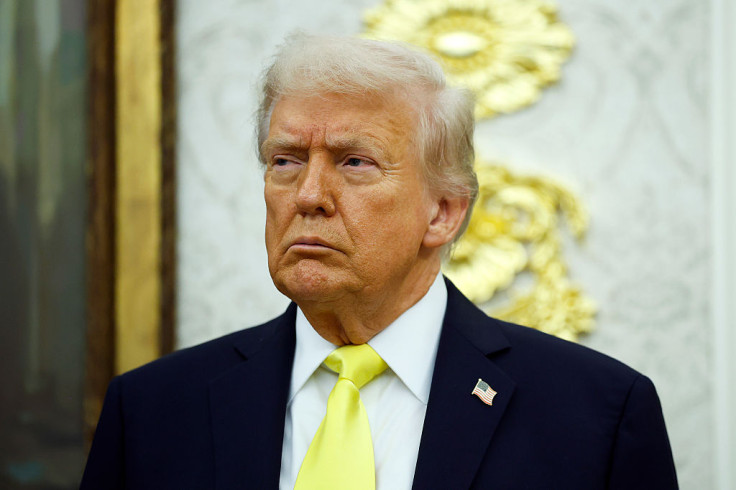
President Donald Trump shared a social media post featuring a Fox News interview in which a contributor predicted that he would visit a "Free Iran, free Havana and free Caracas" before he leaves office in 2028.
The video in question features Marc Thiessen, who made the claim while speaking with Mark Levin.
However, a report from CBS News last week noted that the Trump administration is not seeking to catalyze the collapse of the Cuban regime, but rather negotiate a transition away from its authoritarian communist system.
However, Havana has struck a defiant tone, with Cuban President Miguel Diaz-Canel recently saying the country is not holding talks with the U.S. except on some migratory issues.
In a social media publication, Diaz-Canel said the country has always "been willing to hold serious and responsible talks with the different U.S. governments, including the current one, on the basis of sovereign equality, mutual respect, principles of International Law, reciprocal benefit and without meddling in internal affairs."
"As history has shown, for relations between the U.S. and Cuba to move forward, they must be based on International Law rather than hostility, threats and economic coercion," he added.
The comments appear to be a response to a remark by Trump, who said during in early January that the U.S. was "talking to Cuba."
Diaz-Canel also responded on social media, saying that "those who hysterically drain against our nation do so sick with rage due to the people's sovereign decision to choose their political model."
"Those who blame the Revolution for the severe economic issues we are dealing with should shut up in shame. Because they know and recognize they are a result of draconian measures of extreme asphyxiation that U.S. exerts going back six decades and threatens to increase now," he added.
"Cuba is a free, independent and sovereign nation. No one tells us what to do. Cuba doesn't attack, it's attacked by the U.S. going back 66 years and it doesn't make threats, it gets ready, willing to defend the Homeland until the last drop of blood."
The comments also come in the context of the worst economic crisis the island is going through almost 70 years since the communist revolution, according to a recent report.
According to a recent poll, over three in four Cubans intend to flee the country. The survey was conducted by the Social Rights Observatory during the summer and reported by the Wall Street Journal as part of a broader piece about the country's crumbling economy.
The same poll showed that seven in ten respondents go at least without a meal a day and nearly 90% live in extreme poverty. Moreover, for over 70% of Cubans their main concerns are the lack of food and constant blackouts.


© 2025 Latin Times. All rights reserved. Do not reproduce without permission.
.jpg?w=600)