A leftwing South American firebrand calls for his followers to rally in public squares nationwide to defend his country’s sovereignty and decry verbal attacks from Donald Trump. The US president accuses the leader of personally flooding American streets with illegal drugs and imposes sanctions against him and his wife. Threats of military action are followed by a phone conversation between the two leaders.
One might imagine that this is a description of the buildup of tensions that led to the 3 January special forces raid on Caracas to capture the Venezuelan leader, Nicolás Maduro, and his wife, Cilia Flores, to face several criminal charges in New York.
But a similar script has been playing out in Colombia for the past year, leading to a volley of insults and threats between Trump and the Colombian president, Gustavo Petro, the country’s first ever leftwing leader.
Sandra Borda, a political analyst with the University of the Andes, said: “Trump has been doing to Petro the same thing that he did with Maduro, which is to link him directly as a person with drug trafficking.”
Despite the parallels, Colombia is not Venezuela, and Petro is no Maduro. While Maduro is widely believed to have stolen last year’s election from the opposition, Petro’s electoral win in 2022 has never been questioned. Maduro was indicted in a US federal court; Petro has no such charges against him. The deep institutional ties between Colombia and the US military and police forces are unrivalled in Latin America.
Even so, tensions between Colombia and the US reached their peak this week when Trump threatened military action against Colombia similar to the operation in Caracas and claimed Petro was a “sick man who likes making cocaine and selling it to the United States”. In response, Petro, a former guerrilla, said: “I swore not to touch a weapon again … but for the homeland I will.”
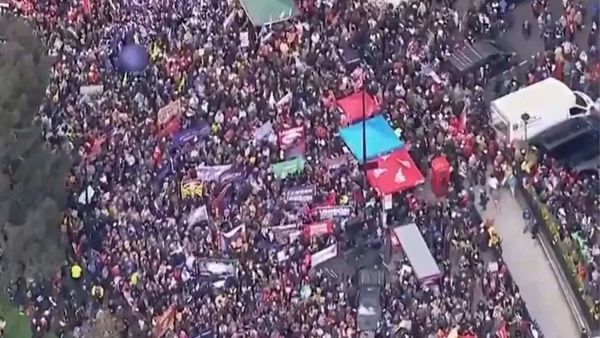
He called on his supporters to rally across the country on Wednesday, but just as he prepared to address the crowds he was patched through to Trump, with whom he spoke for an hour. The call, which the Colombian foreign ministry characterised as a “good meeting”, seemed to defuse the escalation. Trump said in a post on Truth Social that it had been an “honour” to speak to Petro and that he had invited the Colombian president to the White House.
Cynthia Arnson, a lecturer at Johns Hopkins University and an expert on Colombia-US relations, said: “It’s taken herculean efforts by diplomats on the Colombian and the US side to keep the relationship from imploding.”
But profound differences remain between the two leaders and the animus goes back to the first days of the second Trump administration.
Days after Trump took office in January 2025, Petro said his government would refuse to accept US military planes transporting deported Colombian citizens, demanding they be treated with “dignity and respect”. Trump shot back, imposing a 25% tariff on all Colombian goods and revoking the US visas of some government officials. After reaching an agreement on the flights, the US backed down on the tariffs.
In September, the US “decertified” Colombia for not doing enough to combat illegal drug production and trafficking, citing a sharp rise in cocaine production and blaming “the failures and incompetence of Gustavo Petro and his inner circle”. Despite the decertification, a waiver allowed US aid to continue to flow to Colombia.
A week later, during the UN general assembly, Petro stood on a New York street, megaphone in hand, addressing a pro-Palestine rally and called on American soldiers to disobey any illegal orders from their commanders. In response, the United States revoked his US visa.
In October, it placed financial sanctions on Petro, his wife, his son and the interior minister, Armando Benedetti, for what the treasury department claimed was “their involvement in the global illicit drug trade”.
While Colombia is the world’s largest producer of cocaine, there is no evidence that Petro, who was elected in 2022, is in any way involved in the business. Colombia’s narcotics trade is largely controlled by illegal armed groups such as the Gulf Clan, the National Liberation Army (ELN) and dissident factions of the Revolutionary Armed Forces of Colombia (Farc) guerrilla group, the majority of whose members demobilised after a 2016 peace deal.
Petro’s government has seized unprecedented amounts of cocaine – 836.8 tonnes between January and October 2025 – but these successes have been eclipsed by growing coca cultivation and potential for cocaine production, which the United Nations Office on Drugs and Crime (UNODC) reportedly estimated at 3,000 tonnes in 2024, although the official numbers have not yet been made public.
When the US began bombing suspected drug boats in the Caribbean and the Pacific, Petro accused US government officials of having “committed murder and violated our sovereignty in territorial waters”.
Drug trafficking was reportedly one of the principal issues discussed on the Petro-Trump call, with the Colombian president asking for US cooperation in combatting fighters of the ELN who often cross into Venezuela when attacked in Colombia, according to Benedetti.
Until the call between the presidents, Petro’s brash demeanour had made him a lightning rod for Trump and members of his administration. The Colombian president seems to thrive on conflict, as he enjoys posting long rants on social media and giving lengthy, often rambling speeches. “The more I am attacked, the more support I get,” he once told a reporter.
Though many of Latin America’s left-leaning leaders, including Claudia Sheinbaum in Mexico and Luiz Inácio Lula da Silva in Brazil, have clashed with Trump, Petro is “in his own category”, said Adam Isacson, of the Washington Office on Latin America, an NGO. “This is a leader who is every day saying what he thinks about Trump and using very strong language,” he said.
Petro’s rebellious nature began when he joined the M-19 urban guerrilla group at the age of 17. He ascended swiftly into the political wing of the organisation. When he was chosen to serve as his home town’s ombudsman in 1981, he was already an active but covert M-19 member. He was detained by the army in 1985 for possessing weapons – which he said were planted – and subjected to four days of torture by the army. Petro claimed he had never engaged in combat.
The M-19 was of the first guerrilla groups to demobilise in 1990 and seek a role in traditional politics after peace talks. After helping draft a new constitution, Petro won a seat in congress, starting a long legislative career in which he won the most votes of any representative in 2002.
From his congressional seat, Petro presented evidence of collusion between politicians and rightwing paramilitary leaders that implicated allies of the then president, Álvaro Uribe. Many of those Petro accused were eventually convicted. Petro was elected mayor of the Colombian capital, Bogotá, in 2011 for a tumultuous four-year term during which he was briefly removed from office by the country’s inspector general. After several failed bids for the presidency, he was elected to the nation’s top post in 2022.
Borda said the Colombian president’s assertiveness could backfire. “If Petro insists on provoking Trump, it will become more costly politically in terms of the domestic political process,” she said.
Colombia will hold legislative elections in March and the first round of a presidential vote in May. Petro, whose term ends on 7 August, is constitutionally barred from seeking a second term.
Isacson said a belligerent US stance toward Colombia could boost the leftwing candidate, Iván Cepeda. “This sort of new aggressive United States – that is a perfect issue for the left,” he said.
Reacting to the US threats of military action in the country, the rightwing candidate Paloma Valencia, of the Democratic Centre party, said on X: “Our legal and political reality is different from Venezuela’s. We will beat [Petro] and his heirs with votes at the ballot boxes … without intervention from anyone.”
The animosity between Petro and Trump will probably not have disappeared with one telephone call, and Maduro spoke with Trump less than two months before his capture. But Borda said the conversation and the announced meeting in Washington was “a step in the right direction”.