The White House's top economic adviser has suggested that record-low consumer confidence is a byproduct of President Donald Trump doing too much good, too fast.
National Economic Council Director Kevin Hassett told CNBC on 11 May 2026 that the pace of change under Trump was simply 'stressful for people to see,' framing the historic slump as evidence of ambition rather than failure.
His remarks landed on the same day the University of Michigan released preliminary May figures showing its Index of Consumer Sentiment at 48.2, the lowest reading in the survey's 74-year history. The survey's own director pointed directly to petrol prices and tariffs, not political progress, as the drivers.
Hassett's CNBC Remarks and the White House's Defence of the Economy
In a clip shared on X by FactPost on 11 May 2026, Hassett outlined his theory for the collapse in confidence. 'I think that one of the things that's happening is that the world is changing so fast right now that President Trump has sort of taken every problem on Earth and gone 100% at fixing it,' he told CNBC. 'And I think that can be stressful for people to see so much change going on.' He closed the segment with a note of confidence for his party: 'Right now, Republicans should feel very, very good about the trajectory of the economy.'
Top Trump econ advisor claims consumer sentiment is at a record low only because Trump is doing such a good job:
— FactPost (@factpostnews) May 11, 2026
"Trump has sort of taken every problem on Earth and gone 100% at fixing it. And I think that that can be stressful for people to see so much change going on" pic.twitter.com/TwkEUJ5U15
This is not the first time Hassett has drawn attention for minimising consumer hardship. In March 2026, he told CNBC that the economic pain tied to the Iran conflict was 'the last of our concerns right now,' adding that the administration was confident the war would end on schedule.
On 10 May 2026, the day before the latest sentiment data dropped, he separately suggested that once the Strait of Hormuz reopens, oil prices could fall 'relatively quickly,' predicting it could happen 'a month or two after a deal,' according to reporting aggregated by financial commentator Mario Nawfal on X.
🇺🇸⛽ Gas is at $4.52. The White House says a "gusher of oil" is coming. Just hang tight.
— Mario Nawfal (@MarioNawfal) May 10, 2026
- NEC Director Kevin Hassett says once the Strait reopens, oil prices could drop "relatively quickly" and ahead of the midterms
- Reopening could take "a month or 2" after a deal
- Goldman… https://t.co/PJSlwNvQDz pic.twitter.com/LsR15DuOuk
The administration has framed the April jobs report as partial validation of its economic management. Employers added 115,000 jobs that month, ahead of expectations, and the unemployment rate held at 4.3%. Those figures gave the White House material to work with, even as the consumer mood data told a different story.
University of Michigan Survey Results and What Respondents Actually Said
The preliminary May reading of 48.2 broke the record set just one month earlier. April's final figure had been revised up slightly to 49.8, itself the lowest on record, surpassing readings seen during the 2008 financial crisis, the Covid-19 shutdowns of 2020, and the post-pandemic inflation peak of June 2022.
The University of Michigan's Surveys of Consumers have tracked American economic attitudes since the early 1950s, making the May 2026 reading the most negative in the data's entire recorded history.

Survey director Joanne Hsu was specific about the causes in the official release. 'About one-third of consumers spontaneously mentioned gasoline prices and about 30% mentioned tariffs,' she said. 'Taken together, consumers continue to feel buffeted by cost pressures, led by soaring prices at the pump.' She added that no meaningful recovery was likely in the near term: 'Middle East developments are unlikely to meaningfully boost sentiment until supply disruptions have been fully resolved and energy prices fall.'
The decline was described in the survey as near-universal. Every component of the index fell, and 'demographic groups across age, income, and political party all posted setbacks in sentiment,' according to the release. The Current Economic Conditions sub-index dropped 9% in early May to 47.8, driven by concerns over high prices for both everyday finances and big-ticket purchases. Economists polled by Dow Jones had forecast a reading of 49.7; the actual figure came in well below that.
Petrol Prices, Iran, and the Inflation Forecast Behind the Numbers
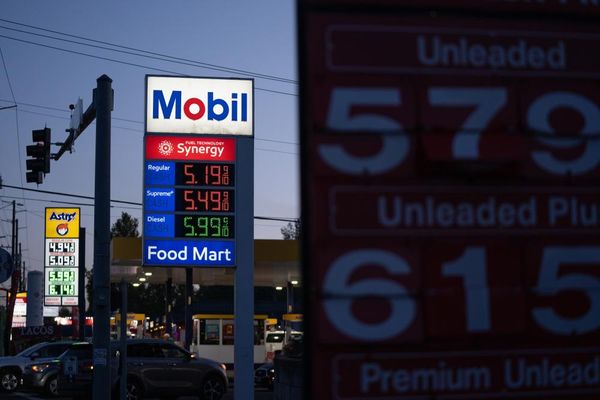
The connection between the Strait of Hormuz and household budgets is traceable and direct. Trump launched military action against Iran in late February 2026, sending crude oil prices up roughly 40%. National average petrol prices rose by more than £1.15 ($1.50) per gallon since the conflict began, according to AAA data cited by Yahoo Finance, pushing the national average toward £3.85 ($5) per gallon by early May. In California, prices had already exceeded £4.62 ($6) per gallon.
Year-ahead inflation expectations recorded in the May survey stood at 4.5%, up from the 3.4% reading in February before the conflict began, and substantially above the 2.3% to 3% range that prevailed in the two years prior to the pandemic. Long-run expectations remained at 3.4%, more than a full percentage point above the Federal Reserve's 2% target. Economists have warned the Personal Consumption Expenditures price index could hit 4% by year-end, which would represent double the Fed's stated target rate.
The Strait of Hormuz, a narrow waterway through which approximately 20% of the world's crude oil ordinarily flows, remains effectively closed despite ceasefire discussions. Its closure has kept energy costs elevated even as diplomatic language softened. Hassett's suggestion that relief is one or two months away hinges on assumptions about a negotiated resolution that have not yet materialised.
Hassett's argument that public anxiety is simply the cost of governing boldly runs directly into the responses of the Americans who filled out the University of Michigan's questionnaire.