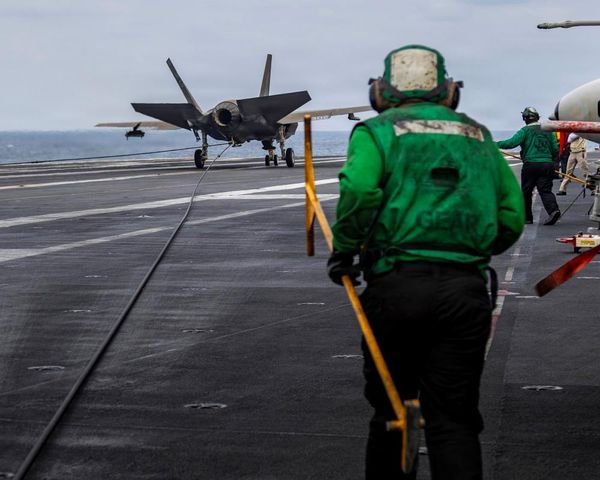
Have Donald Trump’s hard talk and the arrival of a strike-ready flotilla finally made Tehran blink? It certainly seemed so by Monday evening, when Iran said it was willing to talk. A week of trading threats turned to strong indications that Steve Witkoff, Trump’s envoy, and Abbas Araghchi, Iran’s minister for foreign affairs, were readying to meet in Istanbul on Friday. In this week’s big story, Ashifa Kassam and Andrew Roth chart how momentum to war slowed and fears of a wider regional conflict eased, albeit marginally.
The background to Trump’s war of words against Tehran was the huge protests that rocked Iran last month, until they were brutally repressed by the regime. Analysts suggest a fragile domestic security situation prompted the Iranian government’s softening towards US demands. Our diplomatic editor and longtime Iran watcher, Patrick Wintour, explains that while the streets are now quiet, a shift in the balance of power between the people and the government has emboldened domestic demands for a full investigation of the killing and imprisonment of protesters.
It may seem that the US holds all the cards to force a deal, but Dan Sabbagh’s analysis of American military deployments in the region suggests that if Washington and Tehran can’t find common ground, a repeat of Venezuela – where regime change was effected easily last month – will be hard against Iran, and in a far more unstable region.
Get the Guardian Weekly delivered to your home address
***
Five essential reads in this week’s edition
Spotlight | The Epstein files, part two
Daniel Boffey details the biggest bombshell among the 3m newly released documents: disgraced former minister Peter Mandelson’s deep and compromising relationship with the convicted paedophile
Environment | Nature runs wild in Fukushima
Free of human habitation after the 2011 earthquake, tsunami and nuclear meltdown, Fukushima is now teeming with wildlife. But this haven could vanish if people come back, finds Justin McCurry
Features | From hope to despair
The postwar new town of Newton Aycliffe with its boarded up shops is a symbol of the Britain’s economic gloom – and a warning for Labour as it battles the rise of Reform UK, reports Josh Halliday
Opinion | Art, groceries, Greenland – thieves are everywhere
Jonathan Liew reflects on how we all seem to live in a world defined by petty theft and no one, whether it’s the pickpocket or the big AI company, seems to get punished
Culture | Small acts of magic
Mackenzie Crook tells Zoe Williams how his approach to comedy has mellowed with age. Gone is the nervous, awkward energy of Gareth from The Office, to be replaced by the gentle curiosity that animates his new series Small Prophets
***
What else we’ve been reading
If you’ve ever admired Britain’s brilliantly clear and consistent system of road signage, you have the designer Margaret Calvert to thank. Now aged 90, she has become a bona fide national treasure, as this affectionate profile reveals. Graham Snowdon, editor
The crowd is hushed. The judges are ready. The skater, dressed as a Minion, is poised on the ice rink for the start of the music ... and then nothing. The Winter Olympics needs to stop falling foul of despicable copyright slip ups. Neil Willis, production editor
***
Other highlights from the Guardian website
• Audio | Will China replace the US on the world stage?
• Video | ‘You feel part of the family’: inside the scheme helping ethnic minority referees
• Gallery | Catherine O’Hara – a life in pictures
***
Get in touch
We’d love to hear your thoughts on the magazine: for submissions to our letters page, please email weekly.letters@theguardian.com. For anything else, it’s editorial.feedback@theguardian.com
***
Follow us
Get the Guardian Weekly magazine delivered to your home address