

Red Bull is unveiling its new RB22 Formula 1 car in the United States on Thursday, following a tricky 2025 campaign where Max Verstappen nearly overcame a 104-point deficit to win a fifth consecutive title. This prowess is largely irrelevant, however, as F1 switches to new technical regulations on both the chassis and engine sides, with the Red Bull team itself going through a management overhaul.
What's new at Red Bull?
Many things. In fact, the team is vastly different now compared to its set-up when it tackled the 2024 season as the reigning world champion.
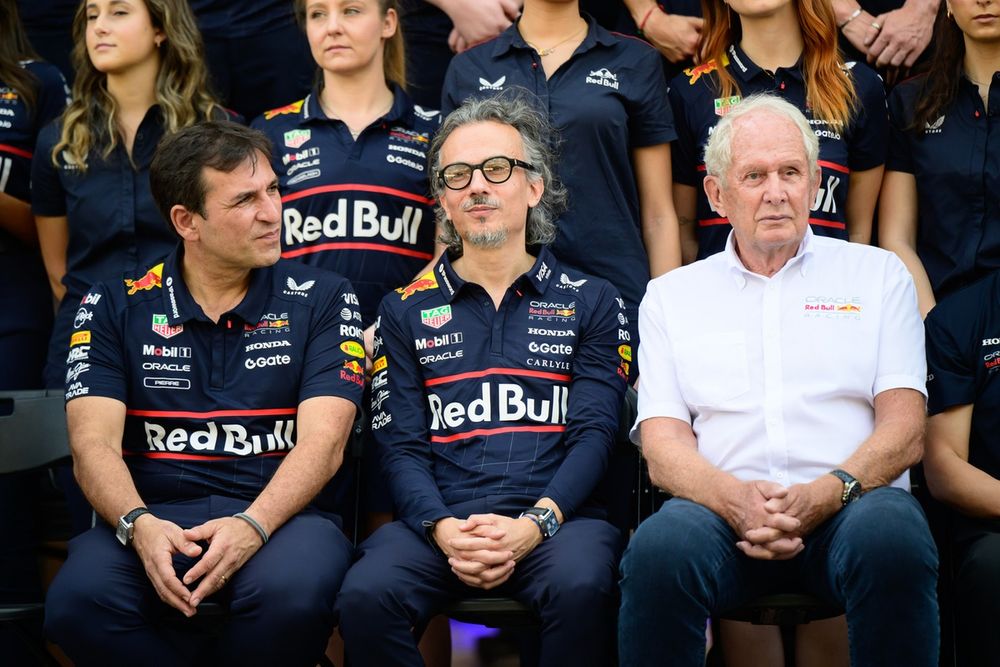
Team principal Christian Horner, chief technical officer Adrian Newey, sporting director Jonathan Wheatley, head of strategy Will Courtenay and advisor Helmut Marko are the highest-profile figures who have left the Milton Keynes-based squad in the past two years – with the latter two departing recently.
Others have stepped up; Red Bull promoted Racing Bulls team principal Laurent Mekies to the main team, Pierre Wache now leads the technical team without Newey’s oversight, and Verstappen’s race engineer Gianpiero Lambiase has taken on additional responsibilities as head of race engineering.
Marko’s departure is unlikely to have repercussions given his diminishing influence and minor impact on actual performance – unlike Courtenay’s defection to McLaren, but Red Bull will retain principal strategy engineer Hannah Schmitz’ services. Schmitz has been credited with a number of race-winning tactical calls, not least pitting as both McLarens stayed out under the safety car in the 2025 Qatar Grand Prix.
Meanwhile, Red Bull also has a new driver line-up. Yuki Tsunoda has been demoted to a reserve role after an underwhelming 2025 season, with Isack Hadjar promoted to the main team for only his second campaign in the world championship. The Frenchman impressed in his rookie season at Racing Bulls, where he had the upper hand on team-mate Liam Lawson and took a maiden podium finish.
What's the biggest challenge to Red Bull?
The main change at Red Bull, however, is also its biggest challenge: using its own power units, in collaboration with Ford.
That decision was made in light of Honda’s departure from F1, which the Japanese brand backtracked on when it realised how competitive Red Bull had become – but the team had already committed to its new project.
Becoming a new engine manufacturer in F1 is a tall order, however, as shown by Honda’s earlier ordeal with McLaren. At the time, Honda had joined 12 months into the new-for-2014 regulations, which proved to be poor timing as it spent years catching up with its rivals. It won’t be the case for Red Bull-Ford, but even with revamped regulations that emphasise electric power, being as competitive as established engine makers from the get-go would be remarkable.
A number of former Mercedes engineers and Ford’s expertise will be particularly beneficial in that regard.

What's the strongest asset to Red Bull?
Red Bull’s strongest asset, without a doubt, is Verstappen. The four-time world champion proved his calibre again in 2025 as he launched an unlikely title bid to end up two points adrift of Lando Norris in the F1 standings, despite a theoretically slower Red Bull car compared to the McLaren.
Of course, whatever Verstappen is able to achieve in 2026 will hinge on how competitive his car will be. No driver ever truly outperforms their car; the Dutchman has certainly been the best at getting 100% out of his, but even he arguably can’t turn a midfield car into a title contender.
What's the goal in F1 2026 for Red Bull?
As the team which has won the most titles in the 2020s so far, Red Bull can hardly aim at anything other than victories and a potential title. In fact, the new RB22’s success will largely depend on how competitive and reliable the Red Bull-Ford powertrain is. In turn, this will influence the team’s ability to retain Verstappen for the future.










Read and post comments