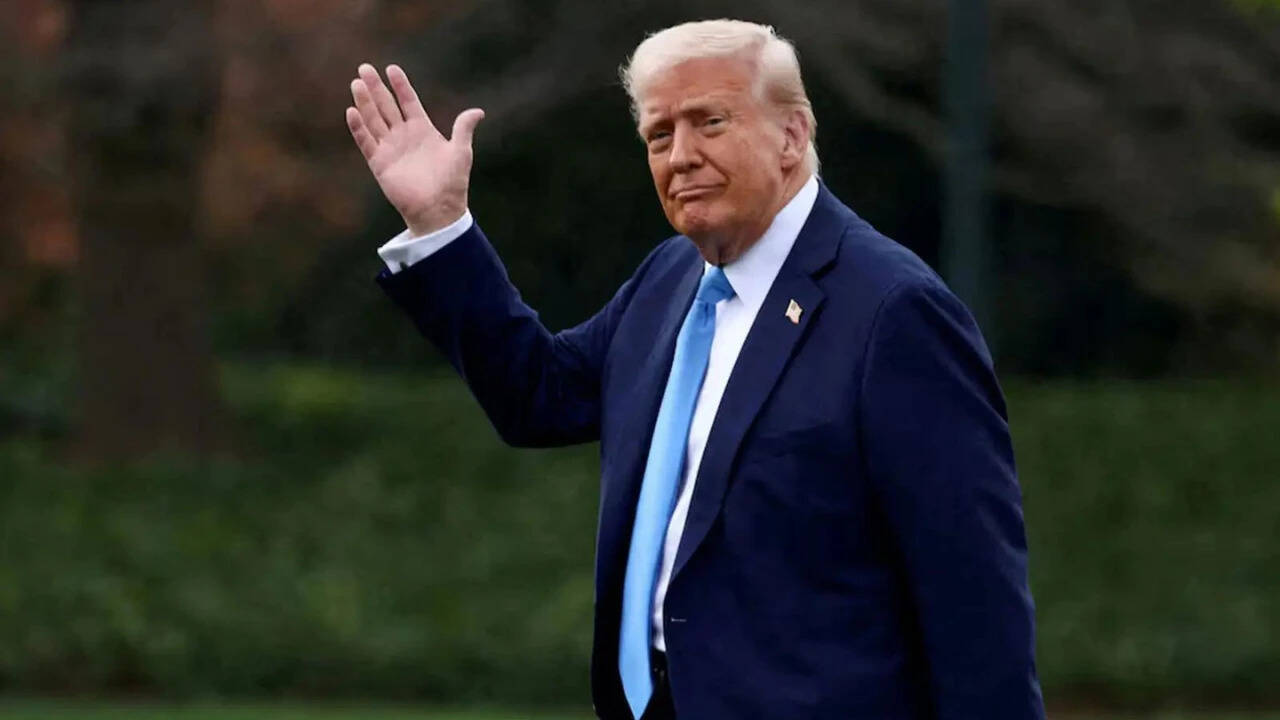
TOI Correspondent from Washington: The “Peace President” has just submitted the most expensive war bill in the history of the United States.
The Trump White House on Friday formally requested the US Congress to approve a staggering $1.5 trillion for defence in the 2027 fiscal year. If enacted, the figure would not only set military spending at its highest level in modern history but would also represent a seismic 40% hike over the previous fiscal, a jump last seen during World War II.
For decades, a popular refrain in defence circles was that Washington spends as much on defence as the next seven countries combined. Under this new proposal, the US is poised to surpass the combined defence spending of the next 10 countries, including China, Russia, India, Saudi Arabia, and the UK.
While the US pushes toward the $1.5 trillion mark, its nearest peer competitor, China, remains a distant second. Though Beijing has accelerated its own military modernisation, its estimated 2026 spend hovers around $310 billion (adjusted for Purchasing Power Parity, the figure is closer to $500 billion, but still barely a third of the new US request).
India, currently the world’s fifth or sixth largest spender, operates on a budget of approximately $85 billion. In short, Trump’s requested increase alone—roughly $430 billion—is larger than the entire annual military budget of China.
The glaring paradox of this budget is the man requesting it. President Trump has spent the last year professing to be the “Peace President,” and clamouring for the Nobel Peace Prize, frequently citing his efforts to de-escalate the 2025 India-Pakistan skirmish — and seven, eight, nine or 10 other wars — and his “America First” reluctance for foreign entanglements.
However, his administration’s logic is a 21st-century update to the Reagan-era “Peace Through Strength” mantra. White House officials argue that the current Iran War (Operation Epic Fury) and the rapid depletion of precision munitions in the Persian Gulf have exposed a “hollowed-out” industrial base. The $1.5 trillion is being framed not as a budget for expansion, but as a mandatory “recapitalisation” of the American arsenal to prevent a larger conflict with China. By making the US military “too big to challenge,” Trump argues he is ensuring a peace that diplomacy alone cannot buy.
Critics argue the military-industrial complex, red-flagged by a military commander-turned-president Dwight Eisenhower, is currently enjoying a free run devoid of traditional oversight. For the “Big Five” defence contractors — Lockheed Martin, Boeing, RTX (Raytheon), Northrop Grumman, and General Dynamics — this budget will be a generational windfall.
Despite the “National Security” argument, the $1.5 trillion request is expected to meet fierce resistance even in a fractured Congress. Lawmakers like Alexandria Ocasio-Cortez and other progressives have labelled the budget “obscene,” pointing out that the 40% increase in defence spending is being offset by proposed cuts to domestic healthcare and education. Others are warning of the US becoming a military state with money being diverted from essential services to law enforcement. Some of Trump’s own allies are balking at the price tag, with deficit hawks expressing concern that a $1.5 trillion defence bill, coupled with 2025’s tax cuts, will push the national debt into a “terminal spiral.” For many, the way Washington is spending dollars makes no sense.