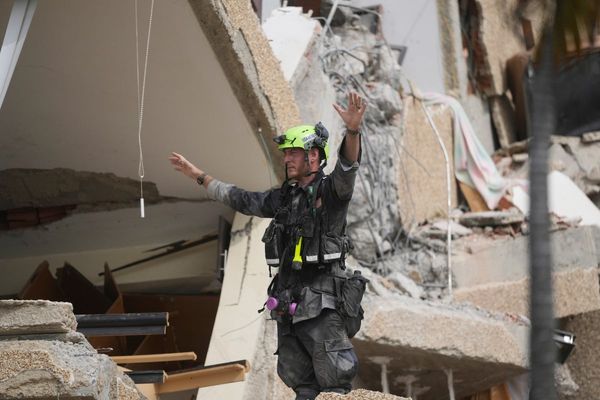
A strong aftershock has rattled northern Venezuela, sending terrified residents racing on to the streets five days after the twin earthquakes that killed 1,719 people, left tens of thousands missing and triggered a growing humanitarian emergency.
The aftershock early on Monday – which the US Geological Survey measured at a magnitude of 4.6 – shook the capital, Caracas, and the devastated port city of La Guaira, where rescue crews are still hoping to pull as many survivors as possible from the rubble. Colombia’s geological survey put the aftershock’s magnitude at 5.1.
Although Jorge Rodríguez, the leader of the Venezuelan national assembly, said there were no immediate reports of new damage, the trembling earth and sounding of quake sirens brought fresh panic to Caracas and La Guaira.
“I was asleep when the shaking woke me up. It felt almost as strong as Wednesday’s earthquake, even though I hadn’t felt the other aftershocks,” said Amarelis Mendoza, a resident of El Hatillo in Caracas.
In the hardest-hit areas of the capital – including Altamira and San Bernardino – people poured on to the streets from the makeshift shelters where they had been staying. Many have been sleeping outside apartment buildings or in tents pitched along sidewalks, fearing further collapses.
Several lines of the Caracas metro were shut down again over concerns that additional aftershocks could further damage already weakened infrastructure.
In San Bernardino, search operations at the 22-unit Rita apartment building, which collapsed completely during last week’s earthquake, were suspended for about an hour and a half following Monday’s tremor.
As the new week began, some businesses across the capital started to reopen. But the number of people seeking refuge in parks and public squares continues to grow as the humanitarian crisis deepens.
Hundreds of displaced families from Caracas and beyond have been camping out in Parque del Este, a 200-acre park in the east of the capital.
“Life is worth more than anything else,” said 35-year-old Katiuska Asuaje, who fled her home in the La Cruz sector of Bello Campo in Caracas with four children.
“We weren’t going to wait for the house to collapse on top of us because one of the concrete roof slabs had already come loose.”
Maryuri Pérez, 36, and Jaime Blanco, 40, had nowhere to go back to after their shack in west Caracas collapsed.
“What we need most is a tent or at least a mattress to sleep on,” said Pérez. “Thank God the neighbours have been bringing us food, but we have nowhere to sleep.”
The aftershock came as local people and Venezuelan and international search teams continued to comb the rubble for survivors of last Wednesday’s back-to-back quakes, which measured magnitude 7.2 and 7.5.
The rescue of a man and his teenage son who were pulled alive from the rubble in La Guaira state on Sunday offered a brief moment of optimism.
“Today we have rescued people who are still alive and therefore these efforts will not be suspended,” said Venezuela’s interim president, Delcy Rodríguez.
But the chances of similar rescues are dwindling. A Salvadoran rescue worker, who declined to give his name, told Agence France-Presse: “At this point, they are probably dead bodies. Thanks to God maybe we can find people still alive.”
According to the government, which has been criticised for its slow response and lack of preparation for the disaster, 5,034 people were injured and almost 800 buildings were badly damaged when the quakes hit.
Tens of thousands of people are still missing well after the closure of the critical 72-hour window for rescuing trapped victims following a natural disaster, while millions more lack sanitation and other basic necessities.
Even as rescue efforts continued, outbreaks of looting hit La Guaira, which is near the country’s main international airport. Much of the city now lies in rubble after last week’s disaster. Pharmacies, supermarkets and other businesses were ransacked, said residents, some of whom complained of the slow and meagre post-quake aid coming from authorities.
The authorities have barred international journalists from entering the collapse zones in La Guaira for 48 hours, saying the restriction had been imposed for security reasons.
Exasperation has boiled over in some areas where people claim that authorities have not done enough to rescue earthquake victims.
“The country needs you. Put down your weapon,” one man shouted to soldiers in the Tanaguarena area of La Guaira state, urging them to swap their guns for picks and shovels.
Twenty-four nations have so far sent 521 tonnes of supplies, 86 units with dogs trained to locate people trapped beneath the rubble and more than 2,700 search-and-rescue personnel, she said.
The UN migration agency said that up to 6.76 million people could be affected by the disasters, and would require shelter, water, sanitation, healthcare and essential relief items.
Venezuela’s worst earthquakes in more than a century have come after the oil-rich country endured more than a decade of economic collapse. The crisis has hollowed out hospitals and public services, driving millions to leave the country.
The UN has put the bill for physical repairs at $6.7bn (£5bn) – equivalent to 6% of Venezuela’s GDP. On Monday, the US announced it was doubling its aid package from $150m to $300m.
“These funds will provide emergency medical care, food assistance, water and sanitation, shelter, protection, and logistics,” the state department said.
The Venezuelan opposition figure María Corina Machado, who is in exile, announced she would return “very soon” to her homeland.
“The time has come,” she told the US broadcaster Fox News on Sunday. “We need to be together, to embrace, to grieve and mourn together, but also to give each other strength at this difficult time.”
Agence France-Presse, the Associated Press and Reuters contributed reporting