Australia’s submarine agency insists the Aukus agreement is progressing “at pace and on schedule”, but sceptics of the $368bn deal argue the chances of the US ever selling promised Virginia-class submarines to Australia are increasingly remote.
The former prime minister Malcolm Turnbull has said the Australian government is engaged “in an exercise of denial” about the parlous state of Aukus’s progress, while the Greens senator David Shoebridge said the deal was a “pantomime”, hopelessly one-sided in the US’s favour.
A new United States congressional report has openly contemplated the US navy not selling any nuclear submarines to Australia – as promised under Aukus – because the US wants to retain control of the submarines for a potential conflict with China over Taiwan.
The January report by the US Congressional Research Service, Congress’s policy research arm, posits an alternative “military division of labour” under which the submarines earmarked for sale to Australia are instead retained under US command to be sailed out of Australian bases.
The report argues both for and against the US selling three Virginia-class submarines to Australia, beginning in 2032. But it makes the case that, in the event of a “conflict or crisis” with China over Taiwan, submarines under Australian command could not be ordered into operation, whereas US-commanded vessels, operated out of Australian bases, could be immediately deployed. Australia has consistently maintained it could offer no guarantees of supporting the US in a conflict with China.
“This could weaken rather than strengthen deterrence and warfighting capability in connection with a US-China crisis or conflict,” the report says.
The defence minister, Richard Marles, dismissed the report as “commentary” when asked on Thursday, insisting Aukus was “full steam ahead”.
“You’re going to hear a whole lot of commentary at the end of the day from the US Congress,” Marles said.
“We’ve heard the US president make clear the position of the United States in respect of this question, and he has said that we are full steam ahead in respect of this, and it includes the transfer of the Virginias.”
A spokesperson for the Australian Submarine Agency told the Guardian that Aukus remained firmly in the strategic interests of its three partners – Australia, the US and the UK – and that “Australia’s commitment to the Aukus partnership is unwavering”.
“All three Aukus partners are investing significantly in our respective industrial bases to ensure the success of Aukus, to meet respective requirements and timelines, including the delivery of three Virginia-class submarines to Australia by the US.”
Sign up: AU Breaking News email
The spokesperson said Aukus was progressing “at pace and on schedule”.
“The optimal pathway has been designed to ensure a methodical, safe and secure transition from Australian conventional submarines, drawing on more than 70 years’ experience and expertise of our Aukus partners in the safe and effective operation of naval nuclear propulsion.”
Turnbull: ‘It’s always been a bad deal for Australia’
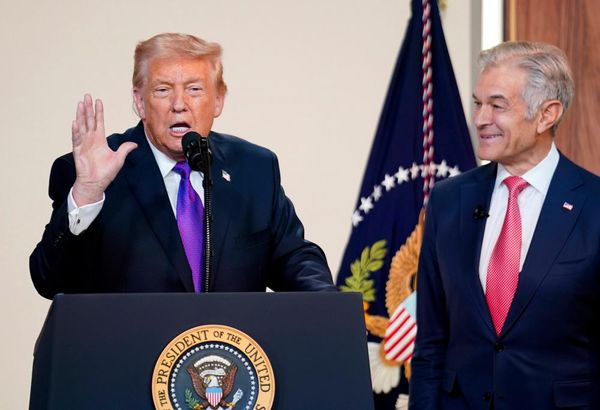
Politically, in the US the Aukus agreement won approval from a Pentagon review last year, which supported the deal continuing. President Donald Trump – who won’t be the president to decide whether or not to sell US submarines to Australia – told reporters the deal was “full steam ahead”.
But Turnbull, the prime minister whose deal to buy submarines from the French group Naval was torn up by Scott Morrison in favour of Aukus, has long argued the Aukus agreement has always been irretrievably lop-sided in the US’s favour.
“The Aukus deal is a very attractive one for the Americans because they get a submarine base and dockyard at Australia’s expense in Western Australia, and they do not have any obligation to sell any Virginia-class submarines to us unless their navy can spare them.
“If the US say ‘there are no subs for you Australia’, it is not reneging on the deal: that is the deal, that is what Australia signed up to. That’s why it’s always been a bad deal for Australia.”
The congressional research report highlighted, again, the lagging rates of US shipbuilding.
For the past 15 years, the US navy has ordered Virginia-class submarines at a rate of two a year, but its shipyards have never met that build rate “and since 2022 has been limited to about 1.1 to 1.2 boats per year, resulting in a growing backlog of boats procured but not yet built”.
The US fleet currently has only three-quarters of the submarines it needs (49 boats of a force-level goal of 66). Shipyards need to build Virginia-class submarines at a rate of two a year to meet the US’s own needs, and to lift that to 2.33 boats a year in order to be able to supply submarines to Australia.
Legislation passed by the US Congress prohibits the sale of any submarine to Australia if the US needs it for its own fleet. The US commander in chief – the president of the day – must certify that the US relinquishing a submarine “will not degrade the United States undersea capabilities”.
Turnbull said US shipbuilding rates had “remained stubbornly set at that low level for a long time, despite many billions of dollars of extra investment”, and that expecting build rates to almost double within a couple of years in order to supply Australia with vessels was unrealistic.
“The Australian government seems to be engaged in an exercise of denial: whenever these figures come out they have apologists who say ‘everything’s fine, there’s nothing see here’.”
Senator David Shoebridge, the Greens’ defence and foreign affairs spokesperson, said the US’s division of labour proposal exposed the “pantomime” that the Aukus agreement was concerned with Australia’s defence.
“No matter what flag is painted on the side of any nuclear submarines Australia gets, they will be US-controlled and US-directed.
“Critics of Aukus have always assumed that the US will not hand over any nuclear submarines unless Australia guarantees they will use them in a US war with China. This report now confirms this is the dominant view in Washington.”
Shoebridge said the Aukus deal was dangerously compromising Australian sovereignty to US interests, at the cost of billions in public funds.
“The fact that Trump, with his ‘America first’ approach to squeezing and humiliating US allies, is willing to press on with Aukus tells you all you need to know about the one-sided deal. If Trump wants it, we should resist it.”