
A new Covid variant is spreading across the U.S. and it may be able to evade protection from current vaccines.
The variant, known as BA.3.2, has been detected in nasal swabs taken from four American travelers and clinical samples from five patients in four unidentified states. It’s also been found in three airplane wastewater samples and 132 wastewater samples taken in more than 20 states, suggesting that its reach is actually far more widespread than what scientists see right now.
Descended from omicron, BA.3.2 was first detected in South Africa in 2024 and in the U.S. in June 2025 in a traveler from the Netherlands. The variant began really surging in September 2025 and has since been reported in 23 countries.
Its evolution was similar to the variant BA.2.86, which emerged in 2024 and later evolved into JN.1: the dominant Covid variant in 2024. But the new strain is “genetically distinct from the JN.1 lineages that have circulated in the United States since January 2024,” researchers warned in the Centers for Disease Control and Prevention’s Morbidity and Mortality Weekly Report.
That could warrant updating current vaccines, which only target JN.1’s subvariants and provide protection against predominant U.S. variants.
BA.3.2 carries approximately 70 to 75 genetic changes in its spike protein - a part of a coronavirus that allows it to enter human cells - that make it easier for a virus to spread more easily and evade immune protection.
Lab studies showed that the new BA.3.2 strain evades the body’s protective antibodies activated by Covid vaccines “likely because of spike protein mutations,” highlighting the need for more data on the effectiveness of the shots.
“The 2025–2026 LP.8.1-adapted mRNA Covid-19 vaccine demonstrates protection against currently predominant JN.1 strains but had the lowest antibody neutralization against BA.3.2 in a laboratory study of seven variants, potentially affecting vaccine-conferred protection,” the researchers said.
So, how concerned should Americans be?
BA.3.2 has been found in California, Connecticut, Florida, Hawaii, Idaho, Illinois, Maine, Maryland, Massachusetts, Missouri, New Hampshire, New Jersey, Nevada, New York, Pennsylvania, Rhode Island, South Carolina, Texas, Utah, Vermont, Virginia, Wyoming, Louisiana, Michigan and Ohio.
Still, the consequences of this evasive variant largely remain to be seen.
BA.3.2 isn’t one of the dominant Covid variants in the U.S., but other offshoots of omicron are, according to a CDC tracker. Reported cases have not been more severe than other infections, either.
The variant was detected in hospitalized patients in December and January in three unidentified U.S. states.
The patients included two hospitalized older adults with additional health conditions - including one who had been admitted for heart care - and a young child who received outpatient care.
All of the patients survived and the researchers said detection in hospitalized patients does “not necessarily indicate that the variant causes more severe disease, nor does it establish any association with risk factors.”
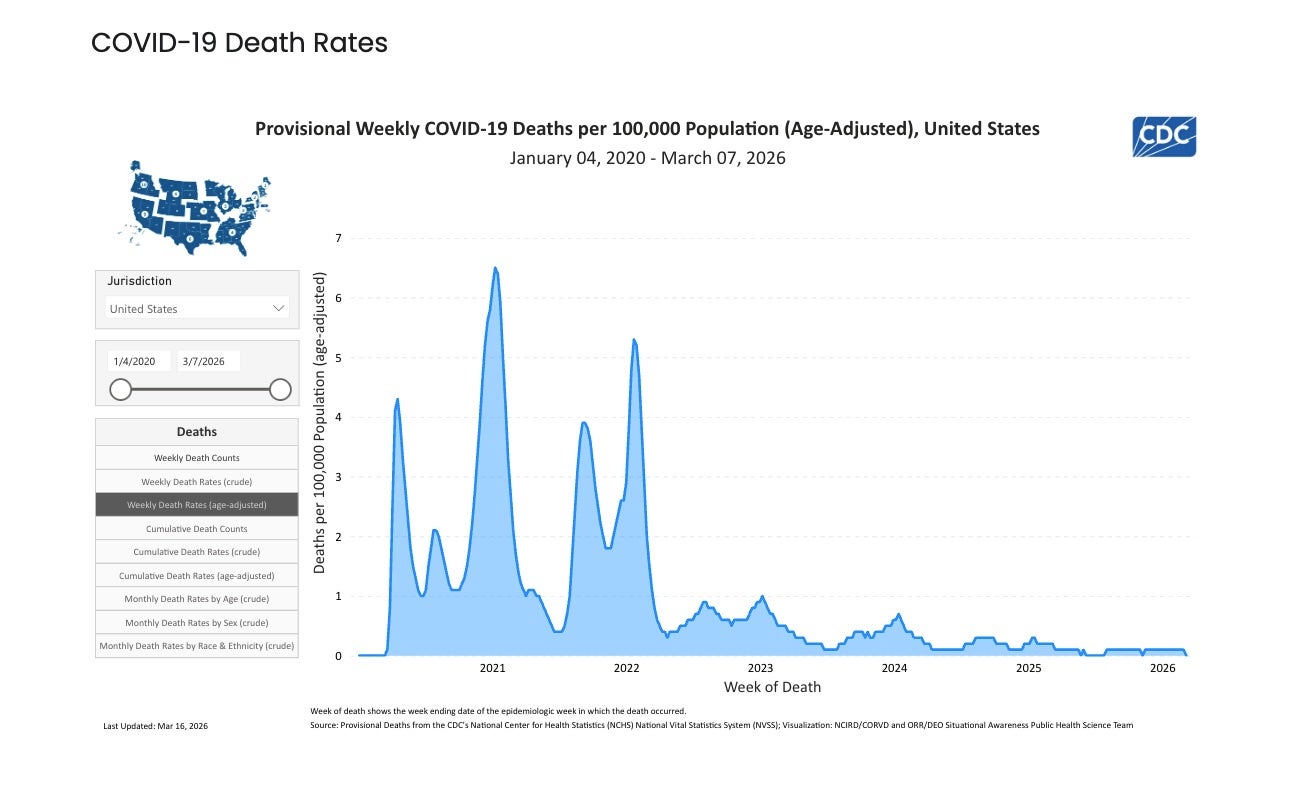
Still, with Covid now considered endemic, viruses will continue to mutate and there are dozens of variants spreading right now. They may not change that much, but scientists say we should still be ready to tune our response accordingly.
"Every time the virus replicates it's basically buying a couple evolutionary lottery tickets," Angela Rasmussen, a virologist at the University of Saskatchewan, told NPR last year.
"Most of those are losers. But sometimes it hits a winner,” she said. “So the key that people should think about, if they want to slow that process, is: Don't give the virus more opportunities to replicate. Don't let it buy any new lottery tickets."
This year, other respiratory illnesses appear to have outpaced Covid during its seasonal winter surge, including flu and RSV. There will likely be another chance for increased cases in summer, which has seen an influx over the years since the pandemic’s start in the U.S.
Covid deaths have fallen since last year. So have positive Covid tests and emergency room visits for infections.
But thousands of people are still dying. There have been more than 3,600 Covid deaths so far this year, CDC data shows.









.png?w=600)




