In the immediate aftermath of Donald Trump’s address investors were back to selling almost everything except the US dollar and sending oil prices higher. US stock futures slid 1% while European futures sank over 1.5%. Asian stocks were clobbered, with Japan’s Nikkei down 1.8% and South Korea’s Kospi index sliding 3.6%.
“We have no additional certainty or clarity around timeline from this address and this is what the market was looking for,” said Jon Withaar, senior portfolio manager at Pictet Asset Management in Singapore.
The fact that we can expect 2-3 more weeks of action, boots on the ground were not ruled out and that threats to hit infrastructure were reiterated will put the market back on the defensive, particularly as we come into the long weekend.“
“The only thing that really matters is whether the strait of Hormuz will open soon. Trump’s speech doesn’t imply this is likely to happen as quickly as the markets were expecting,” said Prashan Newnaha, senior rates strategist at TD Securities.
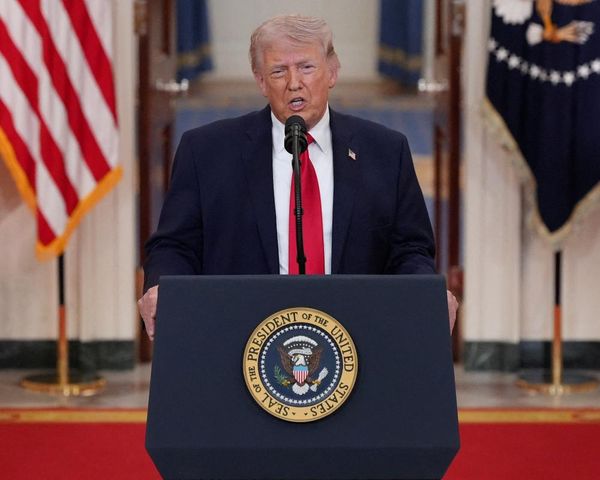
As Trump delivered his speech in the White House Cross Hall, members of his administration were seated directly in front of him. According to the reporter pool following the president, vice-president JD Vance was sat in the front row.
Others in the audience included treasury secretary Scott Bessent, attorney general Pam Bondi, health secretary Robert Kennedy Jr, secretary of state Marco Rubio, defence secretary Pete Hegseth and director of intelligence Tulsi Gabbard.
Donald Trump used a primetime address to the nation on Wednesday evening to declare the month-long war in Iran a success “nearing completion”, despite a spiralling conflict that has caused economic turmoil across the globe, fractured transatlantic alliances and eroded the president’s approval ratings.
In remarks from the White House, Trump argued that the US’s “little journey” to Iran had accomplished nearly “all of America’s military objectives”, but offered little clarity on how he planned to wind down the conflict over the next “two to three weeks”.
“We are on the cusp of ending Iran’s sinister threat to America and the world,” Trump said in the 19-minute speech, delivered from Cross Hall of the White House. “We have all the cards. They have none.”
Australian prime minister Anthony Albanese - one of America’s allies who is most consistently supportive of Donald Trump on the world stage - said on Thursday he believed the original objectives of the war in Iran had been met and it was not clear what more remained to be achieved.
Now those objectives have been realised it is not clear what more needs to be achieved or what the end point looks like.”
Ken Martin, the chair of the Democratic National Committee, has offered up his response to Donald Trump’s address, saying “Trump sold voters on a ‘pro-peace,’ ‘America First’ vision for his administration.”
It was all bullshit.”
Martin said that Trump was “desperately trying to justify his deadly and costly war of choice.”
Trump offered no new information the the American people and once again failed to give the public a clear rationale for his war, while he forces them to foot the bill to the tune of billions of dollars and causes their gas prices to skyrocket.”
As part of his plea for patience from US voters, the Donald Trump ticked through the timeline of American involvement in earlier conflicts.
World War I lasted one year, seven months and five days … World War II lasted for three years, eight months and 25 days.”
He added references to Korea, Vietnam and Iraq — noting Vietnam’s nearly 20-year US commitment.
Action in Iran has spanned 32 days by comparison, Trump said, and has been “so powerful, so brilliant” that “one of the most powerful countries” is “really no longer a threat.”
Key moments from Trump's oval office address
Donald Trump’s Wednesday evening address was an opportunity to use a wide audience to articulate clear objectives for the war, after weeks of changing goals and often contradictory messages about whether he’s winding down or ready to escalate military operations.
He said America’s “core strategic objectives are nearing completion,” but he also spent much of his time repeating many of the same things he said in recent weeks.
He criticised previous US administrations for failing to tackle Iran’s nuclear programme, saying previous presidents “made mistakes and I am correcting them.”
For years, everyone has said that Iran cannot have nuclear weapons. But in the end, those are just words if you’re not willing to take action when the time comes.”
Earlier on Wednesday the president said he did not care about Iran’s stock of highly enriched uranium (HEU) as it was deep underground and could be monitored by satellite. He reiterated on Wednesday evening saying Iran’s various nuclear sites are under “intense satellite surveillance and control”.
If we see them make a move, even a move for it, we will hit them with missiles very hard again.”
Trump claimed the military action was launched to help America’s allies in the region, and also pointedly thanked “Israel, Saudi Arabia, Qatar, the UAE, Kuwait and Bahrain,” adding he would not let them get hurt.
We’re now totally independent of the Middle East, and yet we are there to help … We don’t have to be there. We don’t need their oil. We don’t need anything they have … We’re there to help our allies.”
The president was particularly critical of Barack Obama’s 2015 nuclear deal with Iran, reiterating his longstanding derision of that framework, and commending his decision to pull out of it during his first term.
His Iran deal would have led to a colossal arsenal of massive nuclear weapons for Iran.”
Trump also didn’t talk directly about Nato, at whose members he has fumed over refusal to help secure the strait of Hormuz. The war has sent oil prices soaring as Iran has effectively shut the strait.
During his address, Trump said Americans “don’t need” the strait and that the countries who do “must grab it and cherish it.” The president also claimed that when the conflict is over, the strait would open up naturally.
Oil prices rise after Donald Trump addresses Americans about progress of Iran war
Oil prices surged almost immediately after Donald Trump’s address on the Iran war. His 20 minute speech did little to soothe market worries over the closure of the strait of Hormuz, with the US president calling on other nations to help reopen it.
Brent jumped more than 4% to $105.55, while West Texas Intermediate climbed 3% to hit $103.16. Both had been falling before Trump started his speech.
In early trading on Asian markets, Japan’s Nikkei was down 0.79% and South Korea’s Kospi reacted by dropping by 1.8%. Hong Kong’s Hang Seng index was trading 0.5% lower and China’s CSI 300 fell 0.3% just after opening. Australia’s S&P/ASX 200 was 0.5% down.
Elsewhere, US stock futures dipped by 0.67% and European futures were 0.1% lower.
Updated
Trump once again sets out a timeline of 'two to three weeks', as he defends his decision to go to war
Donald Trump used his first address to the nation since the start of the war in Iran to justify the costs that it is imposing on America and the world, while continuing to claim that he is close to winding up the conflict.
Trump said on Wednesday evening that Iran had been decimated and that the hard part of the war was done. He however added that the US would hit Iran “extremely hard” for the next two to three weeks.
Tonight, I’m pleased to say that these core strategic objectives are nearing completion … In these past four weeks, our armed forces have delivered swift, decisive, overwhelming victories on the battlefield – victories like few people have ever seen before.”
The president also once again called for countries that receive oil through the strait of Hormuz to show “courage” and seize the key waterway, while saying Washington will not allow its Middle East allies to be harmed.
“The countries of the world that ... receive oil through the Hormuz Strait must take care of that passage,” Trump said. “Just take it, protect it, use it for yourselves.”
He also thanked “our allies in the Middle East – Israel, Saudi Arabia, Qatar, the UAE, Kuwait and Bahrain,” saying: “They’ve been great, and we will not let them get hurt or fail in any way, shape or form.”
Updated
Trump says US close to ‘finishing the job’ in Iran
Trump has said that America’s core strategic objectives are nearing completion and he is close to “finishing the job” in Iran. He has once again set out a timeline of “two to three weeks”.
He has followed this statement by once again criticising US allies for failing to take part in the operation against Iran – and told them that they must take responsibility for reopening the strait of Hormuz.
Trump has said over the last few days that the US does not rely on the strait for its oil, so therefore will not take responsibility for reopening the vital waterway.
On Tuesday he told reporters that the responsibility for keeping the strait of Hormuz open will rest with countries that rely on it. “That’s not for us … That’ll be for whoever’s using the strait.”
Updated
Trump has claimed that Iran was “right at the doorstep” of gaining a nuclear weapon.
Earlier on Wednesday the president said he did not care about Iran’s stock of highly enriched uranium (HEU), arguing it was deep underground and could be monitored by satellite.
Experts said that if the US-Israeli offensive against Iran concluded with the Tehran government still in control of its 440kg HEU stockpile, it would be significantly closer to the capability of making nuclear warheads than if the US had pursued a potential negotiated settlement that was on the table at the time the US and Israel launched the war on 28 February.
Trump makes the case for the Iran war
The president has begun to make the case for why the war in Iran is necessary.
From the very beginning my campaign for president in 2015, I said I would never allow Iran to have a nuclear weapon. This regime has been chanting death to America, death to Israel.
Trump is going through a timeline of his approach to Iran over his first and second term. He is spending some time talking about his withdrawal from the 2015 nuclear deal that the Obama administration agreed with Tehran to limit Iran’s enrichment of uranium.
Updated
Trump has begun by praising the victories that the US has achieved in Iran.
Iran’s navy is gone. Their Air Force is in ruins … Very few are left.”
He goes on to praise the operation to remove Nicolas Maduro in Venezuela in January.
We are working along Venezuela .. true partners and we are getting along incredibly well.”
Trump begins address to the nation
Donald Trump is speaking now, we’ll bring you updates as they come in.
As Donald Trump prepares to address the nation, many are asking why he is making this speech now, more than one month into the conflict. One reason might be the amount of recent polling which shows support for the Iran war, and for his administration, falling.
A new CNN poll released in the last few hours shows that just one-third of Americans believe Trump has a “clear plan to handle the situation in Iran”.
The polling also shows that just 34% of Americans approve at least somewhat of the Trump’s decision to launch the war, down 7 points from another CNN poll conducted soon after the start of operations.
More than 5,000 people have been killed across the Middle East since the war in Iran began, according to death tolls from various groups compiled by the Reuters news agency.
The casualty numbers are concentrated in Iran and Lebanon, but also include countries throughout the gulf, Israel, Syria, Iraq and the West Bank.
In Iran, US-based rights group HRANA said 3,519 people have been killed since the war erupted. It said 1,598 of those were civilians, including at least 244 children. The group says its data comes from field reports, local contacts, medical and emergency sources, civil society networks, open-source materials and official statements.
Lebanese authorities say 1,318 people have been killed in Israeli strikes since 2 March, including at least 124 children. More than 400 fighters from Hezbollah have been killed since the Lebanese armed group launched attacks in a new war with Israel, two sources familiar with the group’s count told Reuters. It is unclear if the death toll reported by the authorities includes the fighters.
Three United Nations peacekeepers from Indonesia were also killed in two separate incidents in southern Lebanon, one from a roadside explosion, the other involving a projectile.
As Donald Trump prepares to address the American people, US central command has released an update on the ongoing conflict in Iran.
Operation Epic Fury has seen more than 13,000 combat flights, which have struck over 12,000 targets and damaged or destroyed more than 150 Iranian vessels, according to Centcom.
Despite these raw statistics, Trump is struggling to reconcile weeks of changing goals and often contradictory messages about whether he’s winding down or ready to escalate military operations — as Iran keeps up its attacks on Israel and Gulf countries.
The New York Times has reported that US intelligence agencies believe Iran is not currently willing to engage in negotiations to end the war, and that despite the month-long bombing campaign by the US and Israel, the government in Tehran believes it remains in a strong position.
According to officials speaking to the NYT, Iran doesn’t trust the US or believe Donald Trump is serious about negotiations.
The current conflict was launched while Iran was locked in negotiations with US officials over its nuclear programme. Last year, Israel launched attacks on Iranian nuclear targets, again while the US was engaged in discussions with Tehran.
On Wednesday, Iran rejected Donald Trump’s claim that its leadership asked for a ceasefire, calling the US president’s statement “false” and “baseless”.
Tehran has repeatedly said there are no ongoing negotiations to end the war. The country’s president, Masoud Pezeshkian, has previously said Iran had the “necessary will” for a ceasefire, but only if its foes guaranteed hostilities would not resume.
Trump preparing to make first national address since launching Iran war a month ago
Donald Trump is minutes away from delivering his first formal address from the White House since launching the war in the Middle East a month ago.
It comes at a pivotal moment for the US president, as he faces accusations that he has lost control of the conflict and will not be able to achieve the key aims of the war.
Trump has continued to claim that the US has already won the war, and has refused to take responsibility for the economic fallout that has spread across the world.
In his speech, the president will give an operational update on the progress of Operation Epic Fury, while highlighting the military’s “success in achieving all of its stated goals”, a US official has said.
He is expected to reiterate the 2-3 week timetable for concluding the operation, but crucially is not expected to announced an end to the war.
Recent polling shows Trump’s overall approval rating slipping below 40%, with disapproval climbing above the mid-50s as voters sour on both the war and its economic fallout, while support for the Iran campaign itself polls even lower.
The economic picture has compounded the problem. US petrol prices have surged above $4 a gallon for the first time in years, while consumer confidence has weakened, dragging down Trump’s already fragile standing on the economy.
Updated
Opening summary
Welcome to our continuing coverage of the crisis in the Middle East, as Donald Trump prepares to address America for the first time since the US-Israel war on Iran was launched.
The president will deliver the prime-time speech at 9pm ET from the White House.
The address comes as his administration faces plunging approval ratings, economic jitters and a spiralling diplomatic fallout. Trump is expected to try and reassure the nation that US goals are being met and that he has a plan for completing the war, which has roiled the US economy.
Earlier Wednesday, Trump claimed a major breakthrough, saying Iran’s president was seeking a ceasefire. This was swiftly denied by Iran’s foreign ministry, which also accused Washington of making “maximalist and irrational” demands.
Here’s what else has been happening today:
Iran has rejected Donald Trump’s claim that its leadership asked for a ceasefire, calling the US president’s statement “false” and “baseless”. Trump made the claim in a post on Truth Social, which said: “Iran’s New Regime President, much less Radicalized and far more intelligent than his predecessors, has just asked the United States of America for a CEASEFIRE! We will consider when Hormuz Strait is open, free, and clear. Until then, we are blasting Iran into oblivion or, as they say, back to the Stone Ages!!!”
Trump also said he is “absolutely” considering withdrawing the US from Nato, warning that the matter was “beyond reconsideration” after the refusal of US allies to join the US-Israeli war against Iran. The president’s threats, his most determined to date, have left the alliance facing its worst crisis in its 77-year history, a former US ambassador has said. Here’s our story.
Meanwhile, in an open letter to the American people, Iran’s president Masoud Pezeshkian said relations between Washington and Tehran were “misunderstood” and that Iran was not an aggressor. The Iranian “harbor no enmity toward other nations, including the people of America, Europe, or neighbouring countries,” he said, adding that portrayals of Iran as a security threat were inaccurate, and Tehran was acting in self-defence – not aggression.
In Tehran, Kamal Kharazi, a top foreign policy official and former Iranian foreign minister, has been severely injured in an airstrike on his home in the Iranian capital. His wife was reportedly killed in the attack. Kharazi, considered a moderate politician and veteran policy expert, also served as an adviser to the assassinated former supreme leader Ayatollah Ali Khamenei. Reports suggest his targeting is being viewed as an attempt to derail diplomacy.