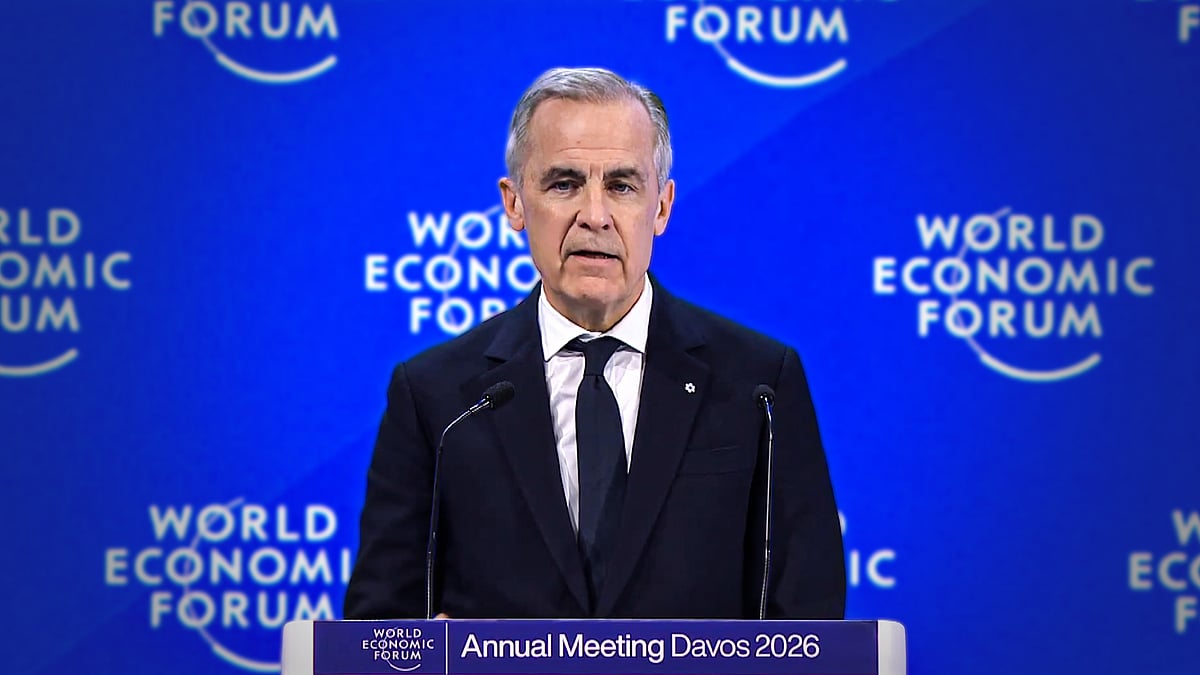
Canadian Prime Minister Mark Carney’s recent special address to the World Economic Forum Annual Meeting in Davos-Klosters, Switzerland, has sent geopolitics watchers and commentators into a tizzy. He did something political leaders seldom do: he delivered a mea culpa.
It is rare to expose the fiction at the heart of the so-called rules-based international order – a system of ever-expanding trade and commercial relations governed by agreed rules – under which Canada, and many other “middle power” countries benefited, but which was neither just, fair nor applied equally to all.
Carney spoke plainly of the fading of the rules-based order, asserting the ugly truth “that the strong can do what they can and the weak suffer what they must” – an unmistakable reference to the conduct of US president Donald Trump and his Russian counterpart Vladimir Putin. He also drew on The Power of the Powerless, in which the Czech essayist and dissenter Vaclav Havel explains how a system built on foundational untruths is sustained only because everyone participates in the lie: repeating it, acting it out, and pretending it is real.
Canada, Carney admitted, went along with the lie. Though it “knew that international law applied with varying rigour depending on the identity of the accused or the victim”, Canada accepted the fiction, because “American hegemony...helped provide public goods, open sea lanes, a stable financial system, collective security and support for frameworks for resolving disputes”. Canada benefited from the make-believe system and so did not call out “the gap between rhetoric and reality”.
The limitations of his speech
Carney’s analysis of what he calls the “rupture”, not merely a “transition” is nevertheless confined to the predicament facing middle-sized powers. He positioned himself as the spearhead of resistance to the unbridled authoritarianism of leaders such as Trump, but he did not explicitly seek to lead the much poorer South against naked aggression and gross tyranny inflicted on peoples like the Palestinians.
However, in calling for new alliances and partnerships grounded in what he terms ‘values-based realism’, Carney was clear that he intends “to be both principled and pragmatic”. The principles he outlined include a “commitment to fundamental values, sovereignty, territorial integrity, the prohibition of the use of force, except when consistent with the UN Charter, and respect for human rights”. The pragmatism he wants is the recognition “that progress is often incremental, that interests diverge, that not every partner will share all of our values”.
Carney’s frank and candid speech deserves the critical praise it has received. Yet his warning – that “the middle powers must act together because if you are not at the table, we’re on the menu” – leaves the poorer nations very much on the butcher’s block.
Despite that limitation, the Davos speech may well come to be seen as a turning point in international geopolitics, perhaps even comparable, in its own way, to Winston Churchill’s Iron Curtain speech. It could mark the moment when a senior Western leader of a G7 nation stood up and squared up to the bully who happens also to be the most powerful man in the most powerful country on earth.
Behind the newfound willingness to confront Trump
Yet another speech delivered by a far less prominent political figure called out the same bully far more directly.
Ed Davey, leader of Britain’s Liberal Democrats – the third largest party by seats in the House of Commons – used a parliamentary debate following a statement by Prime Minister Keir Starmer on the joint European response to Trump’s threats over Greenland, to speak with striking bluntness.
“President Trump”, Davey said, “is acting like an international gangster, threatening to trample over the sovereignty of an ally, threatening the end of NATO altogether and now threatening to hit our country and seven European allies with outrageous, damaging tariffs unless he gets his hands on Greenland.” “Appeasement”, he argued, has failed. He said there are only two ways to deal with a bully and the “most corrupt president the United States has ever seen” – either to bribe him with a billion dollars or to stand up to him.
The tide against American hegemony may be turning, but it bears reminding ourselves that this newfound willingness to confront Trump emerged only after the middle powers themselves were directly affected: first by an economically illiterate tariff war, then by demands for territorial capitulation, and more recently by direct military intervention in Venezuela – a sovereign, if corruptly run, nation, and by the kidnapping of its leader.
For more than two years, the US has financed, armed, and diplomatically shielded what many respected and unimpeachable authorities – including the International Association of Genocide Scholars, Human Rights Watch, The UN Human Rights Council, and scholars such as Brown University’s Prof Omer Bartov and Oxford University’s Prof Avi Shlaim – have identified as a genocide of the Palestinian people in Gaza by Israel.
During this period, most nations, including the very “middle powers” Carney now seeks to rally in defence of values-based principles, did nothing to confront either Israel or its financier and patron, the United States. Not a single nation acted to enforce the arrest warrants issued by the International Criminal Court against Israel’s Prime Minister and Defence Minister. Selective application of the principles of justice, sovereignty and rights leaves the international rules-based order at the mercy of the very hegemony that Carney rightly calls out.
Upholding a genuine international rules-based order may be a tall order even for Carney’s proposed coalition of principled partners. But he has, at least, taken a first step in the right direction.
At Newslaundry, we believe in holding power to account. Our journalism is truly in the public interest – funded by our subscribers, not by ad revenue from corporations and governments. You can help. Click here and join the tribe that pays to keep news free.
Newslaundry is a reader-supported, ad-free, independent news outlet based out of New Delhi. Support their journalism, here.