Emmanuel Macron risked sparking a fresh diplomatic row between Europe and Washington after claiming that Donald Trump may “betray” Ukraine during peace negotiations, according to a leaked transcript of a conference call of European leaders.
The French president told Kyiv’s European allies that the Trump administration could attempt to force Ukraine to give up territory “without clarity on security guarantees”, Germany’s Der Spiegel newspaper reported.
“There is a possibility that the US will betray Ukraine on the issue of territory without clarity on security guarantees,” Mr Macron is said to have told fellow European leaders, including the German chancellor, Friedrich Merz, and Nato secretary general Mark Rutte.
The transcript of the call was leaked as the Trump administration continues to try to exert pressure on Moscow and Kyiv to agree on a peace deal. A 28-point plan proposed by the US late last month demanded heavy territorial and military concessions from Ukraine and caused consternation among European leaders.
It laid bare the rift between Washington and Europe on how to bring an end to the almost four-year-old conflict. Despite a flurry of diplomatic activity over the last two weeks with talks among all parties, there has been no breakthrough on key issues. Trump’s special envoy Steve Witkoff and son-in-law Jared Kushner held five hours of talks with Vladimir Putin in Moscow earlier this week, but little progress was made.
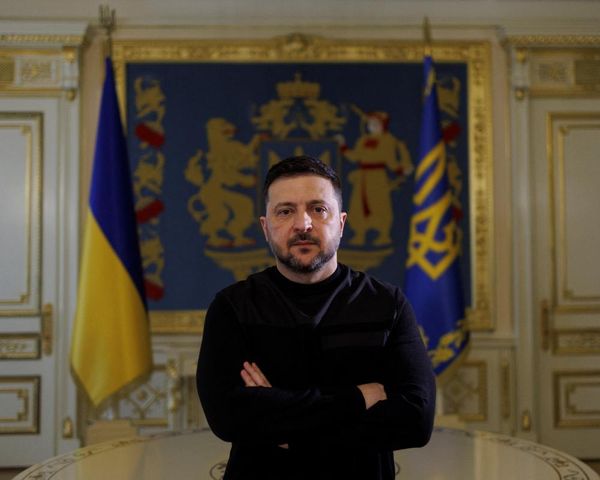
The French president was not the only leader on the call to issue a thinly veiled criticism of President Trump and his negotiating team. Chancellor Merz said Volodymyr Zelensky had to be “extremely careful” in the coming days. In comments that appear to refer to Mr Witkoff and Mr Kushner, Mr Merz said: “They are playing games, both with you and with us.”
The Finnish president, Alexander Stubb, who enjoys a warm relationship with Mr Trump, said: “We must not leave Ukraine and Volodymyr alone with these guys.” Nato secretary general Mark Rutte concurred, saying: “I agree with Alexander – we must protect Volodymyr.”
The call also included Poland’s prime minister, Donald Tusk, Italy’s Giorgia Meloni, Denmark’s Mette Frederiksen, Norway’s Jonas Gahr Store, EU Council president Antonio Costa and EU Commission president Ursula von der Leyen.
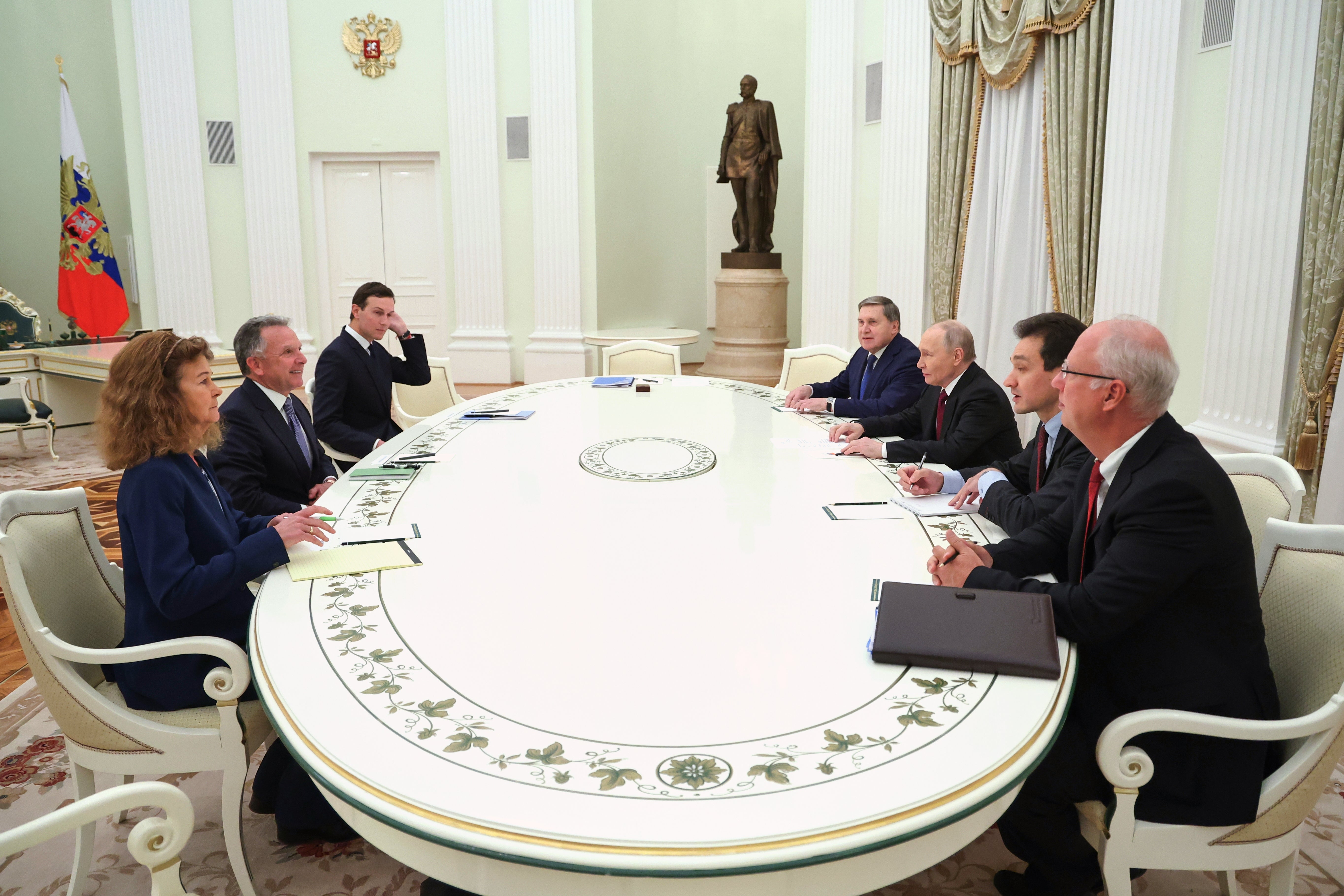
The call was held on Monday, one day before Mr Witkoff and Mr Kushner travelled to Moscow to meet with Putin, Kremlin aide Yuri Ushakov and Moscow envoy Kirill Dmitriev.
Their Kremlin meeting was the culmination of two weeks of negotiations and wrangling among delegations from Washington, Kyiv and Moscow as the Trump administration attempted to force a breakthrough – one of the US president’s main stated aims before his re-election.
Putin said the talks were “necessary” and “useful” but also “difficult work”, with some of the proposals deemed unacceptable by the Kremlin.
Mr Witkoff, Mr Kushner and Ukraine’s lead negotiator, Rustem Umerov, are set to hold talks in Miami on Thursday, according to a senior White House official. President Trump said Mr Witkoff and Mr Kushner’s impression was “very strongly that [Putin would] like to make a deal”.
European leaders on Monday’s call had still hoped to organise a meeting with US envoys on Wednesday, and Mr Merz offered to ask Trump to send Mr Witkoff to Brussels, according to the report.
They discussed whether heads of state should be present at the meeting, and also the potential location. Ms Meloni was said to be against the idea, while Mr Stubb was in favour, arguing that “at the moment we’re out, but we have to get in”.
Mr Witkoff flew straight back to the US from Moscow on Wednesday without meeting European leaders.
Mr Merz also discussed the issue of frozen Russian assets in the group call, warning that the US must be clear that the issue was Europe’s to deal with alone.
On Wednesday, the European Commission proposed a plan which would use €90bn (£79bn) of frozen Russian assets to fund Ukraine’s war – a move which the former Russian president Dmitry Medvedev on Thursday said would be “tantamount to a casus belli [an act that justifies war]”.
Europe could not “leave the decision to other, non-European states regarding what happens to the financial resources of an aggressor that have been legally frozen within the jurisdiction of our rule of law and in our own currency”, Mr Merz told European allies.
Ukraine war live: Macron warned Trump could ‘betray Ukraine’ in leaked call
Trump administration to direct more water to California farms
Zelensky’s plane ‘followed by military drones’ before Dublin visit in ‘hybrid attack’
BBC backs decision to let Israel join Eurovision as four countries boycott event
The events that led to countries boycotting 2026 Eurovision over Israel
Putin ordered novichok poisonings in show of ‘Russian power’, inquiry finds