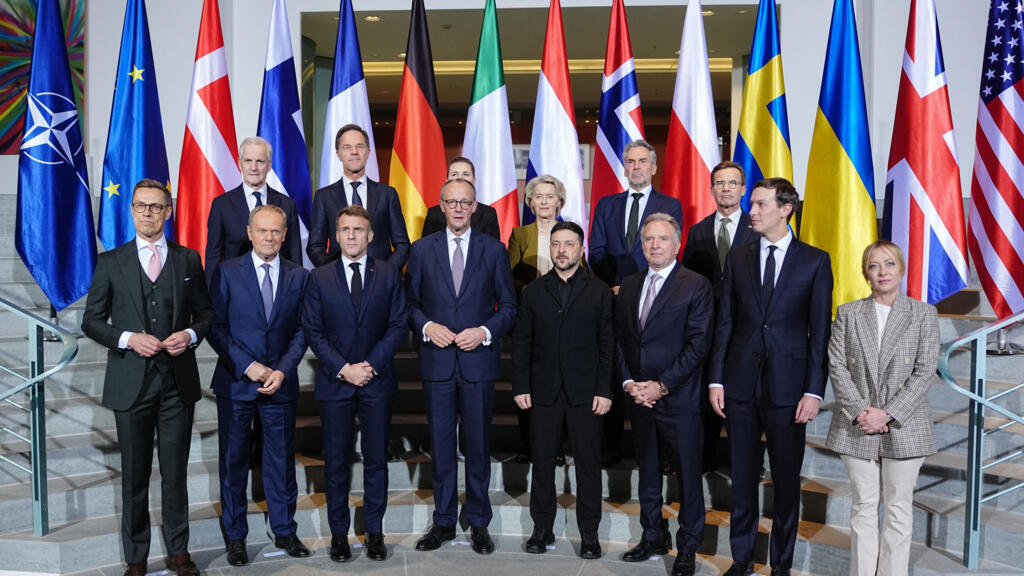
Talks on ending Russia’s war in Ukraine have intensified, with France and other European powers stressing the need for robust security guarantees for Kyiv before any discussion of territorial concessions. While negotiators report progress on Western-backed assurances, deep differences remain over land occupied by Russia.
France has drawn a red line in the latest push to end Russia’s war in Ukraine, saying there can be no discussion of Kyiv ceding territory until “robust security guarantees” are firmly in place.
That's how President Emmanuel Macron’s team framed two days of intensive talks in Berlin, where Ukrainian President Volodymyr Zelensky met United States envoys and European leaders to try to reshape a US-brokered peace plan that many in Europe saw as too generous to Moscow.
“We want robust security guarantees first before any discussions on territory,” a senior adviser to Macron said, underlining Paris’s view that Ukraine must be protected against any future Russian aggression before being asked to make political concessions.
The adviser added that progress had been made on guarantees, particularly after greater clarity emerged on the form US backing would take.
The Berlin talks were part of a broader diplomatic effort led by Washington. While Us President Donald Trump has said a deal is closer than ever, European leaders – led by France and Germany – have been determined to strengthen the security pillar of any agreement before it progresses.
Zelensky in Berlin as Ukraine weighs NATO compromise and EU funding fight
Credible guarantees
At the heart of the European position is the belief that a ceasefire without strong enforcement mechanisms would simply invite renewed conflict.
To that end, leaders in Berlin proposed a European-led multinational force – backed by the US – as part of a package of security guarantees aimed at ensuring Russia does not violate any deal.
Zelensky acknowledged that negotiations with US envoys Steve Witkoff and Jared Kushner were difficult but said they had delivered “real progress” on security guarantees – an issue he has repeatedly described as existential for Ukraine.
“These conversations are always not easy,” Zelensky said on Monday, but added that they had been productive.
He also confirmed that disagreements remained over territory, making it clear that Kyiv’s position on land would not change without firm guarantees in place.
German Chancellor Friedrich Merz echoed this emphasis on security, describing the talks as opening “the chance for a real peace process”.
He praised the US for putting “substantial” legal and material guarantees on the table, calling the move “truly remarkable”.
US officials briefed on the talks said Washington was offering NATO-style assurances, even while ruling out Ukraine’s formal membership of the alliance.
One official described the guarantees as “Article Five-like” with a strong deterrent effect based both on commitments from Western powers and on maintaining a large Ukrainian military.
The tone from Washington, however, carried a sense of urgency. US officials warned that such guarantees would not remain available indefinitely and pressed Kyiv to move towards accepting the broader deal.
France says Ukraine peace plan can only be 'finalised' with Kyiv, European input
Territory on the table
For Macron and other European leaders, that pressure reinforces the need to lock in guarantees first. Trump has repeatedly argued that Ukraine will inevitably have to surrender territory, a stance that remains unacceptable to Zelensky and deeply sensitive in European capitals.
Behind closed doors, US negotiators continue to push for Ukraine to cede control of the eastern Donbas region, comprising Donetsk and Lugansk. Russia occupies almost all of Lugansk and around 80 percent of Donetsk, but Kyiv has refused to withdraw from the areas it still controls.
Russia, meanwhile, is sticking to its core demands. The Kremlin has said it expects the US to brief it on the Berlin discussions and has reiterated its opposition to any European-led force operating in Ukraine.
Moscow also insists that Ukraine must abandon its ambition to join NATO as part of any settlement.
However, US officials said Moscow has indicated it would be open to Ukraine joining the European Union as part of a peace deal – a position Russia has previously tolerated, but which would still represent a notable concession.
According to US officials, negotiators now agree on around 90 percent of the US-drafted plan.
Further talks are already planned, with another round of negotiations potentially following this weekend in the US.
Zelensky has also sought to underline Ukraine’s flexibility, saying Kyiv could drop its NATO bid if it received legally binding security guarantees backed by the US Congress.
Even so, he stressed that NATO membership remains Ukraine’s preferred long-term safeguard.
Wider security issues were also underlined in London, where the new head of the UK's foreign intelligence service MI6 warned that Russia’s actions in Ukraine were reshaping the global threat landscape.
In her first public speech, Blaise Metreweli said President Vladimir Putin’s determination to export instability was creating increasingly unpredictable and interconnected security challenges for Europe and beyond.
(with newswires)