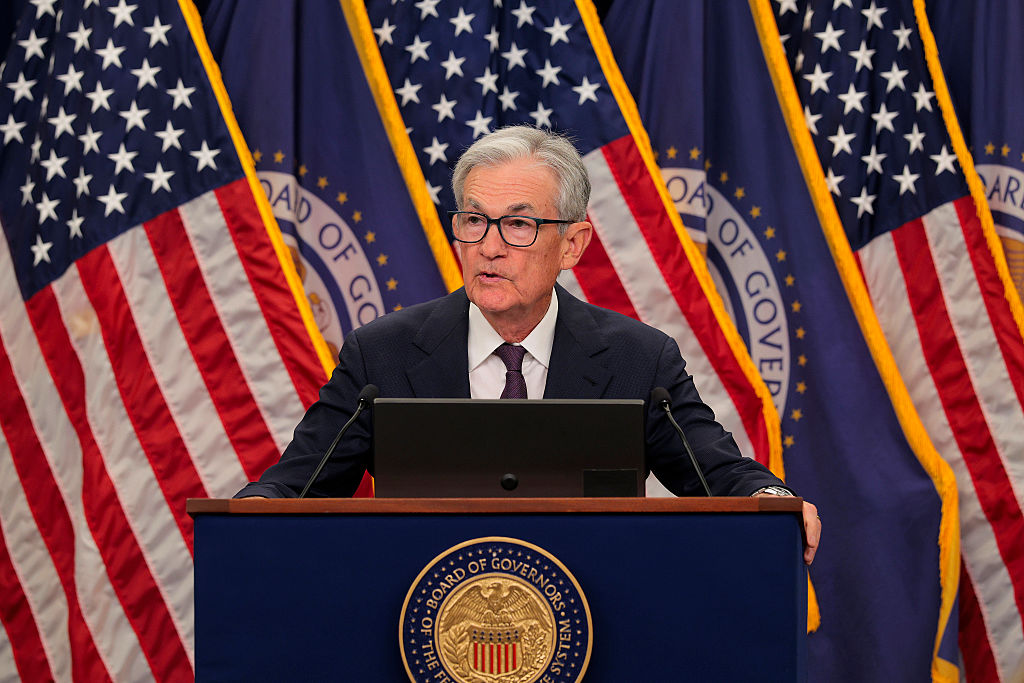
The January Fed meeting wrapped up on Wednesday, January 28, with the central bank's latest policy decision.
Following three straight quarter-point rate cuts to end 2025 and data showing inflation is holding steady, the central bank kept the federal funds rate unchanged this time around, as was widely expected.
"The decision to hold rates at 3.50% to 3.75% at today's meeting was never in doubt and we expect the Fed will remain on hold through June," says Michael Pearce, Chief U.S. Economist at Oxford Economics. "The Fed always moves more cautiously when rates are close to a neutral setting, and we think labor market conditions are stabilizing."
Pierce believes the biggest events shaping the central bank right now are the legal battles over Fed Governor Lisa Cook's potential firing and the Department of Justice investigation into Fed Chair Jerome Powell, both of which Powell refused to comment on during today's press conference.
Powell also refused to answer questions on President Donald Trump's potential pick to replace him, though he did offer up some words of advice for the next Fed chair.
The Kiplinger team reported live on the January Fed meeting, bringing you the news and our expert analysis of what it could mean for the economy. Scroll for the updates.
How the Federal Reserve Affects Mortgage Rates — and What It Means for Homebuyers in 2026 | How Does the Federal Reserve Work? | Quiz: How Well Do You Know the Fed?
Fed meeting schedule for 2026
The next Fed meeting, which runs from January 27 to January 28, marks the first gathering of 2026.
"The committee meets eight times a year, or about once every six weeks," writes Kiplinger contributor Dan Burrows in his feature, "When Is the Next Fed Meeting?".
The Federal Open Market Committee "is required to meet at least four times a year and may convene additional meetings if necessary," Burrows adds, noting that "the convention of meeting eight times per year dates back to the market stresses of 1981."
Fed meetings last two days and wrap up with the release of a policy decision at 2 pm Eastern Standard Time. This is typically followed by the Fed chair's press conference at 2:30 pm.
Here is the full Fed meeting schedule for 2026:
January 27 to 28
March 17 to 18
April 28 to 29
June 16 to 17
July 28 to 29
September 15 to 16
October 27 to 28
December 8 to 9
- Karee Venema
Expect more volatility this week, says Wedbush
Last week's volatility in the stock market, which saw the S&P 500 explore a 145-point intraday trading range and the Cboe Volatility Index (VIX) hit its highest level since November, was sparked by President Trump's turnaround on a potential annexation of Greenland and a new round of tariffs on Europe.
Wedbush analyst Seth Basham expects more volatility this week as market participants sift through a jam-packed earnings calendar and assess the January Fed meeting.
As for the Fed meeting, Basham expects the central bank to maintain a more cautious approach despite political pressure.
"We expect Fed Chair Powell to signal heightened caution at upcoming meetings," the analyst writes in a January 25 note. "With the administration running the economy hot and PCE inflation still roughly 80 basis points above the 2% target, policy changes are likely to pause for some time."
And given Powell is near the end of his term, Basham believes "he’s likely to maintain vigilance against inflation, even if it means disappointing equity investors and the President who are seeking easier financial conditions."
- Karee Venema
When does Jerome Powell's term as Fed chair end?
President Trump has not been subtle in his dislike of Fed Chair Powell. But the question of whether or not Trump can fire Powell is seemingly moot given that his term as Fed chair is up in just a few months – on May 15, 2026.
It's unlikely that those in Trump's inner circle will encourage him to disrupt the status quo and replace Powell before his term is over – which could potentially send stocks and bonds tumbling – given that there's such a small amount of time left.
And the president is widely expected to announce his choice for Powell's replacement any day now. Top candidates include former Fed governor Kevin Warsh, Director of the National Economic Council Kevin Hassett and Rick Rieder, BlackRock's chief investment officer of fixed income.
For what it's worth, Powell's term as a member of the Board of Governors of the Federal Reserve ends on January 31, 2028.
- Karee Venema
There are more rate cuts to come, just not this week
The majority of Fed members believe that additional rate cuts will be necessary at some point, says Goldman Sachs economist David Mericle, but he doesn't expect the next one until June.
"Chair Powell is likely to emphasize that the FOMC has just delivered three cuts that should help to stabilize the labor market and is well positioned for now while it assesses their impact," says Mericle.
And if the labor market steadies, rate cuts become less urgent, he adds.
Mericle thinks the Fed will issue its final cut in September, bringing the federal funds rate to a target range of 3.0 to 3.25%.
"We see the risks over the next year or two as tilted to the downside because we think hikes are quite unlikely but could imagine a few reasons for additional cuts, and our probability-weighted Fed forecast is a bit below both our baseline and market pricing," he notes.
- Karee Venema
Who gets to vote at the January Fed meeting?
The Federal Open Market Committee (FOMC) has 12 total members, eight permanent and four who rotate each year.
The eight permanent voting committee members include the Fed chair and vice chair, the five Fed governors and the president of the New York Fed.
Four regional Fed presidents are rotated in each calendar year.
The 2026 FOMC voting committee consists of:
Fed Chair Jerome Powell*
Vice Chair Philip Jefferson
Fed Governor Michael Barr
Fed Governor Michelle Bowman
Fed Governor Lisa Cook
Fed Governor Stephen Miran**
Fed Governor Christopher Waller
New York Fed President John Williams
Cleveland Fed President Beth Hammack
Minneapolis Fed President Neel Kashkari
Dallas Fed President Lorie Logan
Philadelphia Fed President Anna Paulson
In 2027, the presidents from Chicago, Richmond, Atlanta and San Francisco will rotate in as FOMC voting members, according to the Federal Reserve.
* Jerome Powell's term as Fed chair is up in May 15, 2026
** Stephen Miran's term as Fed governor is up on January 31, 2026
- Karee Venema
What is Wall Street expecting from the next Fed meeting?
The Federal Open Market Committee is widely expected to keep interest rates unchanged when its January gathering concludes on Wednesday.
Of more interest, writes Kiplinger contributor Dan Burrows, is how Chair Powell will manage his press conference as "the Fed's independence has come under question, and Powell is set to preside over just two more meetings before his term as Fed chief ends on May 15."
To get a sense of what Wall Street is expecting from the next Fed meeting, Burrows "turned to economists, strategists and other experts for their thoughts on monetary policy going forward."
Read what they had to say here: What Will the Fed Do at Its Next Meeting?
Who is Rick Rieder?
President Trump is expected to announce his pick to replace Jerome Powell as Fed chair any day now.
The conversation has been ongoing for several months, and many folks are by now familiar with the two Kevins: former Fed governor Kevin Warsh and Director of the National Economic Council Kevin Hassett.
Hassett has moved down the list in recent weeks after President Trump said he'd like him to remain in his current role, while another name has moved into contention: Rick Rieder, chief investment officer of fixed income and global head of asset allocation at BlackRock.
Mr. Rieder joined BlackRock, the world's largest asset manager, in 2009, and currently manages roughly $2.4 trillion in assets. He previously served as CEO of R3 Capital Partners and as head of global principal strategies at Lehman Brothers.
Rieder has served on several government panels, including the Federal Reserve Bank of New York's Investment Advisory Committee on Financial Markets.
Kalshi prediction markets currently put Rieder, whom Trump called "very impressive" in a recent CNBC interview, in the lead.
"Either of the two leading candidates, Rick Rieder or Kevin Warsh, are likely to be welcomed by markets as well-credentialed and more than capable of serving in the role," says Jason Pride, chief of investment strategy & research and Michael Reynolds, vice president of investment strategy at Glenmede.
- Karee Venema
Who appointed Jerome Powell as Fed chair?
Jerome Powell assumed the role of Fed chair on February 5, 2018, after being nominated by then-President Donald Trump, who was serving his first term in the White House.
Powell's initial four-year stint as head of the Federal Reserve ended in 2022, but he was reappointed for a second four-year term on May 23, 2022, after being nominated by then-President Joe Biden.
Powell initially joined the Fed's Board of Governors in 2012 after he was nominated by then-President Barack Obama.
While Powell's second term as Fed chair will expire in May 2026, he can remain on the Fed's board until January 2028.
- Karee Venema
It's a big week ahead for Wall Street
This week will be a busy one on Wall Street. In addition to the Fed meeting, market participants will also have a full earnings calendar to sift through.
Most notable are the handful of Magnificent 7 stocks reporting, including Meta Platforms (META), Microsoft (MSFT) and Tesla (TSLA), whose results will be released after Wednesday's close. Apple (AAPL) will report after Thursday's close.
The outlooks from Apple, Meta and Microsoft will be particularly crucial, says Raymond James Chief Investment Officer Larry Adam. "With AI investment still ramping up and profit margins expanding, Wall Street expects mega-cap tech to deliver another year of standout earnings growth: +25% versus +15% for the broader S&P 500."
Adam adds that "valuations may appear more compelling," with the price-to-earnings (P/E) ratio for the Mag 7 stocks at the lowest level since 2017. "Taken together, the setup may suggest that despite the early stumble, mega-cap tech still has plenty of room to outperform as the year unfolds."
- Karee Venema
The odds of a government shutdown are rising
The risk of a partial government shutdown looms after Senate Democrats said they would block a funding bill that includes spending for the Department of Homeland Security. This comes after federal immigration agents fatally shot another U.S. citizen this weekend in Minnesota.
Part of the deal reached to end the record-long government shutdown in November included a continuing resolution that would fund most federal agencies through January 30, 2026.
The House of Representatives has passed several annual funding measures in recent weeks and the bills were widely expected to pass the Senate until this weekend's fatal shooting of Alex Pretti.
"Importantly, one of the nine annual appropriations bills passed by the House is Homeland Security, which houses Customs and Border Protection (CBP) and Immigration and Customs Enforcement (ICE)," say Wells Fargo economists Michael Pugliese and Tom Porcelli. "In the wake of the incident, some Senate Democrats who were widely expected to support the budget bill have pulled their support until there have been some policy and process reforms to CBP/ICE."
Another shutdown would leave the Fed in a tricky spot, the two add. "The lack of visibility that arises from receiving limited economic data could thrust an already divided FOMC into a period of stasis. Fed officials lamented the lack of clarity on inflation during the last shutdown. We expect they would again use this argument to delay additional cuts."
The January jobs report is currently scheduled for release next Friday, February 6, while the next Consumer Price Index (CPI) report is slated for Tuesday, February 11. Another government shutdown puts the data at risk of being delayed or canceled outright, as we saw last fall.
Related: What Does a Government Shutdown Mean for Stocks?
- Karee Venema
Where have all the Fed speakers been?
The Fed-speak has been nonexistent over the past week or so. That's by design. Since Saturday, January 17, and until Thursday, January 29, participants in the FOMC meeting have been bound by a Federal Reserve policy that limits the extent to which they can talk about the economy and interest rates.
These two-week "blackout periods" begin the second Saturday that falls 10 days before the next FOMC meeting and end the Thursday that follows the meeting. The Fed's blackout period was an unofficial practice that began in the 1980s. It was formalized in 2011 and reaffirmed in January 2025.
Fed-watchers see the policy as a measure against corruption and the potential for information leaks to distort markets. It also provides cover for open discussion during the Fed's most intense periods of policy-making.
Here is a schedule for all blackout periods through January 2028.
- David Dittman
Stocks close higher to start Fed week
It was a positive start to Fed week for the main equity indexes. At Monday's close, the blue chip Dow Jones Industrial Average was up 0.6% at 49,412, the broader S&P 500 had added 0.5% to 6,950, and the tech-heavy Nasdaq Composite was 0.4% higher at 23,601.
Over in the bond market, the yield on the 2-year Treasury note slipped 1.3 basis points to 3.592%, while the yield on the 10-year Treasury note fell 2.6 basis points to 4.213%.
Read more: Dow Rises 313 Points to Begin a Big Week
What the January Fed meeting could mean for consumers, according to Johnson Investment Counsel's chief economist
Brandon Zureick, chief economist and senior managing director at Johnson Investment Counsel expects the January Fed meeting to be "somewhat uneventful."
The Fed cut rates three times to end 2025 in response to a weakening labor market and recent guidance suggests the central bank wants to assess the impact of those cuts before it makes any additional moves, he explains.
While a pause may be disappointing to consumers, Zureick says that there is some good news. "At last month's meeting, 15 of 19 FOMC participants projected that at least one more 0.25% rate cut will be appropriate this year," he says. "Most economists expect that inflation should continue to progress toward the Fed's 2% target throughout 2026, which should allow the Fed to bring rates down a bit more without fear that easier monetary policy could lead to higher inflation."
Forecasts project two more quarter-point rate cuts, which Zureick believes is "reasonable given the current economic environment."
The economist notes that the appointment of a new Fed chair is one dynamic that could "alter the course of policy this year." And while it's unclear who President Trump will choose, Zureick points out that the common theme among the potential candidates "is that they are all somewhat supportive of continued rate cuts."
Still, consumers hoping to consolidate high-interest loans or refinance high-rate mortgages may not find relief from the Fed.
While the central bank "controls short-term interest rates, longer-term loans like mortgages are benchmarked to longer-term interest rates, which take their cues less from monetary policy and more from the overall health of the economy," Zureick explains. "If the economy continues to hold up, longer-term interest rates may stay elevated even if the Fed elects to cut rates a couple more times this year."
- Karee Venema
Futures are mixed ahead of FOMC meeting
Equity index futures suggested a mixed open about 45 minutes before the opening bell on Tuesday, the first day of the first Federal Open Market Committee (FOMC) meeting of 2026.
The S&P 500 and the Nasdaq Composite are in the green, but the Dow Jones Industrial Average is being weighed down by UnitedHealth Group (UNH).
UNH reported beat on earnings, missed on revenue and offered soft guidance. That's on top of the Trump administration proposing a lighter-than-expected increase in 2027 Medicare Advantage payments.
Meanwhile, as BofA Securities analysts Mark Cabana, Aditya Bhave and Alex Cohen observe, "The U.S. rates market expects little from the January FOMC meeting."
The analysts note the Overnight Index Swap (OIS) market is pricing just one basis point of rate-cut risk, while CME FedWatch shows a 97.2% probability the target range for the federal funds rate will remain 3.50% to 3.75% come Wednesday.
Cabana, Bhave and Cohen also see little change in the policy path following the meeting. "We expect Powell to remain strongly data dependent and emphasize a meeting-by-meeting approach," they write.
And, though questions will be asked, discussion of politics is a non-starter. "Chair Powell is likely to get peppered with questions about politics," they write. "He will most likely be asked about the DoJ investigation of his testimony on the Fed building renovations. We expect him to say that he has nothing to add to his January 11 statement."
Nor will the Fed chair explain why he attended oral arguments at the Supreme Court in the case of whether President Trump can fire Fed Governor Lisa Cook.
The BofA analysts suggest that Powell will probably be asked again whether he plans to stay on as a Fed governor after his term as chair ends: "We do not expect him to show his cards yet."
With President Trump intent on putting as many of his people in place at the Fed and lowering interest rates as soon as possible, a lingering Powell may be where most of any ensuing drama from this week's FOMC meeting lies.
– David Dittman
What will Waller do?
The December Fed meeting, which concluded with a third consecutive 25-basis-point (bps) rate cut, was notable for both the number as well as the nature of the dissents from that decision.
Fed Governor Stephen Miran, who was appointed by President Donald Trump to replace Adriana Kugler and took his seat on the board in September, wanted a 50 bps cut. Two other voters on the 19-member Federal Open Market Committee (FOMC) opposed any cut at all.
This time around, the only dissent is likely to come from those who want easier policy interest rates right now, including Miran and perhaps Michelle Bowman and Christopher Waller.
The base-case scenario is a target range of 3.50% to 3.75% for the federal funds rate after this FOMC meeting, as Nick Timiraos of The Wall Street Journal notes.
"Waller’s vote could draw particular scrutiny," Timiraos writes. "He is among the candidates Trump is considering to succeed Powell." President Trump has said he won't pick someone who disagrees with him that interest rates should be lower.
Waller is now a long-shot candidate, trailing late-arriving but fast-rising BlackRock (BLK) Chief Investment Officer Rick Rieder as well as Kevin Hassett and Kevin Warsh.
If Waller votes to cut this week, though, the president will like him more. On the other hand, as Timiraos concludes, "A vote with the majority to hold might burnish his credentials as an independent voice but cost him the job."
– David Dittman
Markets are mostly steady at midday
The main U.S. equity indexes were mostly higher at midday, with the S&P 500 and the Nasdaq Composite up 0.5% and 1.0%, respectively, but the Dow Jones Industrial Average down 0.8% mainly because of UnitedHealth Group (UNH, -18.8%).
The Treasury market is also mixed, with the 2-year U.S. Treasury yield down to 3.573% from 3.597% on Monday but the 10-year U.S. Treasury yield up to 4.217% from 4.211% and the 30-year U.S. Treasury yield up to 4.823% from 4.805%.
The U.S. Dollar Index, which measures the buck against a basket of currencies made up of the euro, the yen, the British pound, the Canadian dollar, the Swedish krona, and the franc, was down to 96.36 from 97.04.
Investors, traders and speculators are pricing in the prospect of another potential government shutdown in the aftermath of the federal government's aggressive enforcement of immigration laws in Minnesota.
That's on top of questions about central bank independence as the Federal Open Market Committee (FOMC) meets to discuss its policy on interest rates amid persistent inflation and continuing concerns about the labor market.
– David Dittman
Consumers are worried about maximum employment
Inflation is an ever-present concern for consumers and markets as well as makers of monetary policy. For the Fed, however, it forms only one half of a dual mandate.
"Maximum employment" is at least nominally as important as "price stability" for Fed Chair Jerome Powell and other voting members of the FOMC.
Some of them have made clear their preference for lower interest rates, citing a softening jobs market as the main threat to sustainable economic growth right now.
The most recent sentiment reading from the Conference Board could provide some fuel for a "get ahead of the curve" argument that acting now will stave off a fuller labor market meltdown.
Indeed, the Consumer Confidence Index fell to 84.5 in January from 94.2 in December, its lowest print since 2014, worse than anything during the COVID-19 pandemic. And it was mostly about jobs.
"The share of consumers saying jobs are 'hard to get' rose to a post-pandemic high," Wells Fargo economists Tim Quinlan and Shannon Grein write. "That took the labor differential (plentiful minus hard-to-get) to a post-pandemic low."
That's not the end of the story, of course: "It is always worth taking consumer confidence readings in context and remembering that vibes are not always fully reflected in spending."
Quinlan and Grein conclude with another caveat: "It still bears noting that consumers felt more confident at the height of the pandemic than they do now."
The economists attribute the drop to deterioration in the labor market, noting also that "persistent high cost of living combined with tariffs and foreign interventions are not doing anything to shore up confidence."
– David Dittman
Facts, feelings and data the Fed depends on
The Conference Board Consumer Confidence Index hit a near 12-year low in January. Best to classify this as "anecdata" rather than straight incoming data such as retail sales numbers reported by the Census Bureau.
There is a split in sentiment and behavior, at least as far as the most up-to-date information we have is concerned. There's even a conflict between sentiment indicators.
As Barclays economist Pooja Sriram notes, the Conference Board reading "shows a different signal compared with the January reading of the University of Michigan survey," which was up 3.5 points to 56.4. "The surveys show competing views about the labor market and the overall economy," Sriram adds.
Context for all that includes, of course, the longest government shutdown in U.S. history, which delayed retail sales reports late in 2025 and into 2026. And what we've seen lately has been a little choppy.
The release of September data was delayed by more than a month, and sales declined 0.1% in October but surged 0.6% in November, as we learned on January 14.
November retail sales exceeded expectations and suggested strong consumer demand. But we won't see retail sales data for January until February 10.
Regular reporting for this high-frequency indicator of consumer demand – which drives about two-thirds of the U.S. economy – is back on track. But messages for the Fed remain mixed and murky.
As Sriram writes, "Intensifying perceptions that jobs are becoming harder to obtain and that overall hiring is slowing have weighed on the overall consumer environment, resulting in the weak labor market outlook."
We'll see whether feelings translate into behavior in mid-February.
– David Dittman
What consumer stocks say about consumers
Here's another piece of data for you to follow when it comes to assessing the big picture: the relative performance of consumer staples stocks.
Yes, people are still spending money. But what are they buying? Is it toothpaste and toilet paper, cigarettes and booze? Or is it Tesla (TSLA) and Tapestry (TPR) for electric cars and iconic clothes?
Generally speaking, when consumer discretionary stocks are near the top of the sector rankings, it's bullish. But when Procter & Gamble (PG) and Altria Group (MO) lead, it's bearish.
Consumer staples underperformed the S&P 500 in 2025, 1.7% to 17.7%. Consumer discretionary added 7.4% last year.
So far in 2026, though, consumer staples are up vs the S&P 500, 6.6% to 1.6%. And consumer discretionary is up just 2.4%.
Whether (and the extent to which) the Fed is worried about the consumer remains to be seen. We'll get some answers on Wednesday.
But recent price action suggests we should at least pay attention for a potential broader shift in the stock market.
– David Dittman
Unemployment is low but angst is high
For Harris Financial Group Managing Partner Jamie Cox today's report from the Conference Board about consumers is just another brick in the proverbial wall of worry for the stock market to climb.
"This is one of the most bullish signs I've seen yet," Cox writes. "When GDP is over 3% and consumers say they are worried, yet spend like they aren't, they are, in fact, confident."
Comerica Wealth Management Chief Investment Officer Eric Teal has a more nuanced view: "The picture for the consumer remains very mixed, with the top earners benefiting from the wealth effect while the bottom 60% of the income distribution is being negatively impacted by policy changes."
Teal cites "shifting tariffs, sticky inflation, and housing affordability." He notes that tighter immigration enforcement means higher wages in some sectors and industries, and he is "cautiously optimistic on the U.S. consumer as tax benefits should be a tailwind in early 2026."
As for why consumers are down even though the unemployment rate remains low relative to historical averages, Deutsche Bank Chief U.S. Economist Matthew Luzzetti is on the case.
"This disconnect between weaker labor market sentiment and still relatively low unemployment is also observed in the NY Fed’s consumer sentiment survey," Luzzetti says.
It's a recent development too: "While sentiment and unemployment have been highly correlated in the past, sentiment has tracked weak hiring and low labor market churn rather than unemployment over the past 18 months."
The problem, as the people see it, is dynamism and the ability to get a job, according to Luzzetti. "The implication is that consumer sentiment about the labor market – and likely the broader economy – may not turn around until hiring and dynamism improve," he concludes.
– David Dittman
3 reasons the Fed won't cut interest rates this week
The prediction for Wednesday's Fed meeting is for rates to remain unchanged. There are three reasons for this.
First, comments from a number of Federal Open Market Committee (FOMC) members at the last meeting in December indicated that there was a desire to stop the "cut at every meeting" trend.
Second, GDP growth predictions for 2026 have been moving up of late as economists note still strong consumer spending and likely bigger tax refunds this spring.
The Fed doesn't want to cut interest rates in the face of a strengthening economy unless the unemployment rate is rising. But that hasn't happened yet.
Finally, Fed Chair Jerome Powell publicly pushed back against the administration in a speech two weeks ago, accusing it of pressuring the central bank to lower interest rates.
A rate cut this early after that would be interpreted as doing the White House's bidding, and the Fed has always jealously guarded its independence.
– David Payne
When Fed meetings move market
Investors, traders and speculators are more than 97% certain the target range for the federal funds rate will remain 3.50% to 3.75% at the conclusion of this week's Fed meeting.
But markets will be watching Jerome Powell's press conference, the first since the Department of Justice subpoenaed central bank officials and one of the last before he's replaced as Fed chair. And they will be moving.
The San Francisco Fed has built a new database on intraday reactions to FOMC meetings that, as Deutsche Bank strategist Matthew Raskin writes, allows us to see "which meeting aspects tend to be most market moving."
The database includes changes in U.S. Treasury yields and prices of other financial assets in 30-minute windows around Federal Open Market Committee statements and Summary of Economic Projections releases and 70-minute windows around the Fed chair’s press conferences.
Raksin compares the relative volatility impact on yields of FOMC statements and SEP release vs press conferences since 2019. He defines "relative volatility" as the "difference between the absolute yield moves in the press conference and statement windows."
As Raskin notes, "For non-SEP meetings like tomorrow's, volatility around the press conference is on average higher than volatility around the statement." The pattern flips for SEP meetings, with volatility around the statement higher.
"The underlying data reveals that the shift reflects an increase in volatility around statements when the SEP is published," he concludes, "as the projections convey additional information on the Fed rate path."
Raskin also cites "evidence that the SEP modestly reduces front-end volatility around press conferences, perhaps because the projections provide some anchor to near-term expectations that attenuate reactions to the chair’s comments."
– David Dittman
Markets are mixed on the first day of the Fed meeting
Stocks closed mixed on the first day of the first Fed meeting of 2026, the S&P 500 rising 0.4% and hitting new all-time highs and the Nasdaq Composite rallying 0.9% with multiple Magnificent 7 stocks reporting earnings this week.
The Dow Jones Industrial Average, weighed down by UnitedHealth Group (UNH, -19.6%), lost 0.8%.
The Treasury market was also mixed, with the 2-year U.S. Treasury yield down to 3.571% from 3.597% on Monday but the 10-year U.S. Treasury yield up to 4.233% from 4.211% and the 30-year U.S. Treasury yield up to 4.842% from 4.805%.
The U.S. Dollar Index, which measures the buck against a basket of currencies made up of the euro, the yen, the British pound, the Canadian dollar, the Swedish krona and the franc, was down to 95.53 from 97.04.
Looking ahead to Wednesday's conclusion of this week's FOMC meeting, Louis Navellier of Navellier & Associates notes that nobody expects any change in the federal funds rate.
"Jerome Powell is essentially a lame duck as we wait to hear who Trump will select to replace him in May," Navellier writes "which is expected soon." Fed funds futures pricing indicates the market doesn't see another move to lower interest rates until June.
Investors, traders and speculators will pay close attention to the Fed chair's press conference. "If Powell gives any indication that a cut may come before he leaves," Navellier says, "the market will rally."
Navellier adds that if the Fed "is looking for a reason to cut key interest rates, it appeared on Tuesday when the Conference Board announced that consumer confidence plunged in January."
Citing its new role as an exporter of energy, gold and pharmaceuticals as well as the blessings of the AI boom, including rising productivity, Navellier says "6% GDP growth will be possible" for the U.S. without adding to inflation.
"Deflation is the only risk that can potentially derail America and the world," Navellier concludes. "It will be the job of the new Fed chair to fight deflation and to spur consumer spending with lower interest rates."
– David Dittman
Stock futures are mostly higher on Fed Day
Stock futures are mostly in the green ahead of this afternoon's policy announcement from the Federal Reserve. At last check, futures on the tech-heavy Nasdaq were up 0.8% and futures on the broader S&P 500 were 0.2% higher as strong earnings from semiconductor equipment company ASML Holding (ASML) lift chip stocks.
Futures on the blue-chip Dow Jones Industrial Average are slightly lower.
Over in the bond market, the yield on the 2-year Treasury is up 0.6 basis point at 3.575% and the 10-year Treasury yield is 2.4 basis points higher at 4.247%.
- Karee Venema
Questions over Fed independence remain front and center, says GammaRoad Capital CIO
It's all but guaranteed that today's policy announcement from the Federal Reserve will leave interest rates unchanged and it's unlikely that Chair Powell will signal any additional cuts for the two remaining meetings he'll head.
"Unless the Fed delivers a surprisingly dovish tone to forward guidance, we believe this meeting will only serve to amplify the recent political pressure on the Fed's independence," says Jordan Rizzuto, CIO at GammaRoad Capital Partners. "Given that the next rate decision is two months away, this leaves ample time for increased rhetoric against the backdrop of deteriorating consumer sentiment driven by a softer labor market, persistently above-target inflation and the resulting affordability challenges facing the American public."
Rizzuto expects this elevated rhetoric puts the premium that U.S. assets have commanded over time at risk. "Increased expectations for a more dovish and less independent Fed would likely drive further weakness in the dollar, higher rates at the long end of the curve, and renewed concerns for an uptick in inflation," he adds.
- Karee Venema
What time will the Fed statement be released and what changes are expected?
The Federal Open Market Committee will release its updated policy statement at 2 pm Eastern Standard Time today, January 28.
"Available indicators suggest that economic activity has been expanding at a moderate pace," the committee wrote in its December statement. "Job gains have slowed this year, and the unemployment rate has edged up through September. More recent indicators are consistent with these developments. Inflation has moved up since earlier in the year and remains somewhat elevated."
As such, the FOMC voted to lower the federal funds rate by a quarter-percentage point to a range of 3.50% to 3.75%.
This time around, Goldman Sachs economists expect small changes to the statement. "The FOMC might remove the comment from December that inflation 'has moved up since earlier in the year' while continuing to note that it 'remains somewhat elevated,'" the group writes. "It might also add balance to the description of the unemployment rate, perhaps keeping that it 'has edged up' but adding that it 'remains low.'"
And while the December meeting had three central bankers dissent, Goldman Sachs expects only one this time, from outgoing Fed Governor Stephen Miran, who they believe will vote for a rate cut.
- Karee Venema
What time does Jerome Powell speak today?
Fed Chair Powell will host a press conference at 2:30 pm Eastern Standard Time today, January 28.
"Given recent events, Powell's presser is likely to focus on some non-economic issues – e.g., the recent DoJ subpoena, Governor Cook's case, who will be the next Fed chair, and whether Powell might remain on the Board," write a team of Deutsche Bank economists.
The team believes Powell will likely respond to any questions over the Justice Department investigation by referring to his January 11 video statement, where he responded to the accusations by saying, "threat of criminal charges is a consequence of the Federal Reserve setting interest rates based on our best assessment of what will serve the public, rather than following the preferences of the President."
There's a good chance he will not comment on questions related to his successor and whether or not he will remain on the Fed's board through January 2028.
The group also expects Chair Powell to describe monetary policy as "well positioned," given that the current range of the federal funds rate, 3.50% to 3.75%, is close to neutral.
"He might also sound somewhat more sanguine on the labor market, while still emphasizing downside risks," the economists add.
- Karee Venema
S&P 500 briefly tops 7,000 before turning lower
With roughly 90 minutes left until the Fed releases its latest policy announcement, the main market indexes aren't making any major moves.
The blue-chip Dow Jones Industrial Average was last seen up 0.07% as UnitedHealth Group (UNH) trades higher following Tuesday's 20% drop.
The tech-heavy Nasdaq Composite is off 0.06%, while the broader S&P 500 is down 0.1% after it briefly topped the psychologically significant 7,000 level for the first time earlier.
Health care is the worst-performing sector at midday, while energy stocks lead as U.S. crude futures trade up 0.4% at $62.65 per barrel.
- Karee Venema
Another near certainty today: Powell's purple tie
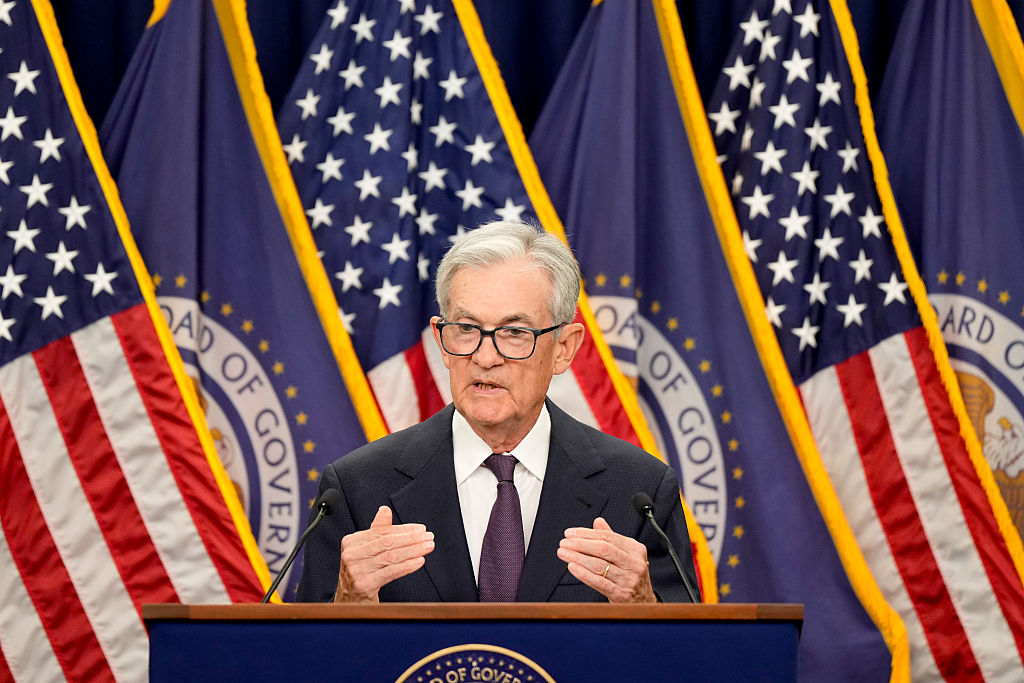
The odds of that the FOMC will keep rates unchanged today are high. It's also a near-certainty that Fed Chair Powell will be wearing a purple tie during Wednesday's press conference.
That's because Powell always wears a purple tie … and there's a reason for it.
During an early April Q&A session with journalists at the Society for Advancing Business Editing and Writing conference, Powell was asked about the significance of his purple ties.
"At the beginning, the only significance was that I like purple ties," Powell replied. At his next press conference, he said he went to reach for a red or blue tie and thought, "Maybe not … so I wind up wearing purple."
He said now it's become "a thing," and it supports the fact that the Fed "is strictly non-political" and "bipartisan," and purple is a good color for that.
"Plus, I like purple ties," Powell concluded.
- Karee Venema
Where can I watch Fed Chair Powell's press conference?
Fed Chair Jerome Powell's press conference will begin at 2:30 pm Eastern Standard Time this afternoon.
The presser can be viewed on the Federal Reserve's website or on the Fed's YouTube channel.
The Fed decision is in
The Federal Reserve stood pat in January, keeping the federal funds rate at its current range of 3.5% to 3.75%, as expected.
Sticky inflation and a stabilizing labor market keep the Fed on hold
Everything you need to know is in the opening sentence of the Fed's statement: "Available indicators suggest that economic activity has been expanding at a solid pace. Job gains have remained low, and the unemployment rate has shown some signs of stabilization. Inflation remains somewhat elevated."
In other words, the economy is growing solidly and inflation remains a concern, so the central bank is not cutting. Additionally, the Fed is not as worried about the labor market right now because it appears to be stabilizing and not getting weaker.
- David Payne
What changed in the January FOMC statement?
Changes to the FOMC's latest policy statement include the following:
Available indicators suggest that economic activity has been expanding at a solid pace. Job gains have remained low, and the unemployment rate has shown some signs of stabilization. Inflation remains somewhat elevated. (Previously read: Available indicators suggest that economic activity has been expanding at a moderate pace. Job gains have slowed this year, and the unemployment rate has edged up through September. More recent indicators are consistent with these developments. Inflation has moved up since earlier in the year and remains somewhat elevated.)
The Committee seeks to achieve maximum employment and inflation at the rate of 2 percent over the longer run. Uncertainty about the economic outlook remains elevated. The Committee is attentive to the risks to both sides of its dual mandate. (Previously read: The Committee seeks to achieve maximum employment and inflation at the rate of 2 percent over the longer run. Uncertainty about the economic outlook remains elevated. The Committee is attentive to the risks to both sides of its dual mandate and judges that downside risks to employment rose in recent months.)
In support of its goals, the Committee decided to maintain the target range for the federal funds rate at 3‑1/2 to 3‑3/4 percent. (Previously read: In support of its goals and in light of the shift in the balance of risks, the Committee decided to lower the target range for the federal funds rate by 1/4 percentage point to 3-1/2 to 3‑3/4 percent.)
The committee also removed this section that was in the December statement: The Committee judges that reserve balances have declined to ample levels and will initiate purchases of shorter-term Treasury securities as needed to maintain an ample supply of reserves on an ongoing basis.
- Karee Venema
Powell starts talking
Powell has begun his press conference. As is typical, he's wearing a purple tie to address the press.
Powell says it was important to attend oral arguments in the Supreme Court case on Trump's attempts to fire Lisa cook
The first question Chair Powell received was why he attended Supreme Court arguments over President Trump's attempts to fire Fed Governor Lisa Cook. Powell refused to answer, except to say he attended because it was important, and he would have had to explain if he didn't go.
He also added that Paul Volcker attended oral arguments in a 1985 Supreme Court hearing.
-David Payne
Powell refuses to answer questions on the DOJ investigation and staying on the board
Powell also refused to answer questions about the current Department of Justice investigation into his congressional testimony from last June, referring reporters to his January 11 video statement. He also said he will not answer any questions as to whether he will remain on the Fed board when his term as chair is up in May.
- David Payne
Powell says there was broad support among FOMC members to hold this time around
There was broad support among committee members at the January meeting for holding and waiting, says Powell.
Following three straight quarter-point rate cuts at the end of 2025, the FOMC, overall, believes it's in a good place to evaluate developments of this easing.
- David Payne
Powell's take on inflation
Regarding inflation, Powell says that most of the overrun in goods prices is from tariffs, but, he adds, that's good news. This is because these one-time price hikes will work their way through the data and eventually not be counted in the 12-month inflation rate.
He adds that it's encouraging to see that long-term inflation expectations are not moving up. This would be worrisome to the Fed if they were.
- David Payne
It's a great time for savers to capitalize on higher rates for 2026
With the Fed refraining from rate cuts, now is the time to find the right savings accounts to reach your savings goals in 2026. If you have short-term benchmarks, some of the best high-yield savings accounts I found offer up to 4.35% APY with no fees.
It allows you to earn a rate that outpaces inflation, before potential rate cuts later this year, since they could still lower rates in the interim on HYSAs. In turn, it can help you build momentum towards achieving your goals for the rest of the year.
Read more: The Best High-Yield Savings Accounts
- Sean Jackson
Powell gives one answer on politics
To kick off the press conference, Powell shut down five different questions related to politics. But he did answer one, from ABC News' Elizabeth Schulze, who asked him, broadly speaking, to explain the importance of keeping central banks separate from politics.
Clarifying that he was talking about central banks globally, Powell said that it's been positive "to not have direct elected official control over the setting on monetary policy" because elected officials could use monetary policy to affect the economy to better serve them during elections.
The separation, he said, has "enabled central banks generally not to be perfect, but to serve the public well."
Asked if he believes the Fed remains separate from politicians, he said it does, adding that "I'm strongly committed to that and so are my colleagues."
- Alexandra Svokos
Powell says a softening labor market is being balanced by a strong economy
When asked about the labor market, Powell said that it has definitely softened. However, it's hard to tell how much of the decline is a result of labor demand and how much is due to lower immigration levels reducing supply.
Powell admits that while this is concerning, there has not been a significant worsening. Additionally, the softening labor market is being balanced by solid economic growth and consumer spending.
- David Payne
Chair Powell talks geopolitical risk
Chair Powell would not answer a question on geopolitical risk, saying it's not the central bank's position to do so. Rather, the Fed focuses on oil price volatility and changes in trade policy.
He does say that the economy has done better than expected on trade changes. This is because the policies enacted were better than feared, and the economy is adjusting to the initial changes. Additionally, other countries did not retaliate.
- David Payne
Powell offers advice to the next Fed chair
While refusing to give specific commentary on his potential replacement, Chair Powell did offer some advice. In addition to staying out of politics, Powell reminded the next Fed chair that their accountability is to Congress and maintaining this accountability will keep them legitimate to the American people.
He also noted that the Fed staff is excellent.
- David Payne
There's still the potential for rate cuts this year, says Johnson Investment Counsel's chief economist
The Federal Reserve left rates unchanged this time around, noting "solid" economic growth and a "stabilization" in the labor market, says Brandon Zureick, chief economist and senior managing director at Johnson Investment Counsel.
With no update to the Summary of Economic Projections (SEP), the Fed's quarterly outlook for the future path of monetary policy and economic data, due until March, "consumers are left with little guidance about how the path of interest rates may evolve over the remainder of the year," Zureick says, though he adds that the two dissents in favor of another quarter-point rate cut show there's still support for additional easing.
The economist says that going forward, the path of interest rates will be dependent on the trajectory of the economy, specifically, inflation and the labor market.
"Ultimately, the Fed has adopted more of a 'wait-and-see' approach to monetary policy," Zureick explains. "While consumers didn't get the immediate interest rate relief they may have been hoping for, there is still the potential for modest rate cuts later this year."
- Karee Venema
Stocks are basically flat on Fed Day
The S&P 500 crossed the psychologically significant 7,000 level for the first time ever but trended lower into the Fed's decision to hold the target range for the federal funds rate at 3.50% to 3.75%.
Stocks were up and down for much of Wednesday's trading session and closed mixed amid a recovery for a big health care stock and solid signals from multiple AI stocks.
"The Fed song remains the same," Morgan Stanley Wealth Management Chief Economic Strategist Ellen Zentner writes. "Lower interest rates may be coming, but investors will have to remain patient."
"With signs of stabilization in the labor market and inflation holding steady," the economist observes, "the Fed is in position to play the 'wait-and-see' game."
Read more: S&P 500 Tops 7,000, Fed Pauses Rate Cuts