Iran’s government has called for dialogue with protest leaders after the country’s largest demonstrations in three years over a plunging currency and declining living conditions.
Protests started on Sunday after Iran’s currency fell to a record low against the US dollar, causing traders and shopkeepers to close their stores in downtown Tehran. This was accompanied by mass protests in the capital as well as in major cities, including Isfahan, Shiraz and Mashhad.
Protesters chanted anti-government slogans, and video on social media showed demonstrators chanting “Don’t be afraid, we are together” and “Azadi”, the Farsi word for freedom. Footage also showed Iranian police in riot gear shooting teargas at protesters.
The protests were the largest since a wave of demonstrations rocked the country after Mahsa Amini, 22, died in police custody following her arrest for not wearing the hijab correctly. At the time, Iranian police responded with force, imposing an internet shutdown and violently cracking down on demonstrations with teargas and gunfire.
On Tuesday, the Iranian president, Masoud Pezeshkian, instructed the government to listen to the “legitimate demands” of protesters. A government spokesperson said that a mechanism for dialogue would be set up to have talks with leaders of the protest movement.
“The livelihood of my people is my daily concern,” Pezeshkian wrote in a post on X. He added that the government had “actions on the agenda to reform the monetary and banking system and preserve the purchasing power of the people”.
Analysts say the Iranian government has reduced its domestic repression since the 12-day war with Israel during the summer, as it seeks to shore up support after suffering significant blows to its image as an impregnable regime. The “morality police”, for example, have at times relaxed the strict application of social edicts in Tehran.
Iranian media have said that recent government liberalisation policies have depressed the currency’s exchange rate. On Monday, state television reported the resignation of the central bank chief, Mohammad Reza Farzin, a day after the Iranian rial dropped to 1.42 million to the dollar. When Farzin took office in 2022, the rial was exchanged for about 430,000 to the dollar.
The erosion of purchasing power is exacerbating an already dire economic situation in Iran, making food and other daily needs increasingly unaffordable.
According to Iran’s government statistics centre, food prices are up 72% and medical goods 50% compared with this time last year. At the same time, the government has said it will increase taxes in the Iranian new year, which starts on 21 March.
As the Iranian government is confronted with protests at home, it also faces renewed threats of attacks from abroad. Donald Trump warned on Monday that the US could carry out further military strikes on Iran if it attempted to rebuild its nuclear programme.
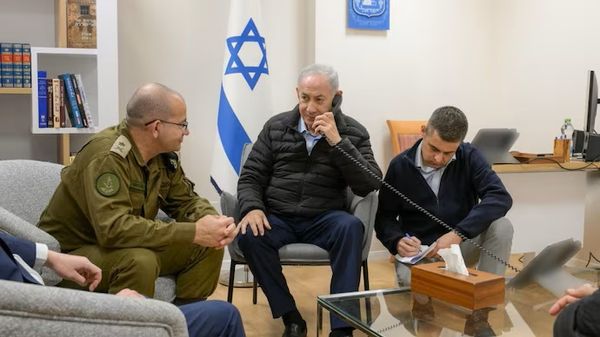
The US conducted massive bunker-buster strikes on key nuclear enrichment strikes in Iran in June. In a meeting on Monday with the Israeli prime minister, Benjamin Netanyahu, Trump said that there could be further nuclear activity outside the sites hit in June.
“Now I hear that Iran is trying to build up again. And if they are, we’re going to have to knock them down. We’ll knock them down. We’ll knock the hell out of them. But hopefully that’s not happening,” Trump said.
Iran has said that it is no longer enriching uranium anywhere and that its nuclear programme is entirely peaceful.
Writing for the Guardian, the Iranian foreign minister, Abbas Araghchi, said Iran wanted dialogue with the US. “Despite Israel’s attack on diplomacy amid Iran-US nuclear negotiations, Iran remains open to an agreement that is built on mutual respect and mutual interest,” Araghchi wrote.