To help you understand the trends surrounding AI and other new technologies and what we expect to happen in the future, our highly experienced Kiplinger Letter team will keep you abreast of the latest developments and forecasts. (Get a free issue of The Kiplinger Letter or subscribe.) You'll get all the latest news first by subscribing, but we will publish many (but not all) of the forecasts a few days afterward online. Here’s the latest…
For years, humanoid robot demonstrations have dazzled, featuring robots that can run, dance and even flip. Now, leading companies want to move from viral online clips to real-world work.
Imagine two-legged, human-like robots in car manufacturing plants, massive fulfillment centers, offshore oil rigs, hazardous waste processing facilities, hospitals, hotels or even in and around your house. The intelligent robots would be tending welding machines, lifting car parts, moving boxes, lugging pipes, fixing mechanical equipment, cultivating gardens, helping elderly people out of bed, unloading the dishwasher and much more. Labor shortages? A thing of the past. Demographic worries? No longer a problem.
That’s the vision, at least. But the reality will be far tougher, with longer timelines than the aggressive push that is now ramping up. As a Bain & Company humanoid report notes, “Current demos often mask technical constraints through staged environments or remote supervision.”
This year will be a testing ground for the tech. Leading humanoid maker Boston Dynamics recently unveiled its first business-ready Atlas model, and other companies are touting commercial models, early trials and even successful robots already in use. Other start-ups include Figure, Agility Robotics, Apptronik, 1X Technologies, Sanctuary AI, Unitree Robotics and AgiBot, all trying to gain traction with customers and drive down the cost of robots.
The excitement over humanoid robots attracted $2.5 billion in venture capital investment in 2024 and has sparked the interest of tech giants, including Tesla. Analysts are starting to track the number in use and project near- and long-term outlooks. 16,000 humanoids were installed in 2025, and cumulative installations will exceed 100,000 units by 2027, says a new report by CounterPoint Research. Goldman Sachs says the total market could be worth $38 billion by 2035. Others are predicting a far bigger market.
A slew of remaining challenges will complicate most plans for commercialization by companies such as Tesla, which plans to build a one-million-unit production line and eventually make tens of millions per year. Hyundai Motor Company, which owns a majority stake in humanoid leader Boston Dynamics, also has plans for a new U.S. factory to build 30,000 robots per year. Hyundai says it will purchase tens of thousands of Atlas robots in the next few years to deploy in its own facilities.
There’s a reason researchers and investors have focused on robots that look human. For example, the Defense Advanced Research Projects Agency (DARPA), the research arm of the Pentagon, concentrated on humanoids after Japan’s 2011 Fukushima nuclear disaster. DARPA spent around $100 million on humanoid research and competitions from 2012 to 2015. The idea was that robots that could climb stairs, turn knobs and navigate buildings could help in disasters.
“In settings built for humans, nothing less than a humanoid robot with hands, legs, and eyes is needed to take over the tedious and strain-inducing jobs humans don’t want,” notes the venture capital firm DCVC in its 2025 Deep Tech report. DCVC has invested in Agility Robotics, which built Digit, a 5’9” robot that weighs 200 pounds and can carry loads up to 35 pounds.
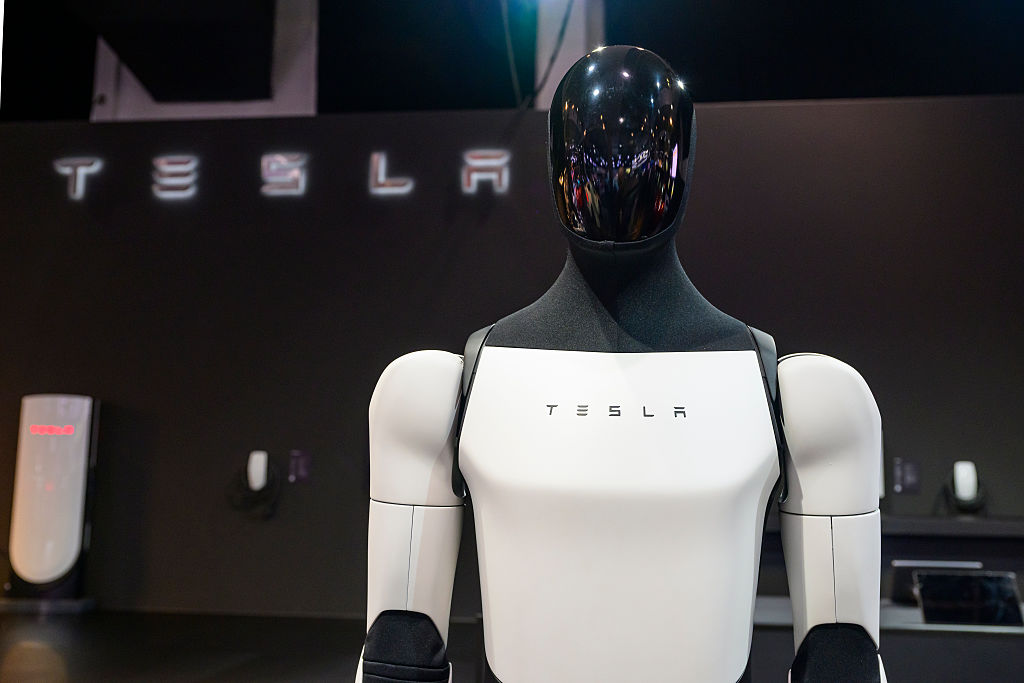
Tesla CEO Elon Musk, who says humanoids are “incredibly difficult,” is betting big on Tesla’s Optimus robot as a major product. His recent $1 trillion pay package, which runs through 2035, includes a milestone of 1 million robots delivered. Tesla could easily fall short over the next decade.
For example, today’s batteries last about 2-4 hours, too short for a useful humanoid on a factory line or helping around the house. Swappable batteries mean downtime, complexity and higher operational cost. Bain analysts sees power as a major problem that could take the longest to solve, with early deployments in the next few years focused on semi-structured tasks, like moving boxes, in “closed environments where traffic is limited and predictable.”
Humanoids are also limited in how much they can lift, don’t have human dexterity and lack the adaptable intelligence of a human worker. One alternative is a wheeled robot platform with one or two arms for grabbing and manipulating things. However, that’s not a humanoid, and many such versions are already in use. Then there’s the extremely high cost of top models, which is the reason manufacturers are talking up mass production.
Boston Dynamics’ recent announcement anticipates these challenges and tries to bat them down. “Atlas is built to power the new industrial revolution,” the company says. The robot is just over six feet tall with a 7.5-foot reach. It can operate in conditions from -4 degrees to 104 degrees Fahrenheit and repeatedly lift 66 pounds. The batteries last four hours and are swappable in less than three minutes for 24/7 operation. It can work autonomously or be remotely controlled. Using AI, which is enhanced by a recent partnership with Google’s DeepMind, the robot can learn new tasks. And it’s easily repaired and serviced, with the high level of cybersecurity that manufacturers expect.
Navigating the messy and unpredictable physical world is incredibly hard, though. Top human workers are fast, strong and smart. Something that could stop a humanoid cold, leading to costly downtime, could be easily solved by a human. It’s likely that today’s hype seriously cools off as robots struggle to adapt to work situations and adoption timelines get pushed back.
Still, there is a lot of ongoing and exciting research and testing that is well worth watching. A workable humanoid robot that could be mass-produced and take on a variety of tasks, including in households, would be a genuine breakthrough, with huge economic upside. This year will shed a lot of light on the tech’s future.
This forecast first appeared in The Kiplinger Letter, which has been running since 1923 and is a collection of concise weekly forecasts on business and economic trends, as well as what to expect from Washington, to help you understand what’s coming up to make the most of your investments and your money. Subscribe to The Kiplinger Letter.