Tsipras ends the session by repeating that Greece is close to a deal. And the stakes couldn’t be much higher:
The result of this battle doesn't concern only Greece, it concerns all of Europe's future. #Tsipras #vouli
— Omaira Gill (@OmairaGill) June 5, 2015
A quick update. Alexis Tsipras is wrapping up events in the Greek parliament now.
He’s telling MPs that his government are committed to ending a “failed programme”, and feels he has parliament’s support.
Tsipras says based on debate in Parl't he feels it's right to reject institutions' proposals. Glad someone got something out of it #Greece
— Nick Malkoutzis (@NickMalkoutzis) June 5, 2015
He also cited a letter in today’s FT from a group of leading economists, who called for “sanity and humanity” to be shown to Greece (we pasted it in the blog this morning). We are not alone, Tsipras says.
Closing summary: Tsipras sends warning to G7
This parliamentary debate is going to rumble on for some time, but I think we’ve got the key points now.
Over to my colleague Heather Stewart to round up the situation:
The Greek prime minister, Alexis Tsipras, has warned that time is running out to rescue Greece from the brink of bankruptcy and exit from the eurozone, ensuring that his country’s plight will be a pressing concern for G7 leaders as they gather in Bavaria.
With the end of June now regarded as the last possible moment for striking a deal to release the €7.2bn in bailout funds that Greece needs to stay afloat, Tsipras struck a defiant tone in a statement before the country’s parliament, accusing Greece’s creditors of making “absurd” demands on his recession-hit country and insisting, “they won’t humiliate us”.
Tsipras also appealed to the Greek opposition parties – and his own Syriza MPs – to back his negotiating stance and reject the latest proposals from the country’s paymasters.
“Time is not only running out for us, it is running out for everyone,” he warned, adding:
“Greek people should be proud because the government is not going to give into absurd proposals.”
He also insisted that a debt restructuring – writing off some of the €320bn that Greece owes – must remain on the table.
US officials, including the Treasury secretary, Jack Lew, have repeatedly warned their European counterparts not to be complacent about the economic risks of a so-called “Grexit”, and President Obama is likely to reinforce that argument this weekend. The US president is likely to be particularly concerned that Greece could turn to Russia for aid. Tsipras underlined that risk on Friday by letting it be known he was holding a phone conversation with president Putin.
In the Greek parliament, Antonis Samaras, leader of the opposition New Democracy party, accused Tsipras of mishandling the negotiations and tipping Greece back into recession.
“You have totally destroyed the country and isolated us,” he said.....
More here:
Tsipras warns G7 leaders time running out to rescue Greece from bankruptcy http://t.co/Btq6cdEds3
— Guardian US (@GuardianUS) June 5, 2015
And unless anything major happens tonight, we’re finished for the week. Thanks, and have good weekends all. GW
Tsipras has also reiterated that he won’t accept an offer that doesn’t include debt relief for Greece -- a key demand, but one which creditors have been reluctant to embrace.
The Greek PM has also just denied that a deal must be reached within 10 days, as one opposition leader suggested tonight:
#Tsipras questions Potami's Theodorakis for saying June 14 is deadline for talks due to Bundestag recess, says even Merkel has not mentioned
— Kathimerini English (@ekathimerini) June 5, 2015
Video: Tsipras warns time is running out
Our multimedia team have just launched a video clip of Alexis Tsipras’s speech to the Athens parliament this evening, complete with subtitles:
Updated
Tsipras: We won't sign a new austerity programme
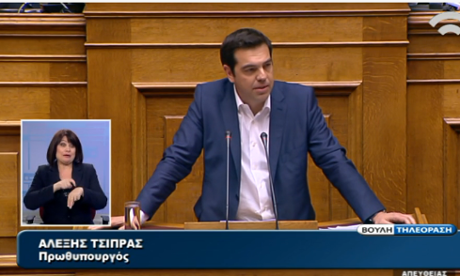
Alexis Tsipras is now speaking in parliament again, responding to the various opposition leaders’ speeches over the last hour.
The Greek PM insists that his government will never sign a new “memorandum of understanding” (a reference to the austerity programme Greece accepted in 2012).
Tsipras: This parliament is not going to vote for a new memorandum. @change4all_eu #parliament_now #tsipras
— change4all (@change4all_eu) June 5, 2015
He is also pushing the opposition parties to choose between his proposals, and those of the creditors...
Bloomberg has a good take on Alexis Tsipras’s speech; focusing on his call for creditors to take back their ‘absurd’ demands:
Tsipras Asks Greece’s Creditors to Withdraw Latest Proposal
Prime Minister Alexis Tsipras asked Greece’s international creditors to withdraw their conditions for giving more money in a defiant address to parliament.
“The proposals from the creditors are clearly unrealistic,” Tsipras told lawmakers in Athens late Friday.
“The Greek government cannot consent to unreasonable proposals that call for devastating measures for pensioners and Greek families. I want to believe that it was a bad negotiating trick.”
The embattled Greek leader went on the attack after telling German Chancellor Angela Merkel and French President Francois Hollande on Thursday that a list of proposals set by creditors to unlock bailout funds can’t be the basis for a deal. German and French officials declined to comment on the contents of the call.
The latest proposal was an “unpleasant surprise,” Tsipras said, adding that voters are asking the government “not to succumb to the irrational, blackmailing demands of our creditors.”....More here
There’s a troubling inconsistency at the heart of Alexis Tsipras’s speech tonight. On the one hand, he emphatically rejects the proposals from Greece’s creditors (he rejects pension cuts, VAT rises on electricity, penurious budget targets)
Minutes later, he’s pledging that a deal is closer than ever before.
But he’s not about to cave in. And it’s not obvious that the IMF, ECB and EC are going to suddenly fold either. So how can a deal happen?
Our head/sub say it all: Greek PM Calls Proposal by Creditors Irrational. However, Tsipras said he believed final deal is closer than ever
— Patricia Kowsmann (@kowsmann) June 5, 2015
Typical #Tsipras speech: blames everyone, offers happy end but doesn't explain how it'll happen. still clueless about what he's going to do
— Anthee Carassava (@antheecarassava) June 5, 2015
Pasok leader Venizelos reminds MPs that Greece will need a third bailout once its current programme expires in June:
#Greece Venizelos: "The country, unfortunately, needs a 3rd Memorandum, a new loan." #vouli
— The Greek Analyst (@GreekAnalyst) June 5, 2015
Four years ago this month, Evangelos Venizelos was Greece’s new finance minister, as part of the left-wing Pasok administration which asked for Greece’s first bailout.
Tonight, he’s giving perhaps his final major speech as Pasok’s leader, having seen their support slump at the last election.
(As PASOK prepares to pick new leader) Venizelos: Government u-turns are "dizzying" #Greece pic.twitter.com/FwysLLyxfb
— Derek Gatopoulos (@dgatopoulos) June 5, 2015
Venizelos criticises prime minister Tsipras for turning up tonight and asking for opposition parties to back him, rather than turning up with an actual deal.
He also questions whether Tsipras actually understands the responsibilities of being prime minister, at such a vital, troubled time in Greece’s history.
Once again, dat awkward moment when Venizelos (w all that his name entails & signifies) gives the best political speech in the parliament.
— The Greek Analyst (@GreekAnalyst) June 5, 2015
While the debate rumbles on, new opinion polling shows that Alexis Tsipras’s party Syriza remains the most popular party in Greece, well ahead of New Democracy.
#Greece poll [MetronAnalysis/@parapolitika]: Syriza 45, ND 21.4, Potami 7.4, GD 5.3, KKE 5.2, IndGrks 3.8, PASOK 3.5 pic.twitter.com/nh6o0RSold
— Yannis Koutsomitis (@YanniKouts) June 5, 2015
Party leaders continue to address the parliament.
Panagiotis Kammenos, the leader of the right-wing ‘Independent Greeks’ party (junior partner in the coalition government) played down the importance of delaying today’s payment to the IMF.
#Greece Kammenos says that "the government is in no danger" even though it didn't pay the IMF tranche today. I am very reassured.
— The Greek Analyst (@GreekAnalyst) June 5, 2015
He also pledged to support Tsipras until a good agreement has been reached.
Kammenos says proposals to lenders by Greek gov't signal the end of MoUs and restoration of country's sovereignty #Greece
— Kathimerini English (@ekathimerini) June 5, 2015
What happens next?
Well, for all Tsipras’s defiance tonight, there’s no suggestion that the two sides will stop talking. Instead, negotiations could (and should) intensify.
G7 leaders are meeting in Germany this weekend -- Tsipras won’t be there, but we can probably expect president Obama to push Angela Merkel, Francois Hollande and Jean-Claude Juncker to sort this crisis out.
America remains very anxious that the eurozone crisis is going to blow up; memories of 2008 and the collapse of Lehman Brothers are still raw in Washington (and rightly so, those were scary days)
The FT reckons that talks between Greece and its creditors could start early next week:
Eurozone officials said talks could resume as early as Tuesday, when Jean-Claude Juncker, the European Commission president, returns to Brussels from the Group of Seven meeting in Germany and Mr Tsipras is due to join his EU counterparts for a summit with Latin American leaders.
The head of the extreme right-wing Golden Dawn party had an alarming message for Greece tonight:
Fresh from being released from his “cell of honour,” Nicholaos Michaloliakos told MPs (those who hadn’t walked out in disgust) that his party firmly opposes the old bailout deal.
“Perhaps the love affair with Europe is over?” he mused. “For five years we have lived the memorandum and look what it has achieved. Our party is firmly against the memorandum.”
Is Golden Dawn lying in wait - readying itself for Syriza to fail with its enforced embraced of austerity? Michaloliakos tonight, with his forebodingly friendly demeanour, proved once again that it is.

Here’s Reuters’ first take on Alexis Tsipras’s eagerly-awaited speech, for anyone just tuning in:
Greek PM says cannot accept “absurd” proposal from lenders
Greek Prime Minister Alexis Tsipras on Friday branded a cash for reforms proposal by his country’s creditors an “absurd” one that he cannot accept and said he hoped it would be taken back.
In an uncompromising speech to parliament, Tsipras said a proposal by Athens made earlier this week was the only realistic basis for a deal with creditors.
“The proposals submitted by lenders are unrealistic,” Tsipras said. “The Greek government cannot consent to absurd proposals.”
Nevertheless, Greece is closer to a deal than ever before since Athens’ proposal is not indifferent to the needs of the creditors, he said.
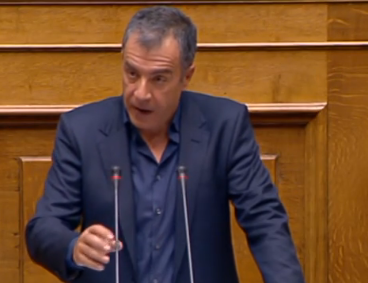
The leader of the Potami party, Stavros Theodorakis, gave a typically moderate speech in response to Alexis Tsipras’s defiant address.
Theodorakis says Tsipras should rein in members of his Syriza party from calling for a ‘rupture’ from lenders, or Greece’s exit from the euro.
More reaction to Tsipras’s speech:
Peter Spiegel, Brussels bureau chief of the Financial Times, suggests it may have alarmed the European Central Bank, which decides next week whether to keep supporting Greece’s banks...and on what terms.
To be a fly on wall at next wk's @ecb #Greece collateral haircut debate after that @atsipras speech completely rejecting creditors' offer...
— Peter Spiegel (@SpiegelPeter) June 5, 2015
But Ed Conway, Sky News economics editor, believes it was mostly posturing. A deal is still possible.
Don’t get over-excited by the melodrama in Tsipras’s speech. Essentially it mainly confirms that the negotiations have another few wks to go
— Ed Conway (@EdConwaySky) June 5, 2015
Tsipras's speech, what the experts say
Alexis Tsipras’s defiant speech may make it harder to reach a deal, warns financial expert Nick Spiro, of Spiro Sovereign Strategy:
Greece and its creditors were at daggers drawn before Tsipras's defiant speech. Now difficult to see a basis for further negotiation.
— Nicholas Spiro (@NicholasSpiro) June 5, 2015
BBC economics editor Robert Peston questions whether a breakthrough is really close:
Tsipras as world champ of words that fight reality? Says Greece is close to a deal with creditors, but his plan is so different from theirs
— Robert Peston (@Peston) June 5, 2015
Tsipras can’t expect the opposition to back him until he has actually reached an agreement, argues Simon Nixon of the Wall Street Journal:
Ridiculous to ask the opposition to write a blank cheque.
— Simon Nixon (@Simon_Nixon) June 5, 2015
While Nick Malkoutzis of Greece’s Kathimerini newspaper liked the speech, but questions its impact:
One of Samaras's better parliamentary performances but is anyone beyond his loyal MPs interested in what he has to say anymore? #Greece
— Nick Malkoutzis (@NickMalkoutzis) June 5, 2015
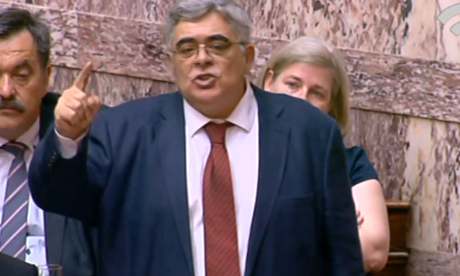
Nikos Michaloliakos, the leader of the neo-Nazi Golden Dawn party, now has the floor.
Yes, a man who is being tried over charges of running a criminal organisation, alongside his fellow MPs.
And that’s because Golden Dawn, notorious for its virulent views on immigration and gay rights, came third in January’s general elections.
Many MPs have exited the chamber.
Neo-fascist Golden Dawn leader talking about democracy and human rights. Insanity at its finest #Greece #vouli
— Loukia Gyftopoulou (@loukia_g) June 5, 2015
Lots of MPs have left the Parliament room after NeoNazi Golden Dawn leader Michaloliakos started his speech. #vouli #Greece
— spyros gkelis (@northaura) June 5, 2015
Updated
The main opposition leader Antonis Samaras is now criticising Alexis Tsipras fiercely in his response to tonight’s speech.
The former PM says:
“You have totally destroyed the country and isolated us,”
He also questions whether a deal is imminent, and claims Tsipras’s mishandling of the situation means creditors are demanding more than in 2014, undoing his government’s hard work.
#Samaras says to change things 4 the better: Stop lying to people, stop hiring civil servants, continue privatisations
— Daphne Papadopoulou (@daphnenews) June 5, 2015
And Samaras warns his left-wing rival that he risks leading Greece to a grisly fate.
#Samaras says measures govt will have to take leave to room for elections. Urges #Tsipras not to become a 'fatal man' for #Greece
— Daphne Papadopoulou (@daphnenews) June 5, 2015
Helena Smith's snap verdict

The Greek prime minister Alexis Tsipras gave one of his finer speeches tonight: eloquent in its sparseness, biting in a low-key punchy way.
The aim clearly was to keep pessimism at bay (perhaps the biggest enemy when it comes to Greece’s fragile banking system) and to win endorsement from the political opposition for the government’s rejection of the creditor’s “shock” proposal this week - crucial to the national unity that he now wants to present to the EU and IMF.
But the leftwing prime minister also risks being exposed by his own transparency: that the drama we have seen in recent days - from refusing to meet today’s IMF payment to rejecting the proposal made by lenders - is just another bargaining ploy.
Updated
Greek PM's speech: Five key points
What did we learn from Alexis Tsipras’s speech to the Athens parliament (highlights start here)?
1) He is not caving into the IMF, ECB and EC, even as time continues to run short to reach agreement before Greece’s bailout ends on June 30.
Tsipras says he will not accept the “absurd” demands from lenders. Indeed, he hopes they will take them back.
“The proposals submitted by lenders are unrealistic,”
“The Greek government cannot consent to absurd proposals.”
#Greece Tsipras is hitting hard on Juncker at the moment, saying NO Greek MP would ever vote the *unrealistic* proposals of institutions.
— The Greek Analyst (@GreekAnalyst) June 5, 2015
2) Greece is sticking to its ‘red lines’. It wants a deal that offers debt relief, low primary surpluses, protection for pensioners, brings back collective wage bargaining, and redistributes income from rich to poor.
3) Despite this firm line, Tsipras insists that a deal is imminent (but for that to happen, someone needs to compromise, and he says it’s not him)
4) Tsipras pledges that Greece will remain in the euro; but creditors must compromise so that fears of Grexit are ended.
5) He has challenged “All parties” in the Greek parliament to support his efforts.
#Tsipras says this 'is the hour of responsibility for all, mainly the govt, but the opposition as well'. parties should avoid scaremongering
— Daphne Papadopoulou (@daphnenews) June 5, 2015
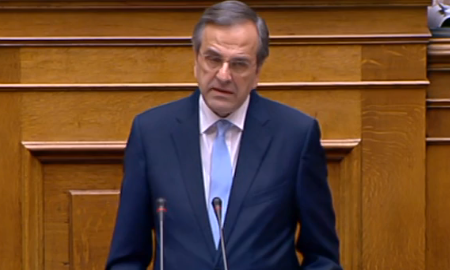
New Democracy’s leader, Antonis Samaras, is now responding. He says Tsipras has “some nerve” to challenge opposition parties to back him.
#Samaras says #Tsipras asking opposition parties to chose sides shows impudence. His party had rejected some tough measures
— Daphne Papadopoulou (@daphnenews) June 5, 2015
Samaras (who was prime minister until January) also criticises Tsipras’s handling of the economy. Anything you have gained through negotiations has been lost by Greece’s fall back into recession.
Tsipras speech: snap summary
That felt like a classic Tsipras speech -- defiant, critical of Greece’s creditors, but still with the promise of a brighter future soon.
It also included a possible trap for the opposition: will they support him, and bolster his hand, or oppose him, and risk losing public support at this crucial time?
Updated
And Tsipras starts to wrap up, saying his first priority is to get low budget surplus targets.
#Greece Tsipras repeats the important red lines of the GR govt: low primary surpluses, debt restruct, protect of pensions & real salary (1)
— The Greek Analyst (@GreekAnalyst) June 5, 2015
And then he ends his speech with this call to arms:
“We want a deal that is economically viable and socially just.”
“This is time of responsibility for all” .
And finally....
Greek people should be proud because the government is not going to give into absurd proposals.
Tsipras: Time is running out for everyone
#Greece "Time is not only running out for us, it is running out for everyone," PM #AlexisTsipras says
— Helena Smith (@HelenaSmithGDN) June 5, 2015
Some instant reaction:
This is not what the institutions were hoping to hear today. https://t.co/MXcVUyjQfk
— Simon Nixon (@Simon_Nixon) June 5, 2015
Betting against Tspiras's political skills has been a losing bet so far. Showing why today - smart politics to pin down opposition.
— Duncan Weldon (@DuncanWeldon) June 5, 2015
Pinning down the opposition: hardly a credible governing strategy #Greece
— wolf piccoli (@wolfpiccoli) June 5, 2015
Updated
Why is a deal close? Because we have international public support for our “realistic plans” and because no-one wants a “rupture”, Tsipras says.
tsipras: first because it is now clear in european and intl public opionion tyhat the greek govt has proposed a realistic framework for
— Diane Shugart (@dianalizia) June 5, 2015
tsipras: and after yesterday's decision to defer IMF payment to the end of the month, it's clear to everyone...no one desires rupture
— Diane Shugart (@dianalizia) June 5, 2015
Hand on heart, Tsipras says, I believe we are on the verge of a deal....
tsipras: are we near a viable agreement? hand on heart, despite the setback, i believe we are closer than ever
— Diane Shugart (@dianalizia) June 5, 2015
MPs applaud Alexis Tsipras has he pledges that Greece will not be humiliated by its lenders
#Greece "the economic asphyxiation of a country constitutes a moral issue" #Tsipras says, adding "they won't humilate us" to applause
— Helena Smith (@HelenaSmithGDN) June 5, 2015
He’s getting more emotive now, talking about financial ‘strangulation’
tsipras says the economic strangulation of a country is a moral issue that raises questions about europe's very future
— Diane Shugart (@dianalizia) June 5, 2015
Tsipras calls on opposition to reject creditors' demands
Tsipras is calling on the opposition MPs to step up and say clearly whether they also reject the proposals which creditors want Greece to swallow.
#Tsipras trying to force opposition parties to say publicly they reject lenders' proposals. This is what it is mostly about #Greece
— Nick Malkoutzis (@NickMalkoutzis) June 5, 2015
Seems like point of Tsipras' whole speech/gambit might be as simple as forcing ND, TP etc to visibly vote against the creditors' demands.
— Andrew Lilico (@andrew_lilico) June 5, 2015
The Greek prime minister is getting into the meat of his speech.
“Let’s not kid ourselves,” he tells parliament tonight.
“The crucial point of these negotiations is not just the reforms being asked of us but stopping the self-perpetuating vicious cycle of [recession].”
That, in a nutshell, is why Tsipras’ radical left Syriza’s party was catapulted into power in January.
“What we need is not just an agreement but a solution that will stop discussions about Greece’s exit of the euro zone .... that will stop this uncertainty,” he tells the 300-seat House.
Some would argue, of course, that the posturing seen in recent months has not helped the Greek economy either.
Updated
Our proposal remains the only realistic basis for discussion to achieve an agreement. #vouli #Greece
— Alexis Tsipras (@tsipras_eu) June 5, 2015
Tsipras: We can't accept absurd proposals
- GREEK PM SAYS LENDERS’ PROPOSAL ARE UNREALISTIC AND BACKTRACK FROM COMMON GROUND WE’VE FOUND IN RECENT MONTHS
- GREEK PM SAYS GREEK GOVT CAN IN NO WAY AGREE TO ABSURD PROPOSALS
Now the Greek PM is criticising the proposals made by Jean-Claude Juncker on Monday night (the five-page document is online here)
Tsipras says he was “negatively surprised” by what Juncker put on the table, and never believed that creditors could think that Greece’s parliament could scrap pensioners benefits, or impose higher taxes on electricity.
Another key point -- Tsipras is telling parliament that Greece needs an end to austerity, complete with debt relief.
As predicted, Tsipras is saying that Greece’s proposals is the “only realistic plan” on the table.
#Our proposal was a clear sign of our respect for [troika] & is the only realistic plan," #AlexisTsipras tells 300-seat House
— Helena Smith (@HelenaSmithGDN) June 5, 2015
Tsipras’s key theme so far is that “Greece needs a solution, not just an agreement, otherwise it will never exit the long crisis”.
And that agreement must put an end to speculation that we might leave the euro.
Tsipras is now arguing that Greece has already compromised, taking on board the progress made in Brussels in recent weeks.
#Tsipras said that gov't has agreed to adopt tough measures in return for a complete solution, putting end to cycle of crisis #Greece
— Kathimerini English (@ekathimerini) June 5, 2015
Oh sorry, BBC World have gone to the Weather!
Here’s your live feed in English:
Tsipras’ speech with English translation on BBC World here: http://t.co/8Vf1vZwIkA #Greece
— Mehran Khalili (@mkhalili) June 5, 2015
Tsipras: our proposal constitutes a sincere attitude for compromise...the result of various negotations of the Brussels Group (ie ex troika)
— Tony Connelly (@tconnellyRTE) June 5, 2015
It’s a pretty serious start from Tsipras.
He says his government has proved its “commitment to the European ideal” by presenting comprehensive proposals to lenders
Updated
Tsipras is telling MPs that he is determined to reach a solution to deliver “a new epoch for the European Union”.
#Greece Tsipras: "It's an overall solution that we need in GR, but also in EU, for the crisis that has hit the GR econ for the past 7yrs."
— The Greek Analyst (@GreekAnalyst) June 5, 2015
BBC World are carrying Tsipras’s speech with an English translation, if you can get it in your area... You’re welcome, World.
Tsipras insists that he has nothing to hide from the people., We are seeking a European solution, for all of Europe as well as Greece.
SPEECH BEGINS
Alexis Tsipras takes the stand (tieless, so we know that a deal hasn’t suddenly been reached behind closed doors).
He tells MPs that he called tonight’s session because the people, and all political parties, need to know the situation - and importantly ‘where we want to go’.
We are in the ‘final stretch’ of negotiations, he says.
#Greece "we are in final stretch of negotiations & at most crucial point" #AlexisTsipras says, opening speech in parliament
— Helena Smith (@HelenaSmithGDN) June 5, 2015
Updated
The Athens parliament is pretty full. We can see Yanis Varoufakis on the ministerial benches, and New Democracy leader Antosis Samaras in front of his block of MPs.
Debate starting Live link https://t.co/Nt3F17PqYZ #Greece pic.twitter.com/007v8oLnGQ
— Derek Gatopoulos (@dgatopoulos) June 5, 2015
And we’re off! Parliament is in session, with speaker Zoe Konstantopoulou outlining tonight’s debate, starting with the speech by Alexis Tsipras...
— Efthimia Efthimiou (@EfiEfthimiou) June 5, 2015
Updated
The delay is giving analysts and commentators time to speculate on what Alexis Tsipras might tell MPs:
I expect: typical fiery-populist Tsipras; "tried our best" rhetoric; blame-shifting towards institutions; extend problem for later in June.
— The Greek Analyst (@GreekAnalyst) June 5, 2015
Hey, @DarthPutinKGB any chance that Tsipras will announce that Russia has offered #Greece a funding facility? #FridayTrick
— wolf piccoli (@wolfpiccoli) June 5, 2015
Some new polling data just hit the Reuters terminal, showing a majority of Greeks support the government’s strategy. But more than a third think they should defy creditors:
- 05-Jun-2015 16:48:23 - GREEK POLL SHOWS 60% OF GREEKS BACK GOVERNMENT’S NEGOTIATING STRATEGY WITH LENDERS
- 05-Jun-2015 16:49:34 - 47% OF GREEKS SAY GOVT SHOULD ACCEPT LENDERS’ PROPOSAL, 35% BELIEVE IT SHOULDN’T - OPINION POLL
There’s quite a Germanic theme to the music being played on the Greek parliament channel.....
Greek parliament channel building mood nicely with progression from serene Mozart to sprightly Bach. http://t.co/n6QVtRx66i
— Tom Nuttall (@tom_nuttall) June 5, 2015
Across the eurozone, Ireland just had its credit rating raised from A to A+ by Standard & Poor’s.
S&P credited Ireland’s improved fiscal performance, state asset sales and robust economic performance since its bailout programme began in 2011.
More resolute words from another government minister:
Syriza's Lafazanis _ Greece doesn't take orders from other countries #Greece pic.twitter.com/r0gFn3lv3G
— Derek Gatopoulos (@dgatopoulos) June 5, 2015
Seems that we have a delay on the Tsipras talk on the #parliament. Keep close cause it'll start anytime soon. Rumours talk bout juicy speech
— change4all (@change4all_eu) June 5, 2015
Greek PM: Our proposals serve the people, theirs do not.
We just got a good hint of what Tsipras will say tonight. His office just released an extremely punchy statement, laying into the creditors’ “extreme positions”, and blasting them for their failure to compromise.
He then pledges that an acceptable agreement would not include any new cuts to wages or pensions, and would include debt relief.
Sound like he’s holding his ground. Firmly
Greek PM office says Brussels proposals were “extreme”; “cannot be accepted” Warning: exclamation marks in statement pic.twitter.com/VKh1uZzevG
— Ed Conway (@EdConwaySky) June 5, 2015
Updated
Events seem to be running a little late in Athens; currently, a “high-spirited” committee meeting is taking place, complete with some full and frank exchanges of views..... Quite entertaining.
@loukia_g Still Adonis Georgiadis hammering Lafazanis, while shouting over Zoe Konstantopoulou's screams. Don't tune yet. @SpiegelPeter
— The Greek Analyst (@GreekAnalyst) June 5, 2015
Tonight’s session could take a while - as Greece’s opposition leaders get to respond to Tsipras, and vice versa...
#Greek PM Alexis .@atsipras due to being addressing Parliament in next 5 mins. He's allowed to speak 3 times; other party leaders twice.
— Elliott Gotkine (@ElliottGotkine) June 5, 2015
Fighting talk from Greece’s finance minister -- he’s told Newsnight’s team in Athens that the offer made by the creditors is “atrocious”, and suggests they don’t want an agreement at all.
.@yanisvaroufakis told me the deal proposed by the creditors is the kind of deal you propose if you don't want a deal.
— Duncan Weldon (@DuncanWeldon) June 5, 2015
.@yanisvaroufakis tells @DuncanWeldon Greece's creditors offered "kind of deal you propose if you don't want a deal" pic.twitter.com/3oYQadd9Ws
— Jess Brammar (@jessbrammar) June 5, 2015
Tsipras to address parliament: preamble
Nearly time for the big event of the evening - Alexis Tsipras’s speech to the Athens parliament.
The Greek PM is due to start speaking at 6.30pm local time, or 4.30pm BST. It’s his first public appearance since his government dramatically raised the stakes against its creditors by withholding today’s €300m repayment to the IMF.
Tsipras addressing #Greece's parliament in 20 min: fasten the seat belts. It is gonna be bumpy
— wolf piccoli (@wolfpiccoli) June 5, 2015
I believe it will be streamed live here. We’ll cover the key points and reaction in the liveblog.
As my colleague Helena explained earlier, Tsipras has three goals:
- to address his own MPs; many in Syriza are apoplectic at the demands the EU, ECB and IMF are now making of Greece, and a section of the party support default and leaving the euro;
- to inform the nation of the state of negotiations
- to tackle the political opposition head on over the stance Greece has taken to its lenders’ latest offer.
As we wait for Alexis Tsipras and the other party leaders to begin speaking in the Greek parliament, there is another potentially important player in the drama. Channel 4’s Paul Mason explains:
Zoe Konstantopoulou, the speaker of parliament, is technically there to chair proceedings.
But while Tsipras, Yanis Varoufakis and their negotiators have been trying to get the country’s debt reduced via the IMF and ECB, Ms Konstantopoulou has been working to get it declared invalid.
Ms Konstantopoulou’s debt truth committee, set to report on 18 June, is said to be on the point of finding some of Greece’s original bailout debt, from either 2010 or 2011, was unlawfully contracted. In addition, Ms Konstantopoulou is armed with a finding from experts that Germany owes Greece €350bn in war reparations – more than the whole of its debt to Europe.
As I’ve said before, those who think the debt truth and reparations processes in Greece are “for show” are mistaken. Ms Konstantopoulou is piling up, effectively, a mega legal claim amounting to hundreds of billions that would be lodged in Europe’s various international courts.
In recent days her efforts have been boosted by a finding by a United Nations expert on human rights that Greeks’ “economic and social rights” had been undermined by the IMF/EU imposed austerity.
Full piece here:
Greece: will Alexis Tsipras waive a writ at Europe?
Updated
Not surprisingly, with the uncertainty over Greece’s future in the eurozone growing following its plan to delay paying the IMF, the country’s banks are taking a hit.
With the Athens general composite index now down 4.96%, most of the big fallers are financial shares. Pireaus Bank is down nearly 14%, National Bank of Greece is off nearly 11% and Alpha Bank is down 9.6%.
Greece’s creditors are trying to make the country sign up to a programme which has already proved to be a failure, argues economist Joseph Stiglitz in a Project Syndicate piece for the Guardian:
EU leaders continue to play a game of brinkmanship with the Greek government. Athens has met its creditors’ demands more than halfway. Yet Germany and Greece’s other creditors continue to demand that the country sign on to a programme proven to be a failure, and that few economists ever thought could, would, or should be implemented.
The swing in Greece’s fiscal position from a large primary deficit to a surplus was almost unprecedented, but the demand that the country achieve a primary surplus of 4.5% of GDP was unconscionable. Unfortunately, at the time that the “troika” – the European commission, the European Central Bank and the International Monetary Fund – first included this irresponsible demand in the international financial programme for Greece, the country’s authorities had no choice but to accede to it.
The folly of continuing to pursue this programme is particularly acute, given the 25% decline in GDP that Greece has endured since the beginning of the crisis. The troika badly misjudged the macroeconomic effects of the programme they imposed. According to their published forecasts, they believed that, by cutting wages and accepting other austerity measures, Greek exports would increase and the economy would quickly return to growth. They also believed that the first debt restructuring would lead to debt sustainability.
The troika’s forecasts have been wrong, and repeatedly so. And not by a little, but by an enormous amount. Greece’s voters were right to demand a change in course, and their government is right to refuse to sign on to a deeply flawed programme.
And he concludes:
Europe’s leaders viewed themselves as visionaries when they created the euro. They thought they were looking beyond the short-term demands that usually preoccupy political leaders.
Unfortunately, their understanding of economics fell short of their ambition; and the politics of the moment did not permit the creation of the institutional framework that might have enabled the euro to work as intended. Although the single currency was supposed to bring unprecedented prosperity, it is difficult to detect a significant positive effect for the eurozone as a whole in the period before the crisis. In the period since, the adverse effects have been enormous.
The future of Europe and the euro depends on whether the eurozone’s political leaders can combine a modicum of economic understanding with a visionary sense of, and concern for, European solidarity. We are likely to begin finding out the answer to that existential question in the next few weeks.
The full piece is here:
A quick update on the markets.
Wall Street is lower in early trading following the better than expected non-farm payroll numbers - which hint at a possible rise in US interest rates later this year - but it is off its worst levels.
The Dow Jones Industrial Average is currently down 11 points or 0.06%, which has helped the UK market recover some ground. The FTSE 100 is down 41.19 points at 6818.05 having fallen as low as 6785 on concerns about the financial crisis in Greece.
The Athens market is still under pressure, down 4.8% and other European markets have also fallen again, with Germany’s Dax down 0.92%.
Oil is also volatile despite Opec deciding to keep production levels unchanged.
Delaying IMF payment not a ratings default, says Fitch
Ratings agencies were not expected to designate the delay in Greece making its IMF payment which was due today as a default, and so Fitch has just confirmed.
But the agency says the move to postpone the €300m payment highlights “the extreme pressure on government funding.” It does not, however, have direct implications for Greece’s CCC sovereign rating. Fitch said:
Fitch’s ratings reflect the risk of default to private rather than official sector creditors, so delaying repayment to the IMF is not in and of itself a ratings default. Nevertheless, bundling this month’s repayments illustrates the pressure that a lack of market or official funding and tight liquidity conditions for Greek banks are putting on Greece’s sovereign liquidity. Our CCC sovereign rating, affirmed last month, indicates that default on privately held bonds is a real possibility.
The risk that Greece misses its larger IMF payment at end-June cannot be discounted. The prospect of fiscal disbursements from Greece’s official creditors is highly uncertain. The Greek government has not accepted the proposals presented by the institutions (the European Commission, European Central Bank, and IMF) this week. If the two sides do agree a deal, it will meet political opposition from elements of Syriza most hostile to the institutions’ proposals for pensions and public sector wages.
Time constraints mean we expect that an agreement would take the form of a further extension of Greece’s existing programme beyond end-June and partial disbursements, conditional on Greece demonstrating its commitment to its terms. These funds would primarily be used to meet redemptions, which will rise sharply in July and August as bonds held by the Eurosystem fall due, as well as enabling Greece to fund a small ongoing deficit.
Missing the larger end-June payment to the IMF would be credit negative. If no outline agreement between Greece and the institutions were in place, it would increase the risk that the ECB restricts Emergency Liquidity Assistance (ELA) to Greek banks. This may ultimately lead to restrictions on the banking sector to reduce liquidity strains, including capital controls. The risk of capital controls is reflected in our B- country ceiling for Greece, which is just one notch above the sovereign issuer default rating.
Updated
Tsipras and Putin to meet in Russia this month
Back to Greece, and a report from Russia’s Itar Tass news agency on the earlier phone conversation between Greek prime minister Alexis Tsipras and Russian president Vladimir Putin:
[The two leaders] have discussed bilateral energy cooperation and Greece’s possible participation in the BRICS [development] bank by telephone on Friday.
“Greek Prime Minister Alexis Tsipras and Russian President Vladimir Putin have discussed energy cooperation between the two countries and the Greek prime minister’s participation in the forthcoming Economic Forum in St. Petersburg on June 18-20 as well as Greece’s cooperation with the BRICS bank. The telephone conversation passed in a friendly atmosphere,” the Greekgovernment said.
“The president and the prime minister discussed practical steps to implement agreements reached during the recent visit of Alexis Tsipras to Russia and the planned construction of gas transportation infrastructure via the territories of Turkey and Greece,” the Kremlin press service reported earlier on Friday.
“The two leaders agreed to meet at the St. Petersburg International Economic Forum on June 18-20,” the Kremlin press service said.

Updated
The US Federal Reserve could raise rates in July or September, reckons Rob Carnell of ING Bank in the wake of the better than expected non-farm payroll numbers. He said:
Just when all the Fed speakers were sounding more and more cautious, in comes a strong labour market report and puts thoughts of tighter policy back on the agenda.
The headline non-farm payrolls gain was 280,000, higher than the 226,000 consensus (ING forecast 240,000), and comes with some nice upward revisions to previous month’s data (up 32,000) that make this an even better looking number.
There was an unexpectedly good wages growth number too, with 0.3% month on month growth in hourly wages taking wage inflation for the year up to 2.3% year on year, which it last touched briefly in August 2013, and then again for one month in July 2011. Other than these brief spikes, wages growth has not been 2.3% or above since 2009. With the pool of available labour having shrunk in each of the last four months, we may now have the conditions in place for a sustained, though modest uptrend in wages growth.
We are not too bothered by the tick up in the unemployment rate to 5.5%. This owes more to a 397,000 rise in the labour force, which lifted the numbers of unemployed by 125,000. But this distorts what is clearly a positive picture, and we think it will be swiftly reversed in coming months. The broad measure of unemployment (U6) remained unchanged at 10.8%.
Taking all of this together, it remains difficult to see the Fed changing rates in June – they have almost already ruled it out in the May FOMC minutes and elsewhere, and we think we need to see the labour market data supported with other non-labour activity improvements first.
But assuming that these are forthcoming, a third quarter 2015 rate hike still looks a decent bet, and could be either July or September. We don’t think the FOMC will be substantially moved by recent comments by the IMF’s Christine Lagarde, namely that rate hikes would be better left until 2016. The Fed sets monetary policy for the US, not for the rest of the world.
The stronger than expected non-farm numbers is also hitting the bond markets:
Bond rout returns with vengeance after bullish US jobs data. 10yr UST yields jump 9bps, 10yr Bund yields by 5bps. pic.twitter.com/znIeJZvnZB
— Holger Zschaepitz (@Schuldensuehner) June 5, 2015
Average hourly earnings increased 0.3% and 2.3%, thus matching their cyclical high.
— Joseph A. LaVorgna (@Lavorgnanomics) June 5, 2015
The higher non-farm numbers of course mean that people are immediately speculating that this gives the US Federal Reserve more fuel to raise interest rates this year (despite what the IMF advised on Thursday).
So the dollar has climbed, with sterling falling a cent to $1.522.
U.S. 10-year yield up to 2.41pct after nonfarm payrolls beat estimates. Stock index futures still lower.
— Reuters Insider (@ReutersInsider) June 5, 2015
Fed rate lift-off now seen by the market as taking place in October compared to expectations of December heading into the release #NFP
— RANsquawk (@RANsquawk) June 5, 2015
The full report from the Bureau of Labour Statistics is here.
Updated
US jobs figures beat expectations
Away from Greece, and there are better than expected US non-farm payroll numbers.
Analysts had been looking for a rise of 225,000 in May, but the figure has come in at 280,000.
April has been revised up from 221,000 to 223,000 and March from 95,000 to 119,000
Odds on countries leaving EU from @WillHillBet Greece 1/3 UK 5/1 Hungary 10/1 Cyprus 12/1 Italy 16/1 Spain 16/1 Latvia 20/1
— Jamie McGeever (@ReutersJamie) June 5, 2015
Some sobering lunchtime viewing: an insight into the impact of Greece’s financial crisis on its people, from Sky News’s Ed Conway and Emily Purser.
"This is rock bottom", says the Athens hospital boss. Our film on the reality of a country on the verge of default https://t.co/Xp3IEbbTkv
— Emily Purser (@EmilyPurser) June 5, 2015
Well worth watching, especially if you’re trying to get an insight into Greece from abroad (those of you reading in Greece already know the picture better than me, of course)
Updated
The FT’s also has a good story about Greece’s debt restructuring hopes, which I shamefully failed to plug early this mornig.
This is a crucial part of Athens’ plan for a comprehensive debt deal, but there’s no mention of it in the latest demands from creditors.
The FT’s Peter Spiegel has seen the document, and explains:
The restructuring plan is ambitious, offering ways to reduce the amount of debt held by all four of its public-sector creditors: the European Central Bank, which holds €27bn in Greek bonds purchased starting in 2010; the International Monetary Fund, which is owed about €20bn from bailout loans; individual eurozone member states, which banded together to make €53bn bilateral loans to Athens as part of its first bailout; and the eurozone’s bailout fund, the European Financial Stability Facility, which picks up the EU’s €144bn in the current programme.
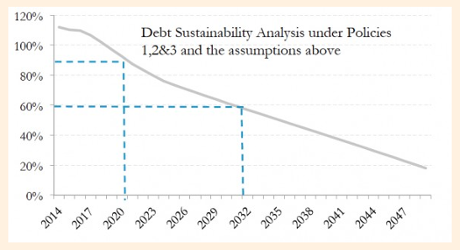
If all the elements of the new plan are adopted, the Greek government reckons its debt will be back under 60 per cent of GDP – the eurozone’s ceiling agreed under the 1992 Maastricht Treaty – by 2030, as this chart from the document shows:
Your morning leak: #Greece's new debt restructuring plan for IMF, ECB, EFSF & GLF loans, posted @ftbrussels blog: http://t.co/bjfViGHcRL
— Peter Spiegel (@SpiegelPeter) June 5, 2015
It’s certainly an ambitious proposal to deal with Greece’s debt mountain (although some of the ideas have been proposed before)
It includes perpetual bonds (ie, debt that produces an income but is not repaid), and GDP-bonds (where the interest rate is pegged to Greece’s recovery).
It also involves eliminating a chunk of Greece’s bailout debt, in return for doubling the interest rate on another chunk. That write-off would cut Greece’s debt burden, and is thus politically unpalatable to much of Europe.
Greece's debt restructuring plan via @SpiegelPeter is same Varoufakis plan floated last year, again in London in Feb. Rejected by Schauble
— A Evans-Pritchard (@AmbroseEP) June 5, 2015
But without such a radical plan, can Greece ever get its debts down to sustainable levels?
Although Greece has bought itself some time, it now faces a mountain of financial demands from 30th June to mid-July:
Here's my updated #Greece payment schedule for @OpenEurope. End of June & start of July now a huge hump to overcome pic.twitter.com/9QdMvsSfEv
— Raoul Ruparel (@RaoulRuparel) June 5, 2015
Top economists urge "sanity and humanity" for Greece
A group of eminent economists from across the world have written a joint letter in the Financial Times today, pleading with Greece’s creditors to provide “hope not despair”.
The list includes Nobel prize winner Joseph Stiglitz, star French economist Thomas Piketty, former Italian PM Massimo D’Alema, and America’s Jamie Galbraith. (generally a pro-Keynesian crowd)
And the letter has also been released by the office of Euclid Tsakalotos, the British-educated economist coordinating Greece’s negotiations, for the benefit of Greeks who don’t take the FT.
Here’s the full letter:
In the final hour, a plea for economic sanity and humanity
Sir, The future of the EU is at stake in the negotiations between Greece and its creditor institutions, now close to a climax. To avoid failure, concessions will be needed from both sides. From the EU, forbearance and finance to promote structural reform and economic recovery, and to preserve the integrity of the Eurozone. From Greece, credible commitment to show that, while it is against austerity, it is in favour of reform and wants to play a positive role in the EU.
In a letter to the FT in January, several of us said: “We believe it is important to distinguish austerity from reforms; to condemn austerity does not entail being anti-reform.” Six months on, we are dismayed that austerity is undermining Syriza’s key reforms, on which EU leaders should surely have been collaborating with the Greek government: most notably to overcome tax evasion and corruption. Austerity drastically reduces revenue from tax reform, and restricts the space for change to make public administration accountable and socially efficient. And the constant concessions required by the government mean that Syriza is in danger of losing political support and thus its ability to carry out a reform programme that will bring Greece out of the crisis. It is wrong to ask Greece to commit itself to an old programme that has demonstrably failed, been rejected by Greek voters, and which large numbers of economists (including ourselves) believe was misguided from the start.
Clearly a revised, longer-term agreement with the creditor institutions is necessary: otherwise default is inevitable, imposing great risks on the economies of Europe and the world, and even for the European project that the eurozone was supposed to strengthen.
Syriza is the only hope for legitimacy in Greece. Failure to reach a compromise would undermine democracy in and result in much more radical and dysfunctional challenges, fundamentally hostile to the EU.
Consider, on the other hand, a rapid move to a positive programme for recovery in Greece (and in the EU as a whole), using the massive financial strength of the Eurozone to promote investment, rescuing young Europeans from mass unemployment with measures that would increase employment today and growth in the future. This could both transform the economic performance of the EU and make it once more a source of pride for European citizens.
How Greece is treated will send a message to all its eurozone partners. Like the Marshall plan, let it be one of hope not despair.
"How #Greece is treated will send a message to all its eurozone partners". Various reasonable folk calling for sanity http://t.co/G63d11b5MG
— Yiannis Mouzakis (@YiannisMouzakis) June 5, 2015
Updated
So, how many countries have actually failed to repay the International Monetary Fund on time?
My colleague Alberto Nardelli has the answer - 32 countries have fallen at least six months into arrears with their IMF bills, from Cuba in 1959 to Zimbabwe in 2001.
And it has usually been prompted by a very serious crisis:
What is evident browsing through this list, from Cuba and Cambodia to Sudan and Yugoslavia, is that many of the countries that are on it were characterised primarily by domestic or regional violence, if not by outright war, during the years in question.
EC defends Greece over IMF delay
Solidarity in Brussels. The European Commission has just defended Greece’s decision to defer today’s IMF repayment until the end of June.
Top EC spokesman Margaritis Schinas told reporters that the move was in line with the Fund’s rules, and has happened before (just once though!).
It would be wrong to make “value judgements” about the move, Schinas insisted.
Greece IMF arrangement has been used before, says @EU_Commission - Zambia 30 years ago
— Bruno Waterfield (@BrunoBrussels) June 5, 2015
No one should make 'value judgements' about Greek IMF decision, said @EU_Commisison
— Bruno Waterfield (@BrunoBrussels) June 5, 2015
The Greek gov is exercising a facility poss under IMF statute so we didn't ask for any explanation - @EU_Commission
— Tony Connelly (@tconnellyRTE) June 5, 2015
Tsipras-Putin call could calm Syriza

Why might Alexis Tsipras want to discuss energy issues with Vladimir Putin, at this crucial time?
Our own Helena Smith has the answer.....
On the issue of energy, the country’s energy minister Panagiots Lafazanis (who also happens to be the third most important man in the cabinet and head of Syriza’s hardline faction, the Left Platform) has been making some very testy remarks recently.
Last night he announced that Athens would “not take orders from anyone” after Washington made clear its displeasure at the government’s declared aim to allow the construction of a pipeline carrying Russian natural gas in northern Greece. This morning he racheted up the pressure further saying: “Greece will not be blackmailed over its energy choices.”
An unrepentant Marxist, Lafazanis has been in overdrive since the leftist-led government assumed power, to cement good ties with Moscow.
The FT’s Athens correspondent, Kerin Hope, agree, saying:
Talking to Mr Putin would also likely reassure the hard leftists in Mr Tsipras’s Syriza party who are balking at the notion of a new agreement involving pension cuts and higher VAT.
Better call Vlad. http://t.co/wfo76GG7Ji #Greece
— Katie Martin (@katie_martin_fx) June 5, 2015
Updated
The German finance ministry has just revealed that Greek finance minister Yanis Varoufakis has asked to meet with his counterpart in Berlin, Wolfgang Schäuble, on Tuesday.
Spokesman Martin Jaeger just told reporters that:
“We’re looking into it...There’s been a request (from Greece) for a meeting but we haven’t been able to find a time yet. We’ll let you know on Monday.”
German FinMinistry Spokesman Jaeger: After Greek Request Meeting For A Meeting, Schaeuble Could Meet Varoufakis In Berlin On Tuesday
— Live Squawk (@livesquawk) June 5, 2015
Reuters: Tsipras to speak with Putin shortly
A Greek government official has confirmed that Tsipras will speak with Putin, in around 15 minutes, according to this Reuters newsflash:
- GREEK PM TSIPRAS WILL HOLD TELEPHONE TALKS WITH RUSSIA’S PUTIN AT 1000 GMT TO DISCUSS ENERGY ISSUES - GOVT OFFICIAL
That’s 1pm Greek time, or 11am BST.
“Energy issues” could refer to a plan to build a Russian gas pipeline through Greece, which could yield an advance payment to Athens.
Greek worries are keeping Europe’s stock markets in the red, but it’s not a major selloff:
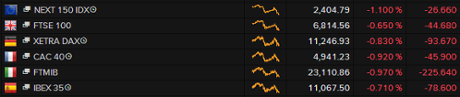
Investors are waiting to see Alexis Tsipras’s next move.
Rabobank strategists say:
“With uncertainty about Greece repaying or not repaying the IMF today out of the way ... markets may focus on the political fall-out from this decision.”
And Royal Bank of Scotland reckons Greeks could soon be heading back to the polling booths (as minister Dimitris Stratoulis suggested this morning).
RBS increases #Grexit probability to 20% from 10-15% as #Greece to bundle #IMF payments. RBS sees early elections now as very likely.
— Holger Zschaepitz (@Schuldensuehner) June 5, 2015
Greece’s Mega TV is reporting that Alexis Tsipras is planning to speak with Russian president Vladimir Putin today:
Acc to Mega TV, #Greece PM Tsipras requested a phone conversation with Putin. Putin said "yes", they will talk today
— Efthimia Efthimiou (@EfiEfthimiou) June 5, 2015
Greek PM Tsipras today requested a telephone call w/ #Russia's Putin, #Greece’s Mega TV reports, without citing anyone. (BBG)
— Holger Zschaepitz (@Schuldensuehner) June 5, 2015
We’re looking into it.....
Western politicians have been fretting that Greece could turn to Moscow to help with its financial plight, at a time when Russia is barred from this weekend’s gathering of world leaders at the G7 summit.
Updated
Brussels insiders have backed up economy minister George Stathakis’s claim that the International Monetary Fund suggested bundling Greece’s June repayments into a single bill.
They’ve told the Guardian that the IMF proposed the option but didn’t receive a reply - before learning last night that this bargaining chip had been played.

A senior EU official has just insisted that the Greece crisis will not be on the agenda at the G7 summit on June 7th and 8th in Schloss Elmau, Germany.
Officially, the leaders of Germany, France, the UK, US, Japan, Canada, Italy and the European Union will discuss the global economy, along with foreign, security and development policies.
Other issues will include “Protection of the marine environment”, antibiotics and the Ebola outbreak, and energy security.
But European Commission president Jean-Claude Juncker has just admitted that the Greek crisis will “preoccupy him” this weekend. He’ll be at Schloss Elmau along with European Council president Donald Tusk.
*EU'S JUNCKER SAYS GREECE TO PREOCCUPY HIM THIS WEEKEND
— lemasabachthani (@lemasabachthani) June 5, 2015
At one stage yesterday, we thought Alexis Tsipras would meet Juncker in Brussels today. That’s been superseded by the debate in parliament tonight.
Greece on tenterhooks before Tsipras's speech

Over in Athens, there is mounting anticipation over the Greek prime minister Alexis Tsipras’ speech before parliament tonight, reports Helena Smith.
This will be the second time that the radical left leader has addressed the 300-seat parliament since assuming power in January.
And as Popi Tsapanidou, who anchors Star TV’s popular morning news show, told the nation:
“And all of us are going to be glued to our screens,”
Will he or won’t he? That is the question. Will Tsipras call a vote of confidence (aides say he won’t)? Will he call fresh elections? (possible but unlikely) Will he reveal that Athens is in fact closer than ever before to cutting a deal with its creditors that would tide the country over the summer - as the German press is intimating this morning?
Analysts believe that the anti-austerity prime minister will have three goals:
- to address his own party, Syriza, whose politicians are said to be apoplectic at the demands the EU, ECB and IMF are now making of Greece;
- to inform the nation of the state of negotiations
- to tackle the political opposition head on over its stance re lenders’ latest offer.
Paula Bolla, a political reporter with SKAI News, explain:
“What he wants to show is that the entire Greek parliament is opposed to the proposal, that’s the message he wants to send lenders.”
The leader’s speech will begin at 6:30PM (4.30pm BST), and will be followed by that of other political leaders. Many are expecting a dramatic night of debate.
The Athens stock market has fallen by over 3% in early trading.
Financial shares are among the big fallers, with Piraeus Bank, National Bank of Greece and Eurobank all shedding at least 5%.
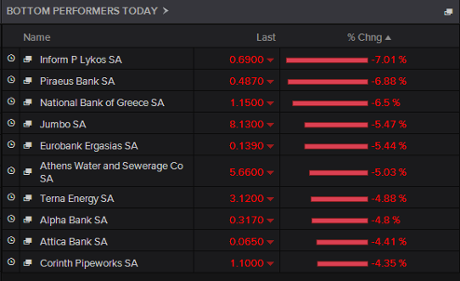
Greek government bonds are tumbling in value this morning.
Investors are rushing to sell, following the decision to delay today’s €300m IMF repayment.
That is driving up the yield, or interest rate, on Greek debt, as this chart shows:
#Greece's 2y yields jump as Tsipras raises stakes in Greek showdown w/ deferral of IMF payment http://t.co/JOjHPwIyUW pic.twitter.com/ugV9HJxDxQ
— Holger Zschaepitz (@Schuldensuehner) June 5, 2015
Here’s another key quote from Greek economy minister George Stathakis on the Today Programme this morning:
“We are looking forward to getting a deal as soon as possible.
The Greek government cannot accept these new proposals put on the table.”
Economy Minister Stathakis: Greece will do everything it can to stay in the euro and change terms of debt agreement: pic.twitter.com/hJOVpiP2Rw
— BBC Radio 4 Today (@BBCr4today) June 5, 2015
Theodoros Fessas, the president of The Association of Greek Industries, is also speaking on Radio 4’s Today Programme.
He says the demands being made by Greece’s creditors are “quite high”, and contain “harsh” measures.
The key to reviving Greece’s fortunes is to improve its tax system, Fessas insists.
All the past governments have not been efficient or effective at collecting taxes.
And that means the burden on those who pay taxes is rising higher and higher, he argues.
Greek minister: We won't leave the euro
Today Programme: What happens if Greece cannot get its way with creditors? Would you compromise, or leave the euro?
We do not have a mandate to leave the eurozone, economy minister George Stathakis replies. He explains that Syriza campaigned on a platform of getting a new deal with creditors, within the single currency.
George Stathakis says:
We have a mandate from the Greek people to go on, to try to change the terms of the agreement.
Greece has to remain in the euro, otherwise we do not have any mandate to take action.
Greek economy minister tells BBC will stick to mandate given Syriza by voters; remains committed to stay in euro. #eurogroup @tsipras_eu
— James Kanter (@jameskanter) June 5, 2015
Greek Economy Minister on BBC Radio 4 right now - Syriza govt has no mandate to take Greece out of the Eurozone.
— Jim Coleman (@Jimcoleman33) June 5, 2015
GREEK ECONOMY MINISTER GEORGE STATHAKIS SAYS GREECE CANNOT ACCEPT NEW PROPOSALS PUT ON TABLE BY LENDERS
— MineForNothing (@minefornothing) June 5, 2015
George Stathakis says that the Greek government is not prepared to accept the proposals tabled by its creditors this week (when Alexis Tsipras met Jean-Claude Juncker in Brussels on Monday night).
He cites the primary surplus targets which lenders are pushing for (including a 1% primary surplus this year; Greece believes only 0.6% is achievable).
Greek minister: We could have paid the IMF.....
Greece’s economy minister, George Stathakis, is now on the Today Programme.
Why has Greece chosen to delay its IMF repayment?
Stathakis:
There was an offer already on the table from the IMF, so I think the government chose to accept this offer and repay at the end of the month.
So you’re suggesting it’s the IMF’s idea?
Stathakis: It was on the table, more or less. Even in the previous instalment there was the idea of paying through our funds at the IMF, rather than draining Greece’s resources.
So you have the money, but you chose not to?
That is correct.
Are you sending a signal to your creditors? And why?
Stathakis explains that the Greek economy is paying all its debt through internal resources since last June, it has not received a single euro since.
He says Greece needs a deal soon, but a sustainable deal on its terms.
Updated
The BBC’s European Editor, Katya Adler, has also heard that Greece had the money to repay the IMF today, but chose not to (as our Helena Smith reported last night).
Adler is telling the Today Programme now that the delayed repayment is being seen as a political jesture:
It is being seen as Greece saying to the international creditors, don’t push us, we’d rather snap than bend.
As feared, Europe’s stock markets are being hit by Greek worries.
The FTSE 100 has dropped by 35 points at the start of trading, to 6824, which I think is a one-month low. More to follow.....
Greece’s economy minister, George Stathakis, is about to discuss the situation on Radio 4’s Today Programme. You can hear it live here.
Despite the turmoil of recent years, most Greeks still want to remain in the eurozone:
#Greece Opinion poll for newsit.gr: Greeks want to remain in the eurozone at all costs http://t.co/YX7NT5fP2m pic.twitter.com/JaTVdNd3bv
— NewsIt (@NewsItFeed) June 5, 2015
We’re not sure what the “other” option would be....
Threat of elections if creditors don't back down
Greece’s deputy social security minister, Dimitris Stratoulis, has warned that early elections could be called unless its lenders soften their demands.
Stratoulis said this morning:
“The lenders want to impose hard measures. If they do not back down from this package of blackmail the government ... will have to seek alternative solutions, elections”.
A new opinion poll this morning shows that 45% of Greeks want their government to cut a deal, even if it means making concessions. But 37% would prefer an election instead.
Opinion poll from #Greece shows 37% of Greeks favour elections while 45% want compromise for a deal with lenders. (RTRS)
— Holger Zschaepitz (@Schuldensuehner) June 5, 2015
Alexis Tsipras’s Syriza party has held a substantial lead in opinion polls over New Democracy (ND), suggesting that it would be returned to power.
Alco poll for Newsit.gr SYRIZA 31.3% ND 20.4 Potami 5.2 G Dawn 4.8 KKE 4.5 PASOK 3.5 Ind Greeks 3.2 Undecided 13.4 #Greece
— MacroPolis (@MacroPolis_gr) June 5, 2015
But such an election probably couldn’t be held until early July - after Greece’s bailout extension expires (and after it is due to pay a total of €1.6bn to the IMF)
Updated
The Agenda: Greece's IMF delay raises the stakes
Good morning.
The Greek crisis is coming towards the boil today, following Athens’ unexpected decision not to pay the International Monetary Fund a €300m repayment due today.
By delaying that payment up until the end of June, Greece’s government has drawn up new battle lines with its creditors, and fuelled fears over the country’s grip on eurozone membership.
As we wrote last night:
Greece has moved closer to default and possible exit from the eurozone after telling the International Monetary Fund it would not be making a debt repayment of €300m (£219m) due on Friday.
A crisis that has been going on for more than five years entered a new phase when Athens surprised the IMF by saying it intended to bundle up four payments in June totalling €1.6bn and make them all at the end of the month.
The move came as the Greek government reacted angrily to what was seen as an ultimatum from its creditors – including the IMF – that demanded further austerity and unpopular reforms to VAT, pensions and wage bargaining as the price for €7.2bn in fresh financial help.
The Financial Times calls the move “a sign of the country’s defiance” against the demands being made by Greece’s creditors in return for ending the months of deadlock over its bailout.
According to our sources at the Bank of Greece, Greece could have found the money to repay the IMF today, but not to hand it over. One well-placed insider told our Helena Smith last night:
“We have enough for the payment but Tsipras wants to save up for salaries and pensions.”
The Greek government is also waiting to hear Christine Lagarde’s response to their decision; only hours after she told reporters she was confident the money would show up.
As our insider put it:
“She’s annoyed that we reassured her earlier and was taken by surprise. “The Bank, however still expects a positive reply tomorrow.”
Good luck with that.....
Greece = 1970s Zambia thanks to request to IMF to defer payment
— Mike van Dulken (@Accendo_Mike) June 5, 2015
So how will things develop today?
Greece’s prime minister, Alexis Tsipras, is due to speak in parliament at 6pm local time, or 4pm BST. He’ll update MPs on the state of play in negotiations with creditors.
hit pause on the second-guessing over #greece's talks with its creditors until greek pm @atsipras briefs parliament at 6pm
— Diane Shugart (@dianalizia) June 5, 2015
Last night, Tsipras told German chancellor Angela Merkel and French president Francois Hollande that lenders were making unacceptable demands on Greece. Athens is expected to submit new proposals of its own soon, in a bid to get a deal before its bailout expires at the end of June.
European stock markets are expected to dip today, as the Greek crisis dominates the financial world.
Stan Shamu of IG explains:
While optimism had been growing that progress had been made in negotiations between Greece and its creditors, it’s clear there is still a long way to go and some of that optimism might have been a little unfounded.
I’ll be tracking all the main events through the day....