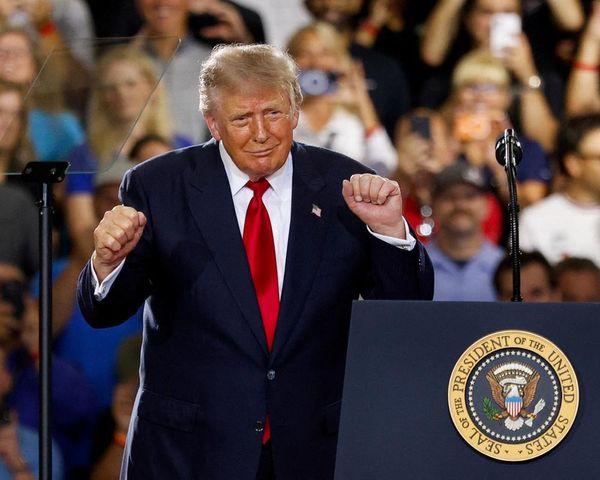
Comment: United States President Donald Trump’s Make America Great Again (MAGA) movement is not a good formula to be copied in New Zealand.
Fox Meyer’s Newsroom story on July 22 makes the case that, here, New Zealand First has climbed on the Trump bandwagon. It also reports New Zealand First’s youth party membership has shot up in the past 18 months.
Young people, the party says, are turning to it because the major parties lack the courage to try something new. One young member put it this way: “Trump doesn’t have a trademark on nationalism.”
The youth wing insists it is not simply copying Trump. Meanwhile NZ First leader Winston Peters and minister Shane Jones have made the comparison themselves, and not always reluctantly. Mr Peters kicked off his party convention recently with a pledge to “turn this country’s democracy upside down for a great and real purpose”.
The “proud patriots” of New Zealand First should be careful what they wish for.
To understand in detail what President Trump has achieved so far in his second term as President, it is worth reading the book by Maggie Haberman and Jonathan Swan Regime Change: Inside the Imperial Presidency of Donald Trump. This account amounts to a description of “Trump unleashed.”
What was epoch-making and unprecedented in his first term has hardened into something closer to autocracy in his second.
Everything now revolves around the President. He insists on making all the decisions himself, asserts he has the authority to override federal agencies, and accepts virtually no limits on presidential power.
He has attempted to fence off the Congress, both the Senate and the House of Representatives. He tries to make calls himself that courts would otherwise make. He intimidates critics with personal attacks that are often baseless or wildly exaggerated.
Trump treats the courts and the law as obstacles rather than as constraints he must respect, while using litigation itself as a weapon, suing opponents in cases with little realistic chance of success. It rarely needs to succeed: it is enough to exhaust and intimidate. Only the very rich can afford to fight that way.
The traditional American assumption that the courts stand independent of the executive branch no longer holds in practice. Under Trump, the decline of the rule of law in the United States has been palpable.
That is worth dwelling on, because the same instincts are visible closer to home, and the argument of this article is that they are dangerous wherever they appear, not because of who wields them, but because of what they do to a country’s institutions.
Nationalism of this kind is not about love of country. Patriotism, properly understood, is an attachment to a place and its people that coexists easily with respect for the courts, the free press, the public service, and the give-and-take of parliamentary politics.
What Trump has supplied, and what some rhetoric in New Zealand increasingly echoes, is something narrower: a politics built on identifying enemies. The media, the judiciary, “elite” universities, and international experts are cast not as institutions doing an imperfect job but as adversaries working against ordinary people.
This style of politics substitutes grievance for argument. It treats institutions built to check power, such as the courts, the press, the public service, as suspects rather than safeguards. Politics becomes personalised around a leader’s instincts rather than a party’s programme.
Winning support not by persuading people your policies are right but by convincing them someone else is to blame is a shallow foundation for a democracy to stand on.
Comparing the situation here with that of the United States, it can be clearly demonstrated that the power to prosecute in New Zealand has not been, and cannot readily be, politically weaponised without extensive legislative change.
The Crown Law Office, the Attorney-General, and the Crown Prosecutors in each region do not, and structurally cannot, make politically motivated decisions about whom to prosecute.
That separation is built into our constitutional arrangements, and it is a blessing we should not take for granted while politicians experiment with importing the rhetoric, even if not yet the practice, of a system where it has broken down.
A robust rule of law is a necessary protection in any democracy. Politicising it will weaken and eventually destroy it. There are many definitions of the rule of law in the literature, but one of its essential features is that courts must follow the law, which in New Zealand means the statutes passed by Parliament and the common law inherited from England that underpins our own.
The rule of law is, and should remain, a concept kept separate from the passing controversies of political and social life. It requires that the law be ascertainable and that government abide by the rules until Parliament changes them. That is a founding principle of New Zealand’s democratic framework, and on the evidence of Trump’s second term, it is a considerably better one than the alternative now on display in the United States.
Young New Zealanders drawn to nationalist rhetoric because the major parties feel stale deserve a genuine answer to that complaint. But borrowing the language of a politics that treats courts, the press, and the public service as the enemy is not a new idea. It is an old one, and its costs, wherever it has been tried, have fallen heaviest on the very institutions that protect ordinary people from the arbitrary use of power.
Be careful what you wish for, New Zealand.