At the World Economic Forum's Annual Meeting in Davos, French President Emmanuel Macron used his address before global leaders to call for more economic relations with Beijing, calling for increased Chinese foreign direct investment in France and Europe as tensions flare up with the United States and President Donald Trump.
During his speech, Macron emphasized that although Europe welcomes economic engagement from China, what is needed now is "more Chinese foreign direct investments in Europe, in some key sectors, to contribute to our growth and to transfer some technologies."
China's government responded swiftly to Macron's remarks. During a Wednesday press briefing, Foreign Ministry spokesperson Guo Jiakun reiterated Beijing's support for increased investment in Europe "in accordance with market principles," while also urging the EU to maintain a fair, non-discriminatory, transparent and predictable market environment for Chinese companies. Guo described China-EU economic ties as complementary and based on mutual benefit, reiterating Beijing's interest in being not only the "world's factory" but also the "world's market."
While Macron's speech also touched on geopolitical instability and a shifting world order where international norms are under strain, he announced Europe's openness to cooperation with China so long as it is grounded in mutual benefit and respect for equitable standards.
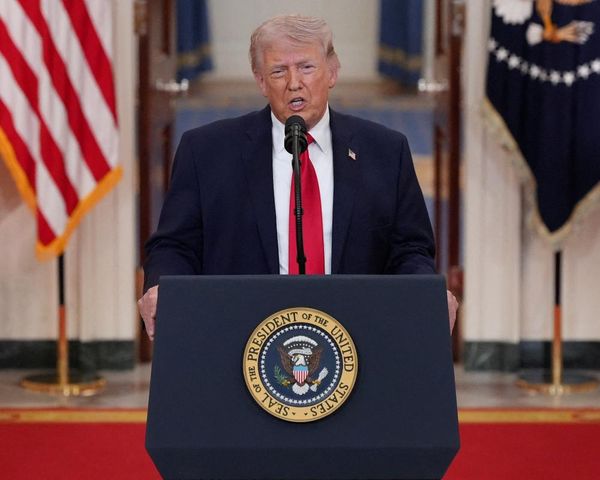
Tensions between Europe's primary trading partner, the United States, and the EU have flared up since President Trump announced his intentions to annex the Arctic island nation of Greenland as part of the United States. Trump had previously stated that he cannot rule out military intervention if Greenland does not cooperate, but he told reporters at Davos that he will not be taking Greenland by force.
"It's...a shift towards a world without rules, where international law is trampled underfoot and where the only law that seems to matter is that of the strongest," Macron said.
In the run-up to Davos, Trump announced plans to impose tariffs of 10 percent on imports from eight European nations, including France, escalating to 25 percent unless the United States secures "complete and total purchase of Greenland," a move that alarmed EU leaders and threatened economic relations. He also announced a potential 200% tariff on French wines if Macron declined to join his Board of Peace for Gaza. The threat of tariffs was also likely a source of tension prior to the summit.
However, at Davos, Trump claimed that after securing "the framework" for a "future deal" with Greenland, he would not be imposing the tariffs. Macron called the tariff threats "unacceptable" and warned of the potential use of the EU's anti-coercion mechanism, dubbed a trade "bazooka," to counter perceived economic pressure from Washington.