A member of the militia group known as "Colectivos" takes part in a march calling for release of Venezuela's President Nicolas Maduro, after he and his wife Cilia Flores were captured following U.S. strikes on Venezuela, in Caracas, Venezuela. Photograph: Gaby Oráa/Reuters
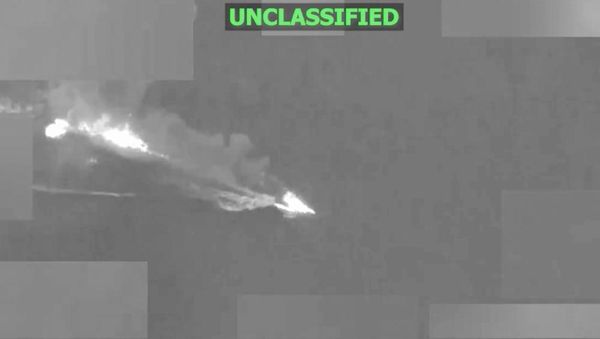
There was a whirlwind of emotions on the streets of Caracas on Sunday, 24 hours after the first-ever large-scale US attack on South American soil and the extraordinary snaring of Venezuela’s president, Nicolás Maduro.
“Uncertainty,” said Griselda Guzmán, a 68-year-old pensioner, fighting back tears as she lined up outside a grocery store with her husband to stock up on supplies in case the coming days brought yet more drama.
“Anger,” said Sauriany, a 23-year-old administrative worker from Venezuela’s state-owned electricity company as she queued outside a supermarket on the other side of town with her 24-year-old partner, Leandro.
Leandro voiced shock as the couple waited in a 100-person queue to buy flour, milk and butter alongside a quartet of nuns. “Who could have imagined that his would happen? That right at the start of the year they’d bomb our country while everyone was asleep?” he asked.
“If I thought it would improve the country I’d welcome it,” Leandro added, as shoppers were allowed into the overcrowded supermarket in small groups. “But I don’t believe this will happen. If they wanted peace, this isn’t the way to achieve it.”
Similarly confused sentiments could be heard all over Caracas on Sunday as its 3 million citizens came to terms with the traumatic nocturnal blitz on their city – a move the governments of Spain, Brazil, Chile, Colombia, Mexico and Uruguay warned set “an extremely dangerous precedent for peace and regional security”.
“It’s all so distressing,” said Gabriel Vásquez, a 29-year-old video-maker, recalling how he had been woken by the sound of a “gigantic” explosion at about 2am on Saturday and how his community in central Caracas was plunged into darkness as aircraft circled overhead.
“I thought that any time my house could get bombed too,” said Vásquez, whose neighbourhood was still in the dark on Sunday. “We have no water, no electricity, no phone reception – nothing,” he complained.
Julio Pimentel, a 33-year-old designer, said his electricity and water supplies had also been cut but admitted he had been surprised by the number of people out on the streets “considering the situation we’re in”. “Supermarkets and pharmacies are very, very crowded,” Pimentel said.
There was scant sign of citizens celebrating Maduro’s downfall, something locals attributed to fear that his regime – which remains in power despite his arrest – might crack down and a deep-rooted sense that little had actually changed as a result of the US intervention.
On Sunday, the head of the armed forces, Vladimir Padrino López, announced that military chiefs had recognised the vice-president, Delcy Rodríguez, as Venezuela’s acting president after the “cowardly kidnapping” of Maduro and his wife, Cilia Flores. Trump has also indicated he is prepared to deal with Rodríguez. “She’s essentially willing to do what we think is necessary to make Venezuela great again,” he said after Saturday’s assault.
“They’ve taken Maduro but the [Bolivarian] revolution isn’t over,” said Griselda Guzmán’s 71-year-old husband, Antonio, who like his wife, asked not to be identified with their real names. “We’re still in the same situation – they’ve just removed a pawn from the game of chess.”
But many locals were quietly rejoicing at the demise of a politician who many loathe for leading their oil-rich country into years of ruin and repression since he took power in 2013 and is widely believed to have stolen the 2024 presidential election.
“We all get what we deserve. Maduro is a man who never put his hand on his heart to see the hardships of his country, to see his people going hungry,” said Griselda Guzmán, recalling the satisfying moment she had seen images of the dethroned dictator languishing in US custody. “When I saw him like that – handcuffed – I saw him for what he was: the biggest fool on Earth.”
Guzmán said she believed Maduro had had “the opportunity of a lifetime” to leave power voluntarily after the 2024 vote, which independently verified voting data showed he had lost to the political movement led by the Nobel laureate María Corina Machado. “He could have handed over the presidency because he knew he hadn’t won,” she said.
But instead Maduro chose to cling to power – and now he was behind bars in New York facing decades in a US jail.
Her husband attributed the lack of public commemorations within Venezuela to a widespread belief that Saturday’s bombardment was merely the beginning of the latest rollercoaster chapter in Venezuela’s turbulent recent history. “Nothing has happened yet … this only started yesterday,” he predicted.
Others were outraged by their president’s abduction and Trump’s decision to invade, a move many experts believe represents a flagrant violation of international law.
“OK, there are problems – but they are Venezuelan problems and Venezuelans need to solve them,” said Sauriany. “They [the US] aren’t Venezuela’s owners. He [Trump] can’t just come along and say … he’s going to rule Venezuela because he’s removed Maduro.”
Sauriany believed Rodríguez should be allowed to “carry on Maduro’s legacy” for the remainder of his six-year term, a prospect that appalls Venezuela’s opposition but seemed to become more likely after Trump’s comments on Saturday.
In the weeks before Trump’s invasion, diplomats and experts warned that such an attack could plunge Venezuela and the surrounding region into chaos or conflict. But on Sunday there was no immediate sign of violence erupting in the wake of Maduro’s toppling, or of a dangerous split in the military, but regional governments are on edge.
Colombia’s president, Gustavo Petro, ordered 30,000 troops to its border with Venezuela to guard against possible turmoil. Armoured personnel carriers took up position at the border crossing between the two countries in the city of Cúcuta.
The Colombo-Venezuelan rebel army, the National Liberation Army, condemned what it called Trump’s “imperial” onslaught, vowing to “confront” the attack on Venezuelan sovereignty.
As he waited to stockpile food on Sunday, Antonio Guzmán said there was little caraqueños could now do but wait: “We still don’t know what is really going on.”